
The most familiar image of a Roman aqueduct is a line of arches crossing a landscape. But the more revealing question comes at the other end: once the water reached the city, who received it, under what rules, and through whose labor?
Aqueducts were engineering achievements. They were also systems of allocation. Their history includes pipes and gradients, but also permissions, public basins, private connections, maintenance crews, and officials trying to make the records match the flow. Following the water into Rome turns a monument into a social history.
The arches were only part of the system
Frontinus, appointed to oversee Rome’s water supply in 97 CE, began his account by setting out what an administrator needed to know: sources, routes, lengths of underground channels and raised sections, elevations, distribution, and legal responsibilities. His opening description of the investigation is a reminder that an aqueduct was not simply a bridge with water on top.
The Met’s Roman Art resource for educators explains how gravity-fed supplies served fountains, baths, and some private homes. Storage and distribution were essential parts of the arrangement. A channel bringing water to the edge of a city would not, by itself, deliver it to the people and buildings that needed it.
Thinking in terms of a connected system changes what counts as important. A spectacular arch may survive and attract attention, while an ordinary distribution point tells us more about access. Neither engineering skill nor an impressive ruin can settle the question of how evenly the benefits were shared.
Public water had several destinations
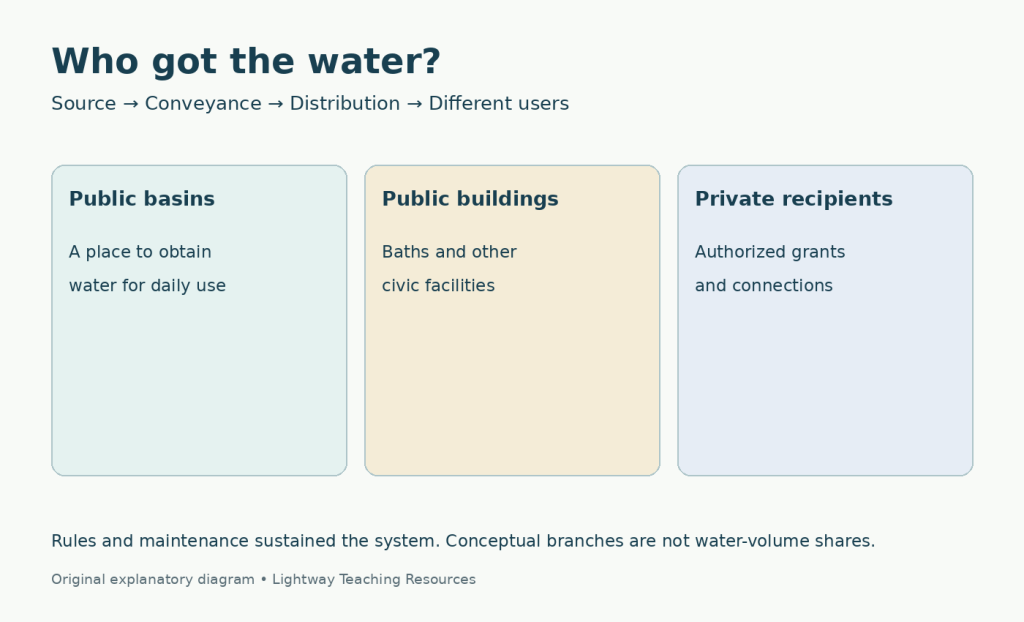
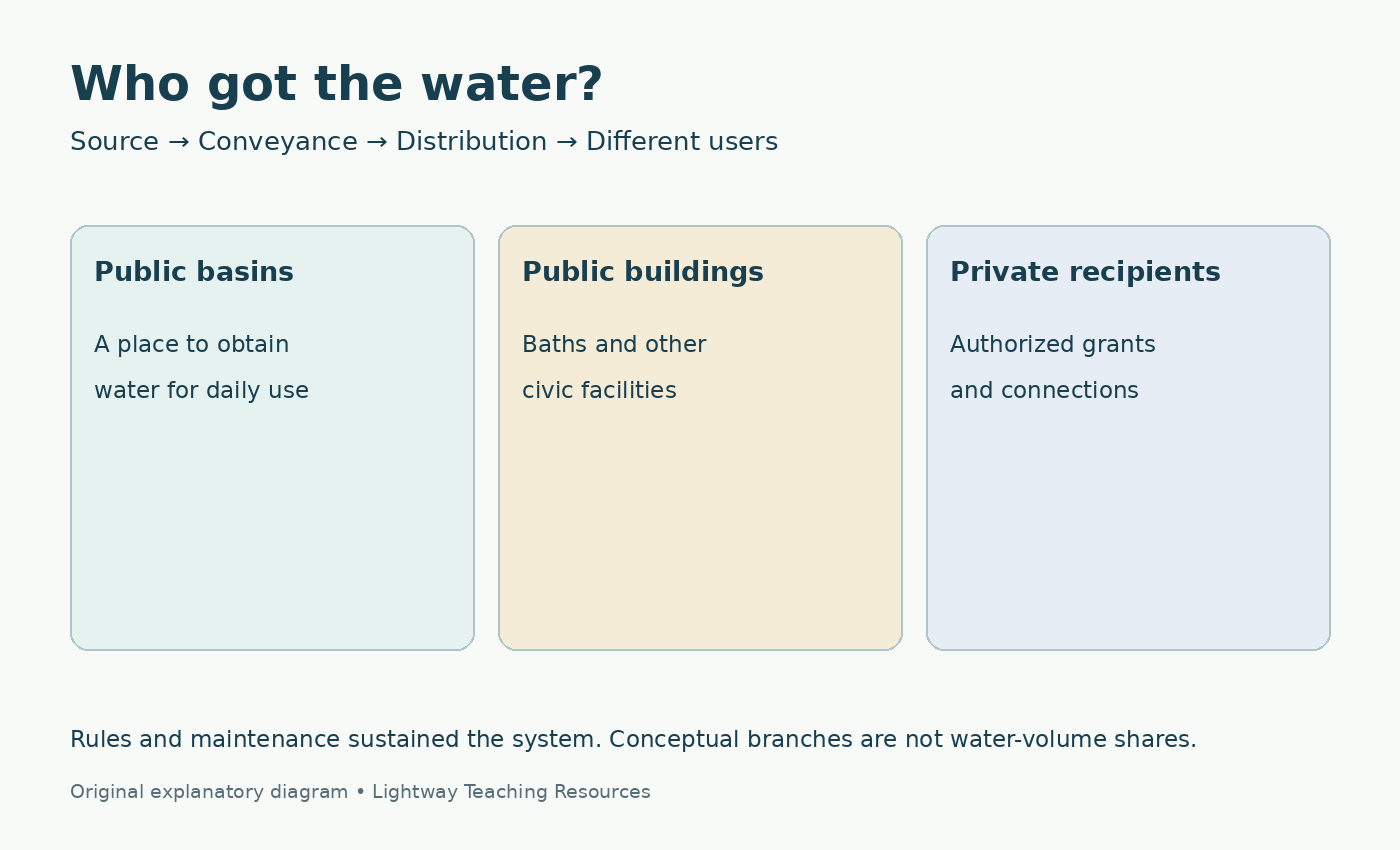
The scholarly Digital Augustan Rome discussion of water supply distinguishes the categories used by Frontinus: supply associated with the emperor, private recipients with permission, and public uses. Public uses themselves included buildings, military facilities, ornamental fountains, and basins.
These categories caution against an easy equation between a city’s total water supply and the amount available to each resident. Water serving a bath complex was not the same as water carried from a neighborhood basin. An imperial building and an ordinary household occupied different positions in the network. A large aggregate figure cannot tell us how far someone had to walk, who did the carrying, or how an interruption affected one street.
Nor should every connection outside the city be imagined as theft. Legitimate private arrangements existed. The important distinction in the sources is between an authorized allocation and an unauthorized diversion, not simply between public virtue and private use.
Permission mattered as much as plumbing
In Book II of his account, Frontinus discusses the rules governing private supply and the protection of conduits. Section 106 records a senatorial resolution that prohibited private users from drawing directly from public channels and required authorized supply through delivery tanks. The details show an effort to make connections legible and controllable.
For a modern reader, a pipe may look like a purely technical object. In this setting it also embodied a grant, an entitlement, and a limit. Control over where it connected and how much it could carry belonged to the politics of the system. Engineering made a supply physically possible; law helped decide which use was legitimate.
Frontinus’s account does not give us a transparent picture of every resident’s experience. It gives us the viewpoint of a senior official explaining what should happen and what he says he found. Rules are valuable evidence of priorities, but their existence does not prove universal compliance.
The water that disappeared between the records and the city
Frontinus repeatedly compares recorded quantities with his own investigations. He reports leaks, irregular connections, and diversion by people along the routes. His discussion includes accusations against water workers and landowners. The drama is administrative rather than military: an official trying to establish where a public resource was going.
Read those accusations with two questions in mind. First, what practical problem does the report describe? Second, how does the writer present himself and the emperor? Frontinus portrays correction as an achievement of good government. That framing does not make every observation false, but it is part of the evidence, not something to strip away.
The report also describes attempts to reduce the consequences of breakdowns by providing more than one supply route to areas and basins. This is a reminder that ancient infrastructure required resilience and repair. The everyday success of the system depended on work that could become visible chiefly when it went wrong.
Labor behind the achievement
Book II also discusses the workers responsible for the water system, including enslaved labor. A history that names emperors and admires engineering but omits maintenance leaves out part of the achievement’s human foundation. Channels had to remain usable; damage had to be found; rules had to be enforced.
Recognizing that labor is not a reason to deny the technical accomplishment. It is a reason to describe it more completely. Infrastructure joins different forms of power: the ability to command resources, the expertise to organize construction, and the authority to direct other people’s work. The finished monument rarely explains that arrangement by itself.
What a ruin can, and cannot, tell us
Later images add another layer. Thomas Cole’s A View near Tivoli (Morning), painted in 1832, includes Roman aqueduct remains in a landscape changed by later structures. It is a nineteenth-century view of an ancient inheritance, not a photograph of Roman operations. Its appeal helps explain why the arches dominate our imagination while the distribution rules do not.
The larger story emerges when we combine different kinds of evidence without asking any one of them to do everything. Surviving structures illuminate construction and routes. Administrative writing reveals categories, regulations, and an official’s concerns. Later art shows how the remains were viewed and reinterpreted.
Rome’s water supply was remarkable partly because it connected all these practical tasks: obtaining water, conveying it, allocating it, and keeping the system working. Asking who got the water turns admiration into investigation. It lets us see not only what Roman engineering could build, but what Roman society chose to maintain and distribute.
