
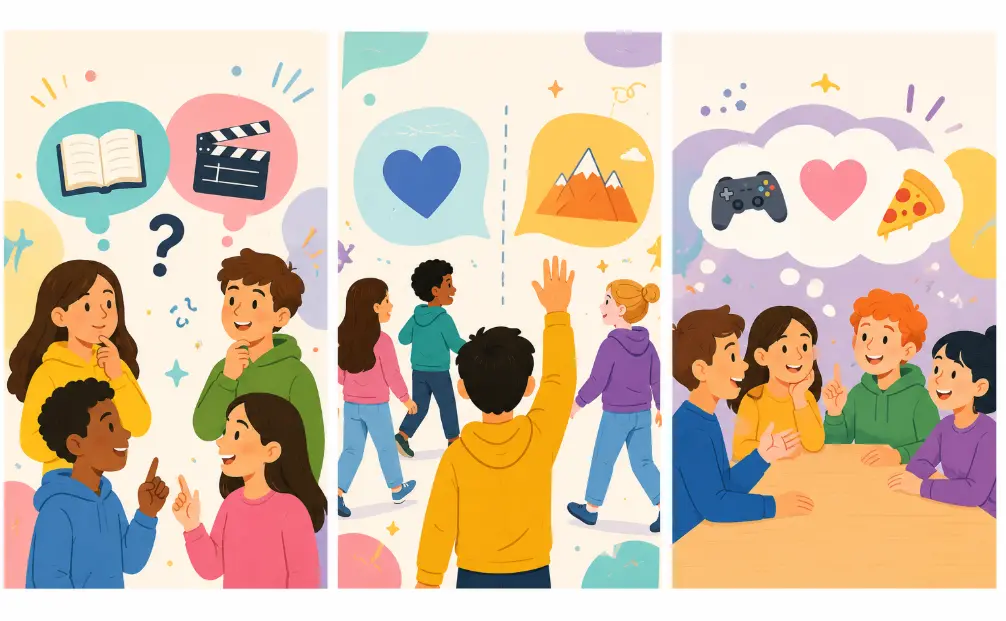
Middle school icebreakers can be tricky. Students are old enough to feel self-conscious, but they still need opportunities to relax, talk, and learn something about the people around them. The best activities are usually the ones that feel more like a quick game than a formal “get to know you” exercise.
I have found that simple choice-based activities work especially well because students do not have to reveal anything too personal. They can participate immediately, and teachers can easily turn a basic question into movement, discussion, or a quick class vote.
Here are ten easy icebreaker ideas that work well with middle school students.
1. This or That
This is one of the simplest classroom icebreakers to run. Give students two choices such as:
- Books or movies?
- Summer or winter?
- Dogs or cats?
- Math or science?
- Beach or mountains?
Students choose one side, raise a hand, point, or move to a designated part of the room.
The activity works especially well because there is almost no explanation needed. Students understand the game immediately and can begin participating within seconds.
If you want a ready-to-project version, I created a This or That Classroom Icebreaker Game with 40 questions and bonus activity slides.
2. Move to a Side
Take any two-choice question and assign one side of the classroom to each answer.
For example:
THIS: Books
THAT: Movies
Students physically move to the side that represents their preference.
After everyone moves, ask a few students to explain their choice or discuss it with someone standing nearby.
Movement helps reduce the pressure of speaking because students are already doing something before they are asked to talk.
3. Find Three Things in Common
Put students into groups of three or four and give them three minutes to discover three things everyone in the group has in common.
The rule is that answers should not be obvious things such as “We are all students.”
Encourage them to discover preferences, hobbies, foods, entertainment choices, or experiences they share.
This activity is simple but creates surprisingly good conversations.
4. Class Vote
Turn icebreaker questions into quick classroom polls.
Ask questions such as:
Would the class rather explore space or explore the ocean?
Would more students choose video games or board games?
Would the class rather have unlimited snacks or unlimited free time?
Record the results on the board and let students predict which answer will win before voting.
5. Four Corners
Instead of giving students two choices, give them four.
For example:
What is your ideal weekend?
A. Staying home
B. Playing sports
C. Going somewhere new
D. Spending time with friends
Assign each option to a corner of the classroom.
Students move to their answer and then talk with someone in the same corner.
6. Turn and Talk
Sometimes the easiest icebreaker does not require movement at all.
Project a simple question and ask students to turn to someone nearby.
Give them a sentence frame if needed:
“I choose ___ because ___.”
Even students who are nervous about whole-class speaking often feel comfortable sharing with one partner.
7. Stand Up If…

Read a series of statements and ask students to stand if each statement applies to them.
Examples:
Stand up if you have a pet.
Stand up if you like spicy food.
Stand up if you prefer reading the book to watching the movie.
Stand up if you enjoy working in groups.
This is a great way for students to quickly see what they have in common.
8. Quick Partner Rotations
Give pairs about one minute to answer a fun question, then rotate partners.
Questions can be simple:
What is your perfect weekend?
What is something you are really good at?
Would you rather travel to the past or the future?
After several rounds, students will have spoken with many classmates without having to participate in a formal introduction activity.
9. Guess the Class Favourite
Ask a question but do not let students vote immediately.
Instead, students first predict which answer will be most popular.
For example:
Which will win: pizza or tacos?
Then hold the class vote.
This small prediction step makes a simple question more engaging.
10. Create Your Own This or That Question
Once students understand the format, ask them to create their own questions.
Students can write questions individually or in small groups.
Collect the best ones and use them during future brain breaks, form time, morning meetings, advisory periods, or Fun Friday activities.
Why Simple Icebreakers Often Work Best
The goal of an icebreaker is not to force students to share personal information. It is simply to make interaction easier.
Quick choice activities work because students always know what to do. There is no complicated worksheet, no long explanation, and no pressure to give the “right” answer.
A simple question such as “Books or movies?” can lead naturally to laughter, conversation, movement, and students discovering things they have in common.
If you would like a no-prep version to keep ready for your classroom, you can find my 40-question This or That Classroom Icebreaker Game here:
