
Grades 6–8 · Economics · 30–35 minutes
Ask students what it costs to choose a free activity, and some will say “nothing.” Ask what they give up, and others will list every alternative they can imagine. Both responses are useful starting points for teaching opportunity cost.
In economics, opportunity cost concerns the value of the best alternative forgone. That definition requires a real constraint, feasible options, and a ranking. The Federal Reserve Education explanation connects scarcity, choice, and the most valued opportunity given up. The classroom model below makes those pieces visible without asking students to disclose family finances.
Begin with one scarce resource
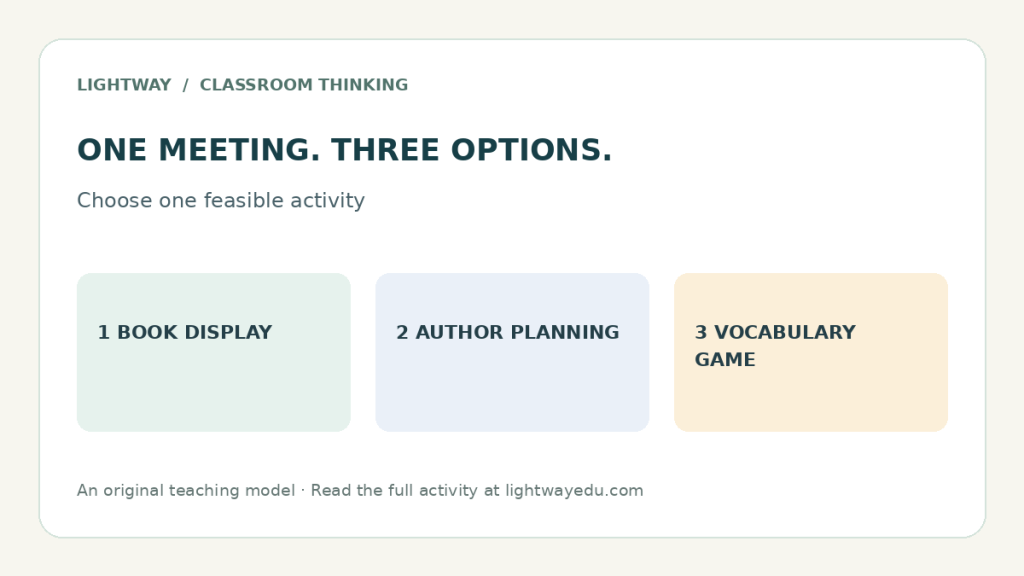
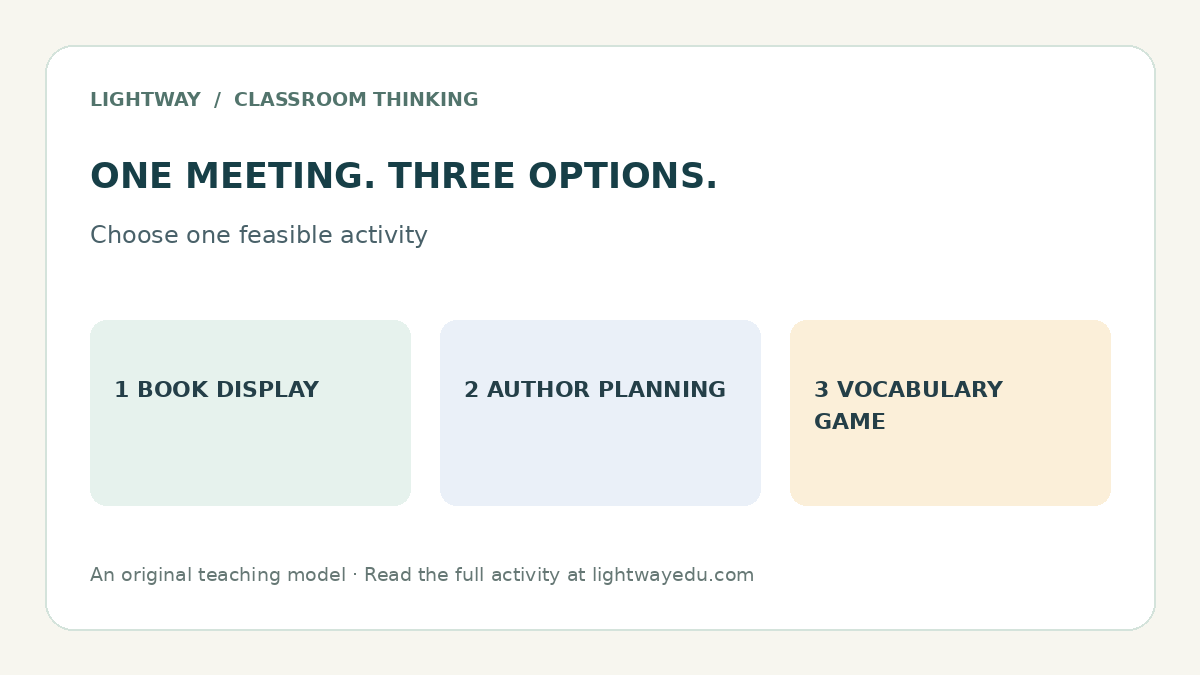
Tell the class: “The library club has one 25-minute meeting before the library closes. It can complete one of these activities: make a book display, play a vocabulary game, or plan an author interview. Each activity takes the whole meeting. Assume all materials are already available and there is no money charge.”
Give each pair three paper cards and a blank strip labeled first choice, next choice, and third choice. Students rank the options for a fictional club. They must explain the goal behind their ranking: attracting new readers, practicing vocabulary, or preparing a future event. Different rankings can be reasonable.
A 30–35 minute sequence
1. Establish feasibility (5 minutes)
Ask, “Can the club complete all three during this meeting?” Have students underline the time condition. Ask whether an activity unavailable that day belongs in the ranking. A choice can have many imaginable alternatives, but this exercise compares the ones the decision-maker could actually take.
2. Rank before choosing (7 minutes)
Pairs arrange the cards and write one sentence explaining the order. Suppose one pair ranks the book display first, author-interview planning second, and the vocabulary game third. Ask, “If the display were unavailable, which would you choose?” Their answer identifies the next-best alternative under their stated preferences.
Use a full sentence: “The opportunity cost of making the display is the value of the author-interview planning we would otherwise have done.” Students need not invent a dollar value. They can describe the benefit forgone, such as being better prepared to invite an author.
3. Compare two decision-makers (7 minutes)
Show a second club’s ranking: book display, vocabulary game, author-interview planning. Both clubs choose the display, yet their opportunity costs differ. Ask students to explain why. The resource constraint is the same, but the next-best option is different. This prevents a common shortcut in which the chosen item is assumed to determine its opportunity cost for everyone.
4. Change the constraint (6 minutes)
Now announce that author-interview planning requires a teacher who is absent. Students remove that option and revise the ranking. Ask whether the opportunity cost changed even though the selected activity stayed the same. Then offer an extension in which two short activities can fit. Explain that the alternative may now be a feasible combination. The key remains the best alternative that could replace the chosen use of resources.
5. Explain individually (5–10 minutes)
Give students this new case: “A school garden team has one empty bed. Its ranked choices are beans, flowers, then herbs. It plants beans. What is the opportunity cost? What extra information would you need if the ranking were missing?” Ask for an explanation before inviting partners to compare.
Model responses and discussion notes
The garden team’s opportunity cost is the value of growing flowers, its next-best feasible use of the bed. Herbs are also rejected, but the team could not grow both alternatives in that same bed under the stated model. Without a ranking, we would need to know which alternative the team values most. A student who says “flowers” has identified the alternative; ask them to add the benefit the team gives up.
For the first library club, the next-best alternative is author-interview planning. For the second, it is the vocabulary game. Neither ranking needs to be judged morally superior. Evaluate whether the explanation follows the given information.
Three misconceptions worth stopping for
- “It is free, so there is no cost.” The money price is zero, but the meeting time has another possible use.
- “Opportunity cost is everything we rejected.” Return to what the club would actually do instead. Do not add mutually exclusive alternatives as though all could happen together.
- “Opportunity cost means the choice was bad.” Even a well-reasoned decision can give up something valuable. The concept makes the trade-off visible; it does not automatically condemn the decision.
Support and extension
For students who need language support, provide the frame “We chose ___ instead of ___ because ___. The benefit we gave up was ___.” Use icons or read the cards aloud so the literacy demand does not hide the economic reasoning. For an extension, ask students to design a scenario in which a missing constraint makes the answer impossible to determine.
Close with two questions: “What is scarce?” and “What is the best feasible alternative?” The St. Louis Fed’s real-life opportunity-cost overview supplies background for teachers connecting the idea to other contexts. Keep the first classroom examples impersonal, concrete, and small enough that students can defend a ranking rather than guess what an adult wants them to value.
A related classroom resource
For a broader Grade 6 economics sequence, the Lightway pack includes a 30-slide lesson, printable practice, task cards, assessment questions, and teacher guidance. Opportunity cost is one part of that larger resource.
