
Grades 4–9 · Formative assessment · Classroom routine
A blank exit ticket can mean several things. The student may not understand the concept, may have misunderstood the wording, or may have run out of time while packing up. A correct answer can also conceal shaky reasoning. The useful question is what the response lets you decide about the next lesson.
Design the ticket backward from one teaching decision: “Do students need another model of this idea, a supported example, or a chance to apply it in a new setting?” The routine below takes about four minutes of class time. It includes a separate way to signal unfinished work, so missing evidence does not automatically become evidence of a misconception.
Choose a single learning target
For the worked example, use a middle-school social studies target: distinguish a primary source from a secondary account for a specified historical question. Students should already have met the concept. The ticket checks their use of it; it should not introduce an unfamiliar rule at the door.
Prepare a quarter-sheet or display the prompt while students respond in notebooks. Read the directions before the last few minutes. Explain that you will use their answers to plan the next lesson, and that an honest “I need more time” is useful information.
- We are studying what happened at a school meeting in 1995. Which is the more direct primary source: the meeting minutes written in 1995, or a textbook summary published in 2025?
- Explain your choice using how the source was created. Then name one thing your chosen source might leave out.
- Mark one: I finished / I need more time / I need the question explained. Optional: circle the part where you got stuck.
These school-meeting sources are invented for practice. No private student record or real school dispute is needed. The source question matters: a 2025 textbook could itself become a primary source for a different inquiry about how history was taught in 2025.
For the source concept itself, the Library of Congress primary/secondary-source sorting activity emphasizes justifying a classification in relation to the time or topic being studied. That is why the ticket names the historical question.
Collect reasoning as well as an answer
Give students one quiet minute to choose, two minutes to explain, and one minute to complete the status line. The exact pacing can change. Keep the conceptual task short enough that handwriting speed is less likely to dominate the result. Offer an oral or typed response when that is an established accommodation.
A confidence scale can be an optional addition, but confidence alone cannot show whether a student understands the idea. Ask for an observable move: identifying relevant evidence, explaining a choice, comparing two cases, or correcting an error. The Education Endowment Foundation’s assessment guidance emphasizes using evidence to identify what learners know and to plan subsequent teaching. It also cautions that understanding needs to be considered across different tasks and over time.
Read four responses without collapsing them into one score
- “The minutes, because someone recorded the meeting then. They may omit a disagreement.” This response supports the target and notices a limitation. Give this student a new source question next time.
- “The minutes, because old sources are always true.” The choice is correct, but the reasoning reveals a reliability misconception. Plan a short counterexample about an inaccurate contemporary account.
- “The textbook, because textbooks contain facts.” Ask a follow-up about when and why each source was created. The student may be using authority as the deciding criterion.
- No answer; “I need more time” marked. You do not yet have enough evidence. Re-present the same question briefly before assigning reteaching.
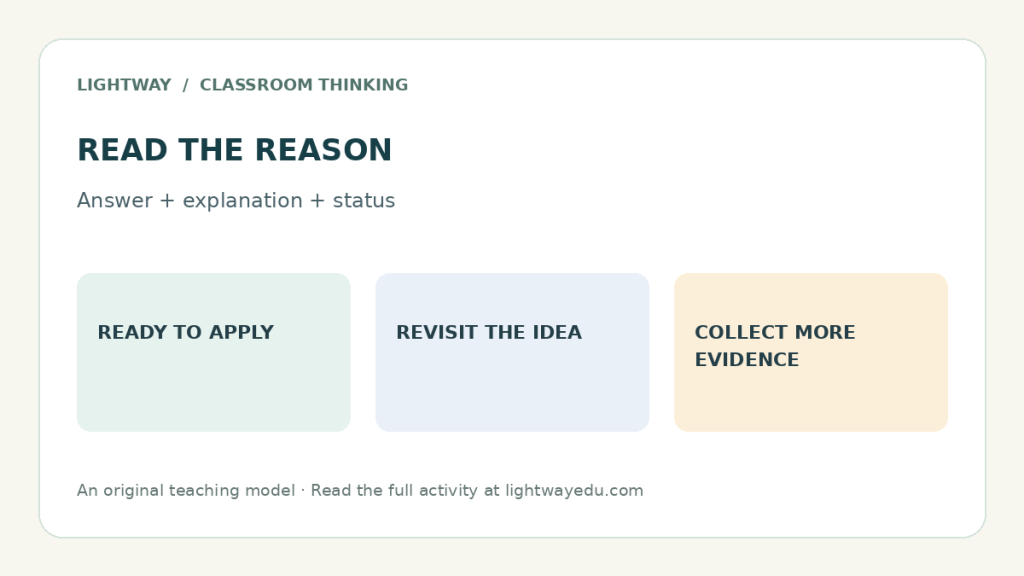
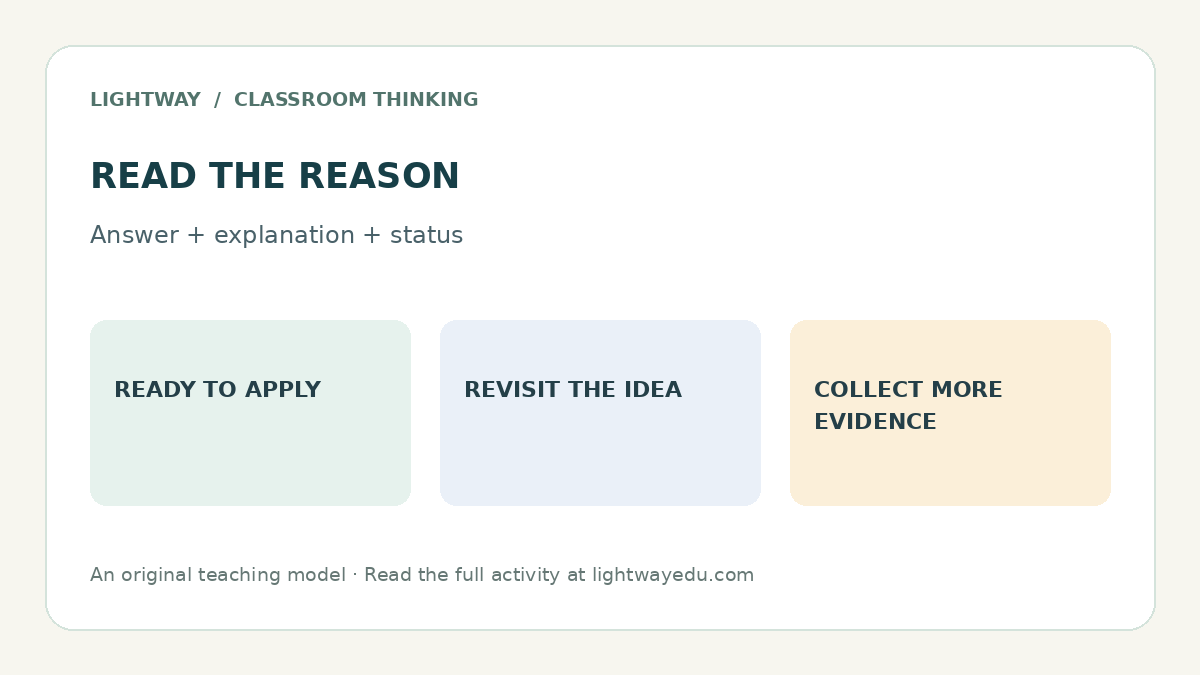
Put the tickets into three working groups: ready for application, concept to revisit, and evidence still needed. These are temporary instructional decisions. They should not become permanent ability groups or public rankings.
Model answer and an important qualification
For a question about the 1995 meeting, the minutes are a primary source because they were produced in connection with that event. They could omit informal conversation, record a viewpoint unevenly, or contain an error. Being primary does not guarantee accuracy. The textbook is a later interpretation for this question. If the question changes to how textbooks presented the meeting in 2025, its role in the inquiry changes too.
Make the next-day response visible
Start with two anonymized teacher-written examples that reflect the patterns you saw. Ask which explanation is stronger and why. Model how to improve the “old sources are always true” answer, then let students revise their own reasoning. Do not show identifiable student errors without permission.
Students whose first response was unfinished can answer while others attempt an extension: “Can two primary sources disagree?” Those needing support can use the sentence frame, “For our question, this source is primary because it was created ___; it may still leave out ___.” Remove the frame as independence develops.
Try the same design in another subject
In math, ask students to choose between two worked solutions and identify the first step that changes the result. In science, ask for a prediction, a reason linked to the model, and one observation that would challenge the prediction. In literature, ask which detail supports an inference and explain the connection. Keep the separate unfinished-work signal in each version.
After the next lesson, use a fresh but comparable example. A single corrected ticket may show that a student followed your model; a new example provides another opportunity to see how the idea travels. Keep the collection manageable enough that you can actually act on it. One well-chosen question with a clear response plan is more useful than a stack of reflections that nobody reads.
A related classroom resource
The Lightway closing-routine deck includes 20 slides, including Claim + Evidence, Explain It Simply, and Help Me Plan Tomorrow. Use a layout to display a lesson-specific question and retain your own plan for responding to the answers.
