
Grade 6 · Literary analysis · 35–40 minutes
Students can correctly list what happens in a story and still struggle to explain why one scene matters. A plot diagram gives names to parts of a narrative, but filling the boxes does not by itself show how a character’s response changes what happens next.
This lesson asks students to test a turning point with a causal question: “If this response were different, which later events would probably change?” The question supports an interpretation; it does not prove that every story has exactly one uncontested turning point. ReadWriteThink’s lesson on character, conflict, and plot uses altered choices to examine consequences in high-school drama. The original short activity below adapts that general analytical move for Grade 6.
Read this original micro-story
The Spare Sign
1. The library club had ten minutes before visitors arrived. Lena had drawn an arrow on a large sign to guide them to the reading room. When she lifted it, she noticed the arrow pointed toward the locked storage hall.
2. “We can turn it around,” said Omar. But the back was blank, and the painted words would disappear. Lena glanced at the carefully lettered sign. She had spent yesterday’s whole meeting on it.
3. A stack of plain cardboard stood beside the desk. Lena could hear the first visitors outside. She put her painted sign on the floor, took a blank piece, and asked Omar to write while she drew a new arrow.
4. The replacement was crooked. One corner still showed the name of the box it came from. Lena held it at the entrance, and the visitors walked straight to the reading room.
5. Afterward, Omar asked whether they should throw the first sign away. Lena picked it up. “Keep it,” she said. “Next time we’ll check the direction before we paint the words.”
Original Lightway classroom text, written for this article. Teachers may display or print it for this activity.
Make the first reading about meaning (5 minutes)
Read the story aloud while students follow. Ask them to identify Lena’s immediate goal and the problem that prevents it. An appropriate answer is that she wants to direct visitors to the reading room, but her finished sign points the wrong way and little time remains. Do not begin by asking for five plot labels; first ensure the class understands the situation.
Separate sequence from explanation (8 minutes)
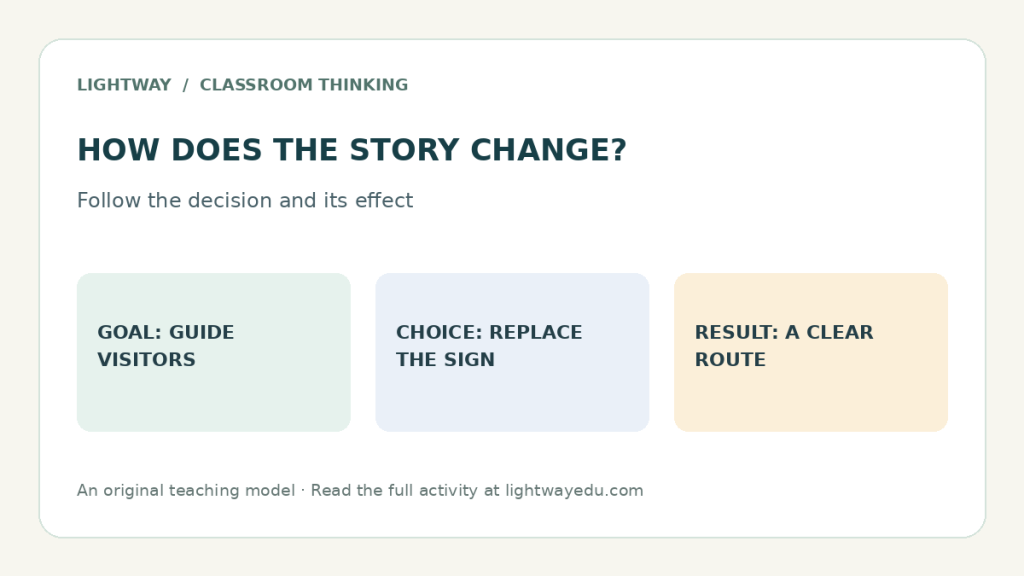
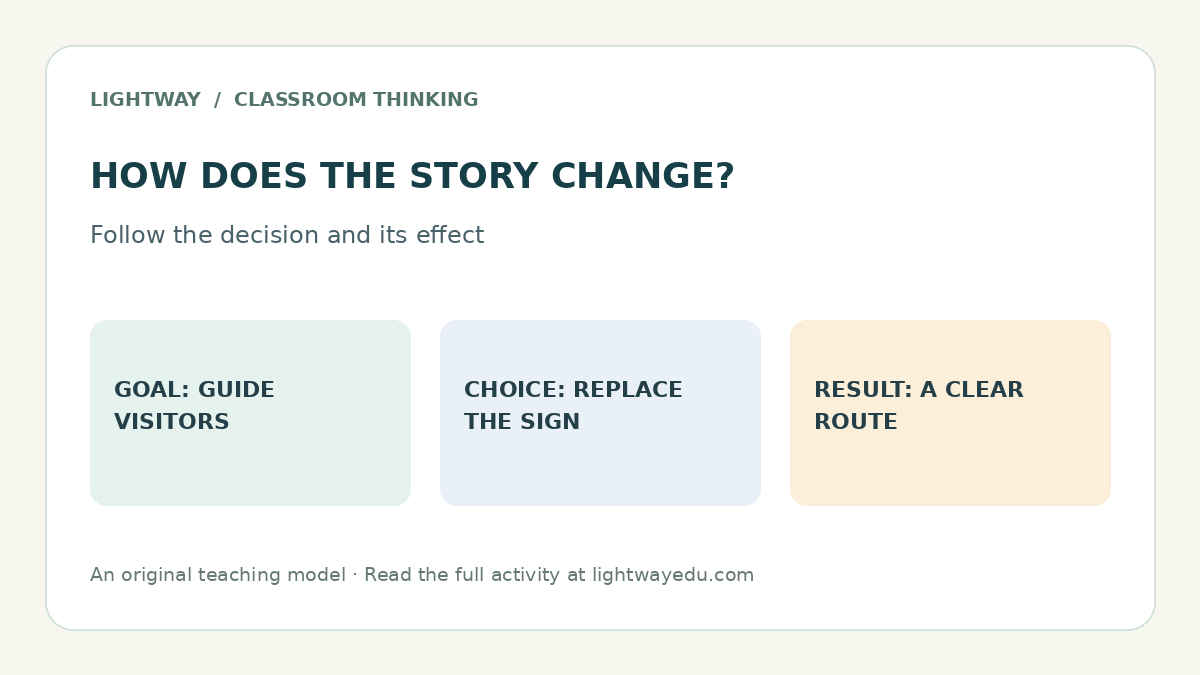
Write two sentences: “Lena finds cardboard and makes another sign.” “Lena gives up using her carefully painted sign so the visitors can reach the room on time.” Ask what the second sentence adds. Students should notice a choice, a goal, and a connection between them.
Have pairs list three important events, then connect two using because or therefore. Require them to check that their connector is justified. “Visitors arrive because Lena finds cardboard” reverses the logic; the visitors’ approaching arrival creates urgency, while the replacement sign changes how they find the room.
Test a turning-point claim (10 minutes)
Offer two possible claims. Claim A: paragraph 1 is the turning point because Lena discovers the mistake. Claim B: paragraph 3 is the turning point because she chooses a workable replacement. Ask students to identify what changes at each point. Discovery creates the immediate problem; the decision redirects her response toward a solution.
Invite students to defend a choice with a before-and-after explanation. A strong answer for paragraph 3 might connect her attachment to the painted sign in paragraph 2 with the successful direction of visitors in paragraph 4. Accept a different turning-point claim when its reasoning fits the text and your class’s working definition. Avoid grading the label without reading the explanation.
Now ask, “If Lena kept trying to use the first sign, which later event would be less likely?” Students may reasonably predict that visitors would not all walk straight to the room. Label this a counterfactual inference. The story does not tell us exactly what would happen, and readers should not invent certainty.
Model analytical paragraph
Lena’s decision in paragraph 3 is a turning point because she changes from protecting her finished work to solving the visitors’ problem. Paragraph 2 shows her looking at the sign she spent time making, while paragraph 3 shows her setting it aside and working with Omar. That choice makes the useful replacement in paragraph 4 possible. The crooked sign matters because its appearance is less important to her immediate goal than its accurate direction.
Let students revise a weak response (7 minutes)
Give them this teacher-written example: “The turning point is paragraph 3 because it is important. Lena makes a sign. Then visitors come.” Ask students to underline the vague word, add one precise earlier detail, and explain one consequence. They can use the frame “Before ___, the character ___. When ___, the character ___. This changes ___ because ___.”
For students ready to extend the analysis, ask how the final paragraph complicates a simple “old work is useless” message. Lena keeps the original sign as a reminder to plan differently. The ending suggests learning from the mistake rather than treating the earlier effort as meaningless.
Check understanding with a new question (5 minutes)
Ask, “What would the story lose if paragraph 2 were removed?” A supported response is that readers would have less evidence of why setting the sign aside is difficult. The choice would still occur, but its emotional weight would be less clear. This checks scene function rather than asking students to repeat the modeled turning-point label.
Score informally for three things: a clear claim, a relevant detail, and an explanation of the connection. Offer oral rehearsal or a pre-highlighted paragraph for students who need reading support. Keep the reasoning demand intact. ReadWriteThink’s plot-structure reference can support vocabulary after students have practiced explaining the relationships. The goal is a reader who can say how a story works, not simply name its parts.
A related classroom resource
For a longer literary-skills sequence, the Lightway pack includes three original stories, 30 teaching slides, 10 worksheet pages, task cards, and teacher support. The micro-story above is an original blog activity, separate from the paid pack.
