
Grades 6–8 · U.S. history · 40–45 minutes
A map that changes color in 1763 can make the end of the French and Indian War look deceptively simple. Britain gains territory, France loses territory, and the lesson moves on. Students need another question: what did an agreement between European powers settle, and whose conflicts did it leave unresolved?
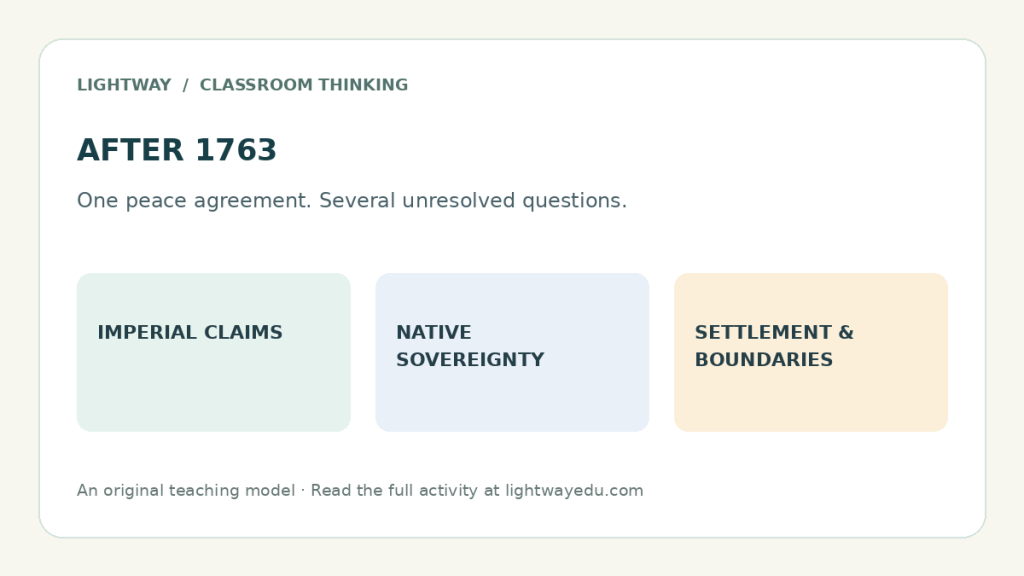
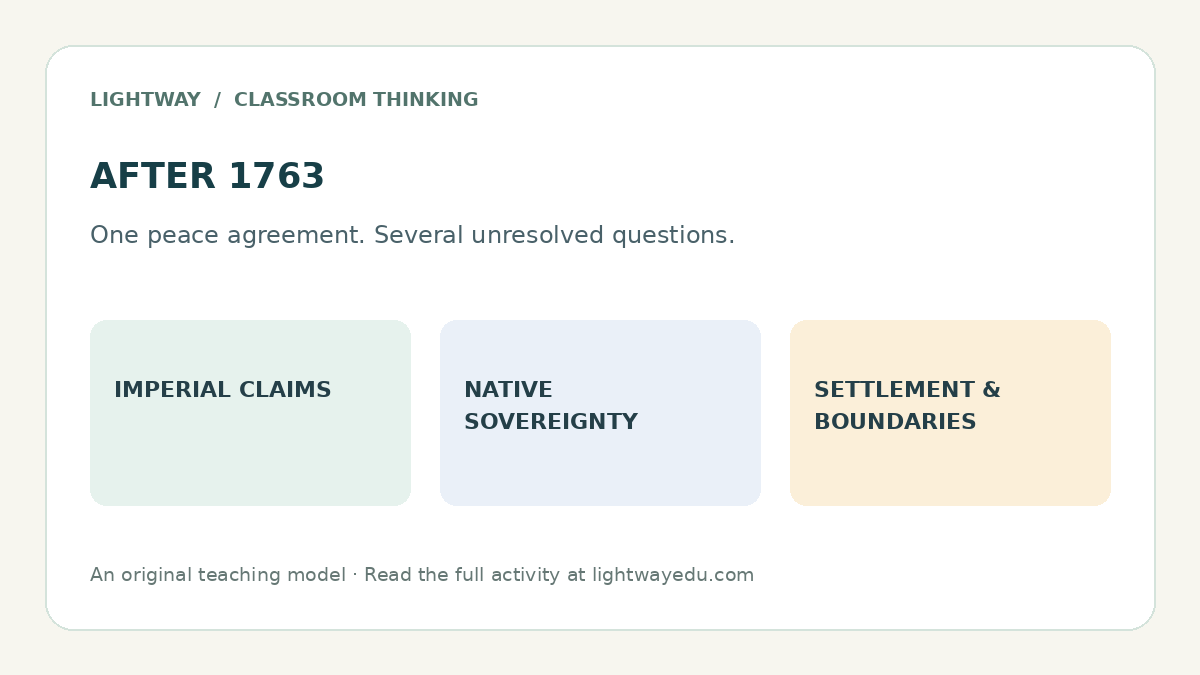
Use a consequence map to keep several perspectives visible without asking students to impersonate historical people or negotiate away Native lands. Students act as historians comparing evidence. The goal is to explain why a military victory and an imperial peace could coexist with continuing resistance, uncertainty, and competing claims.
Prepare three short evidence stations
You need a map showing European territorial claims before and after 1763, a display or handout with the three teacher-written evidence notes below, and paper divided into “change,” “affected group,” and “new question.” Preview source vocabulary such as treaty, claim, sovereignty, and proclamation. Explain that a colored area on an imperial map represents a claim; it does not show that every community inside it agreed to that claim.
The National Park Service’s How Did the War End? provides maps and background. Its original classroom activity is designed for younger grades; this article uses a different, document-analysis approach for middle school.
Evidence notes for the activity
A. An imperial agreement. The Treaty of Paris of February 10, 1763 set peace terms among Britain, France, and Spain and changed European territorial claims in North America. Ask what a treaty among those powers can establish about their agreement, and what additional evidence would be needed to establish Native consent.
B. Continuing Native sovereignty and resistance. Native nations had their own political goals. The treaty did not settle their independence or all disputes over their lands. British policies and settler expansion contributed to further conflict in 1763. Avoid treating every Native nation as a member of one alliance or as having one response.
C. A boundary that did not end the dispute. The Royal Proclamation of October 1763 established a boundary intended to constrain colonial settlement. Settlers and land speculators already had interests beyond it, while Native communities also lived east of the line. A rule on paper and its effects on the ground need separate investigation.
These are modern teaching summaries, not quotations from eighteenth-century documents. Background: National Park Service sources linked in this article.
Start by reading the map’s claim (7 minutes)
Show the map without first asking who “won.” Students record two visible observations and one question. Accept observations such as a change in the color key or a labeled boundary. Challenge an inference presented as an observation: “Everyone there became British” goes beyond what the map itself shows.
Ask who made the map, when it was made, and what its labels represent. A modern teaching map and an eighteenth-century map have different origins. Both need context. If the map groups a large region under a European name, ask what information about Native communities is missing from that representation.
Trace a consequence without flattening a group (12 minutes)
Pairs rotate through the three notes. For each, they write one change and one group affected, then add a question that cannot be answered from that note alone. Useful questions include: Which British officials made this policy? Which settlers sought land west of the boundary? Which Native nation and community does this source describe?
Replace “the colonists wanted” with a qualified phrase when the evidence supports only some colonists. Replace “the Indians agreed” with the name of a documented nation or council when possible. When the available evidence is too broad, record the limitation rather than supplying an invented viewpoint.
Compare the problem a policy tried to solve with what remained (10 minutes)
Draw two branches from “Royal Proclamation, 1763.” Label one “intended boundary” and the other “unresolved pressures.” Students add the interests that could make enforcement difficult. The NPS account of the 1768 Treaty of Fort Stanwix shows that boundary negotiations and conflicts continued. Use it as a later check, not as proof that every participant in 1763 knew what would follow.
For a careful extension, ask why a later treaty involving particular Native representatives cannot automatically stand for the consent of every affected nation. Students should look for who participated, whose interests were claimed, and who disputed the result. The evidence question stays more precise than a broad statement that one people “gave away” a continent.
Model explanation and misconception check
The 1763 peace changed agreements among European empires, but it did not end all conflict in North America. Native nations retained their own goals and resisted threats to their lands and independence. The proclamation boundary also conflicted with existing settlement and speculative interests. Therefore, a map of new imperial claims cannot by itself demonstrate general consent or stable control.
Misconception: “The French and Indian War was France fighting all Native Americans.” Correction: the name does not describe a single unified Native side. Examine specific alliances and their changes rather than inferring participants from the title.
Exit ticket: revise an overconfident sentence (5–8 minutes)
Give students: “The Treaty of Paris solved the North American land conflict because Britain owned everything it received.” Ask them to revise it with one specific change, one unresolved issue, and one source limitation. A strong response distinguishes an imperial claim from consent and control. A weaker response merely adds “some people were unhappy” without explaining the competing interest.
Provide a vocabulary bank or a partly completed consequence map for students who need support. Let students rehearse an explanation orally before writing. For advanced readers, use the NPS primary-source teaching guide to examine the proclamation in greater context. End with a genuinely open historical question. Students should leave knowing which claims the evidence supports and what they would need to investigate next.
A related classroom resource
The Lightway French and Indian War lesson includes 30 teaching slides, 10 worksheet pages, 40 task cards, and five primary-source cases across eight analysis pages. It covers the war and its immediate consequences; detailed Stamp Act and later protest lessons are outside its main scope.
