
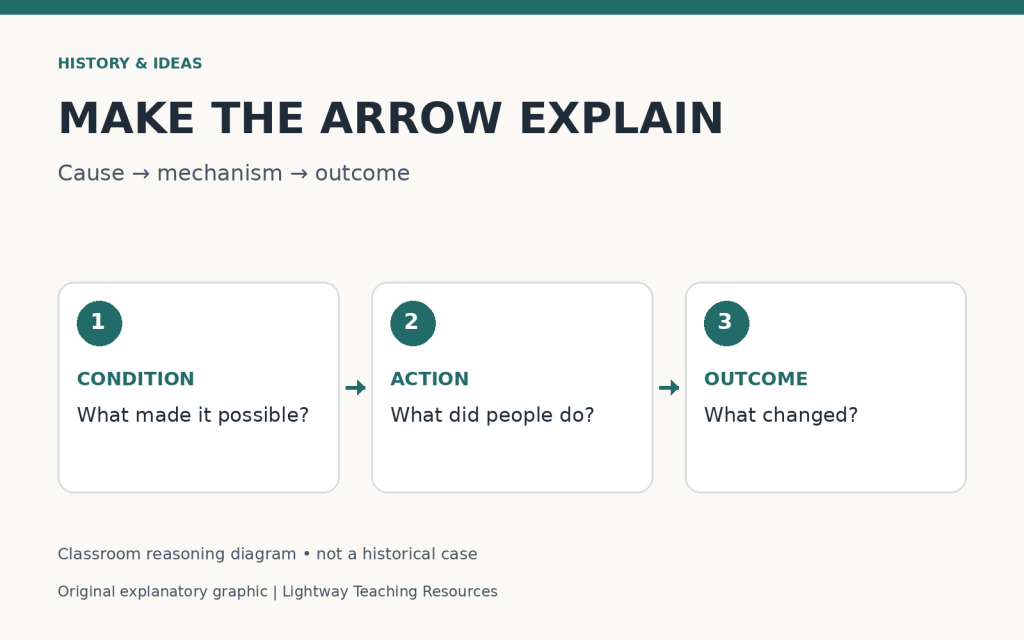
A student draws an arrow from “trade” to “growth.” The page looks like a causal explanation. But the arrow has not explained anything yet. What changed, who acted, and how did that action produce the result?
A useful classroom rule is simple: every arrow needs a verb. Instead of collecting more causes, ask students to explain one connection well. This routine works with a short source set and an event your class already knows.
Start with a precise outcome
“Why did the empire fall?” is usually too large for an opening exercise. Narrow the outcome: which institution weakened, which decision changed, or which event occurred, and when? Put that outcome in a box. A precise question makes it easier to decide whether a proposed cause is relevant.
The Historical Thinking Project treats causes as interacting conditions and human actions, not a single chain with an inevitable ending. Give students that distinction in ordinary language: some circumstances made something possible; people still made choices within them.
Model a connection before asking for a diagram
Use this deliberately fictional practice case. A town’s Saturday market closes for one week. The supplied information says that heavy rain flooded the usual site, the council could not approve an alternative site in time, and traders had already paid for advertisements.
Model: “Flooding made the usual site unusable, so the market needed another location.” Then add: “The lack of an approved alternative prevented the market from moving.” These are mechanisms: they explain how one circumstance affected another.
The advertising expense belongs in the discussion, but the information does not establish that it caused the closure. Students should be able to leave a plausible-looking card unconnected. Clarify that this invented case practices reasoning; it is not historical evidence.
Build a small, evidence-linked map
- Choose three candidate causes. Provide a manageable set of evidence from the actual historical topic. Students select causes rather than copying every detail.
- Label each arrow. Require a phrase such as “made transport cheaper,” “limited the available choices,” or “prompted leaders to act.” “Led to” alone is not enough.
- Add an evidence reference. Attach the source number or passage supporting the link. If the connection is an inference, label it as an inference.
- Compare explanations. Partners identify the strongest connection and one that needs more support.
Keep the first diagram small. A crowded web can conceal weak reasoning as easily as a neat list can. Students can expand it after they can explain the initial links aloud.
Separate importance from timing
The last event before an outcome is not automatically its most important cause. Ask: “What made this action effective at this particular time?” A trigger can matter because earlier circumstances gave it force.
The project’s causation guideposts also distinguish differing causal influence, interaction, unintended consequences, and contingency. Translate these into questions: Which connection does the most explanatory work? What did people intend? What happened that they did not expect?
A cautious counterfactual can test an explanation: “If this condition had been absent, what evidence suggests the outcome might have differed?” Do not grade imaginative alternative histories as facts. Reward students for identifying what the available evidence cannot settle.
Check the reasoning, not the artwork
For support, provide a verb bank and two possible arrow labels, asking students to choose and justify one. For extension, ask them to challenge the ranking of causes or explain why a factor affected groups differently.
Finish with one sentence: “_____ contributed to _____ because _____; the evidence is _____.” Look for a genuine mechanism, a relevant reference, and appropriately cautious wording. The Canadian Museum of Immigration’s discussion of causation is a useful teacher follow-up for keeping explanations attentive to complexity rather than inevitability.
For a companion routine, see Teaching Historical Claims: Match Confidence to Evidence.
Featured graphic: original explanatory diagram by Lightway Teaching Resources, not a historical case.
