
A student writes that an ancient city was peaceful because its excavated buildings have no obvious fortifications. Another insists that we can know nothing about the city at all. Both answers miss the same opportunity: to say exactly what the surviving evidence supports, and where the claim outruns it.
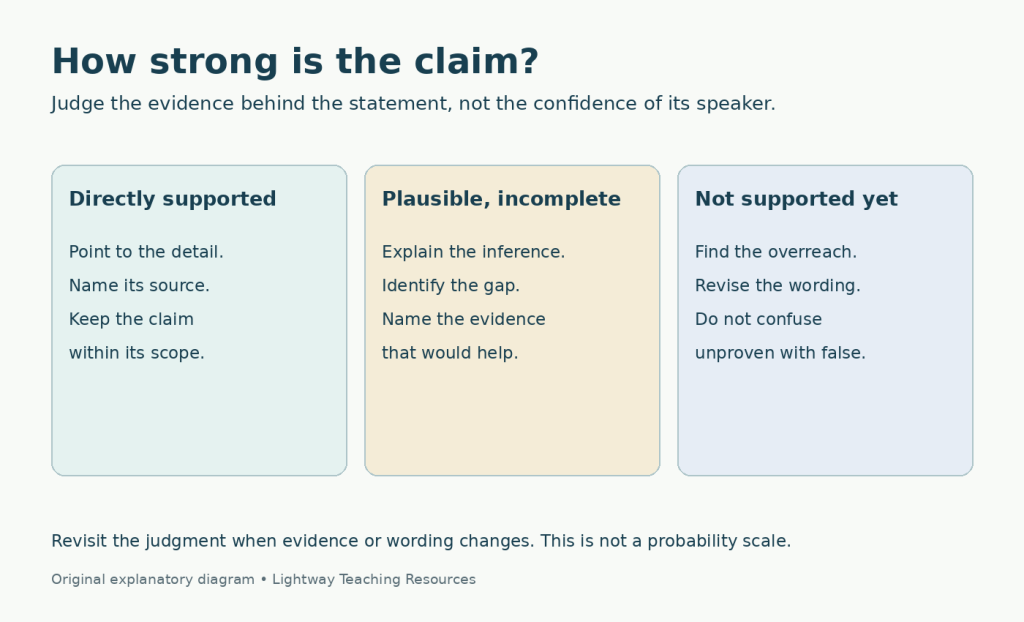
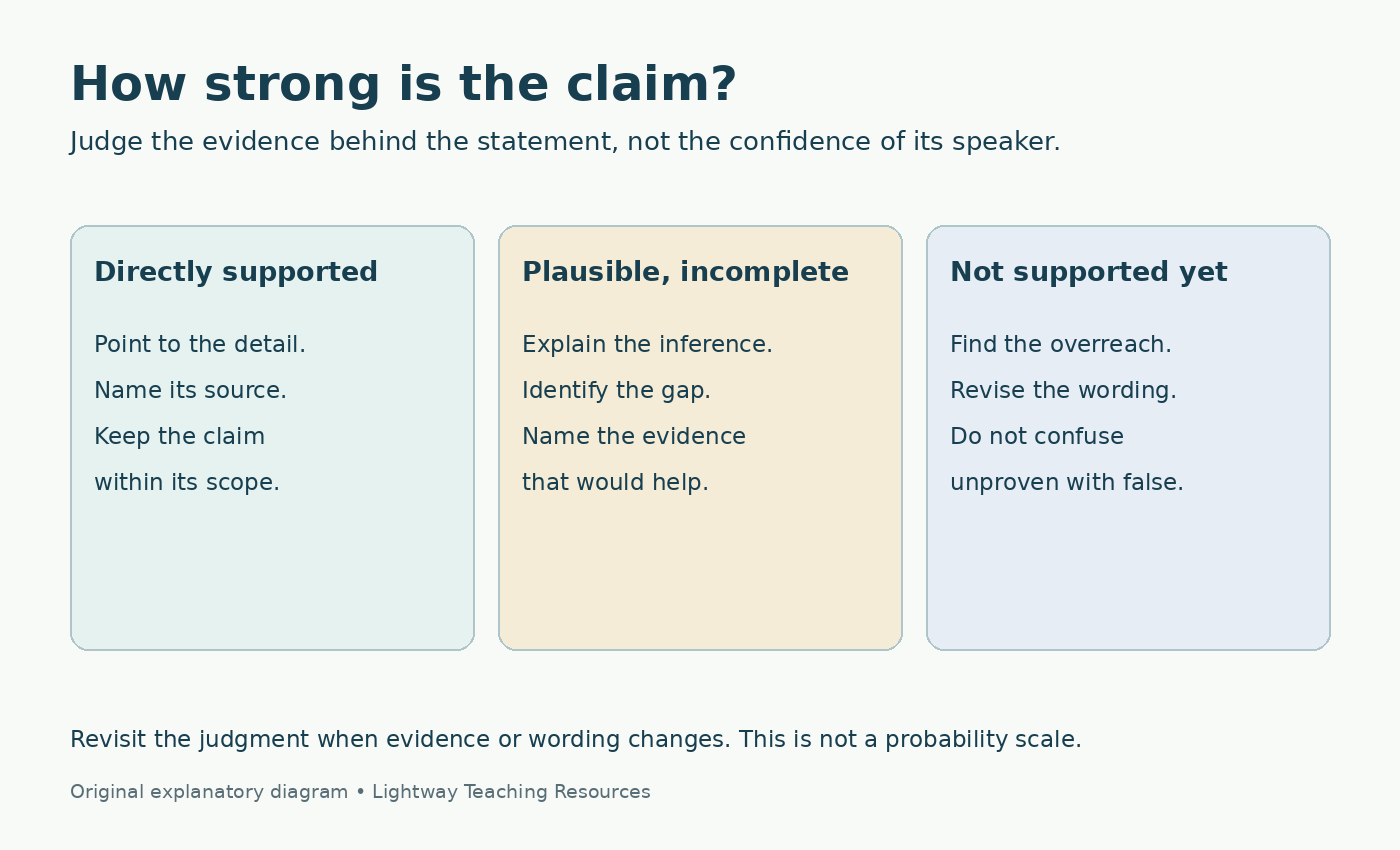
Historical reasoning needs more than a choice between “fact” and “opinion.” Students need practice making claims whose strength matches their evidence. The confidence ladder below is an original classroom routine for that purpose. It is not a numerical probability scale, and it is not a substitute for teaching the historical context.
Start with the claim, not the student’s confidence
Ask “How well supported is this particular claim?” rather than “How confident do you feel?” A fluent speaker can be very sure of a weak argument. A hesitant learner can make a careful one. We want to assess the relationship between the statement and the evidence, not the personality of the speaker.
Use three working categories: directly supported by the evidence provided; plausible but requiring further evidence; and unsupported by the evidence provided. These categories are temporary judgments. A claim can move when new evidence arrives, when its wording becomes more precise, or when the class discovers that a source has been misunderstood. “Unsupported” does not necessarily mean false. It means the current evidence does not establish it.
Choose a source with something students can actually check
For a short introductory activity, use the Metropolitan Museum of Art’s Old Babylonian student exercise tablet. Its record identifies a small clay tablet dated approximately to the twentieth through sixteenth centuries BCE. The museum explains that the name of the deity Urash was copied six times. Its account distinguishes the readable signs from damaged material on the reverse.
Students cannot verify an ancient translation merely by looking at the photograph. Make that distinction explicit: the photograph supports observations about the visible object; the museum’s specialist description supports statements about its reading and interpretation. A responsible answer should identify which kind of evidence it uses. Do not ask students to “discover” a translation that they have not been taught to read.
The Library of Congress analysis guides distinguish observing, reflecting, questioning, and further investigation. This activity builds on that broad distinction while adding a focused revision task. It is our suggested teaching routine, not a Library of Congress-endorsed method.
A practical 25-minute sequence
Minutes 0–5: separate observation from supplied knowledge. Display the image with its museum credit. Ask learners to record two visible details without guessing the writer’s feelings. Then reveal the date, material, and explanation from the object record. Have them label each note “image” or “museum description.” A reader who needs support can use two colored pencils rather than extra writing.
Minutes 5–10: sort three claims. Provide these statements: “This tablet contains repeated writing”; “Repetition formed part of at least some scribal learning”; and “Every child in Babylon learned to write.” Students place each statement on the ladder and underline the words that determine its strength. The first is closely supported by the image and description. The second is a reasonable, bounded inference from this example and the museum’s account of exercises. The third extends one specialist training object to an entire population without evidence.
Minutes 10–15: require a warrant. Each pair completes: “We placed the claim here because ___; this evidence cannot tell us ___.” A citation by itself is not enough. The explanation must connect the particular feature or contextual information to the statement. If learners disagree over the second claim, let them explain whether they are judging the single object alone or the museum’s wider contextual statement. That disagreement can reveal the importance of defining the evidence set.
Minutes 15–20: revise, rather than merely reject. Give students the overbroad claim about every child. Ask them to make it defensible without making it meaningless. A possible revision is: “This exercise tablet is evidence of scribal training in the Old Babylonian period.” Another is: “The museum’s explanation suggests that copying signs was one method used in training scribes.” Neither claims universal school attendance or tells us who made this particular exercise.
Minutes 20–25: name the next useful evidence. Ask what would be needed to investigate access to education. Accept a relevant proposal, such as comparing more training tablets and scholarly research on their find contexts and users. Do not accept “look on the internet” without specifying what information the search should establish.
What to assess
A short exit response can contain just three sentences: one bounded claim; one explanation of supporting evidence; and one limitation or next question. Look for precise scope, a relevant source detail, and an honest boundary. A polished paragraph with an unsupported “all” or “always” should not score above a shorter response that accurately distinguishes what is known from what is inferred.
When providing feedback, identify the repair: narrow the population, name the period, remove an invented motive, or distinguish the image from its catalogue interpretation. “Use more evidence” is too vague when the real problem is that the claim asks a single object to represent an entire society.
Keep uncertainty productive
A common failure is to reward endless hedging. Students begin adding “maybe” to every sentence, including straightforward statements about the supplied record. Explain that careful history can be firm about limited claims. Uncertainty is useful when it tells us where the evidence stops and what would help next.
Another failure is to treat all interpretations as equally good. They are not. An argument that fits the evidence, addresses context, and survives comparison is stronger than a guess built on appearance alone. The goal is neither absolute certainty nor permanent doubt, but accountable judgment.
For another source-focused classroom sequence, see our cuneiform tablet inquiry.
