
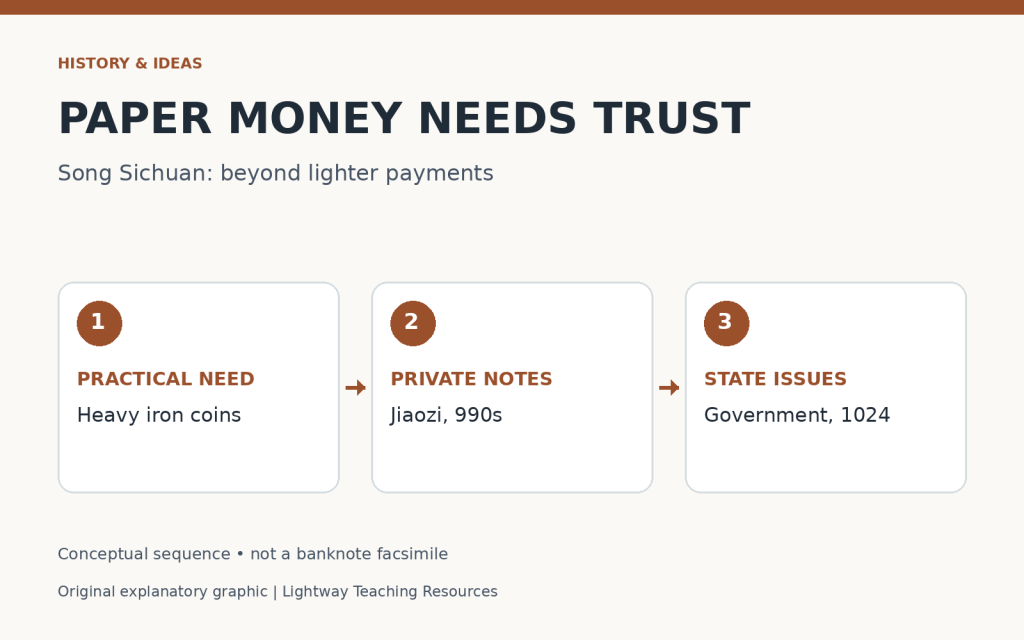
Money can become so awkward to move that its weight interferes with the trade it is meant to support. In Song-era Sichuan, where iron coins were cumbersome, paper offered a practical answer. But a light piece of paper raised a heavy question: why should anyone accept it?
A transport problem became a monetary experiment
China’s expanding commercial economy did not simply abandon coins when paper appeared. Different forms of payment served different needs. As Columbia University’s Asia for Educators explains, strings of coins could be inconvenient for large transactions, and merchants had already experimented with paper receipts before the Song government issued currency.
The regional setting matters. Historian Richard von Glahn’s published chapter summary on Northern Song Sichuan identifies private jiaozi notes in the 990s, followed by a state takeover in 1024. The notes helped intraregional exchange where iron coinage was particularly inconvenient.
That sequence is more revealing than a single “invention of paper money” date. Merchants tried a solution; issuers encountered difficulties; officials intervened. This was an institutional experiment as well as a technological one.
Paper did not remove the problem of trust
A coin can be weighed and examined. A note asks its holder to rely on an issuer and on other people’s willingness to receive it. The material is easier to carry, but the promise behind it becomes especially important.
Von Glahn’s summary links the early private system to issuer insolvency, unsuccessful regulation, and eventual government control. It also emphasizes fiscal circulation: taxes, public purchasing, spending, and transfers of revenue helped sustain the state-issued notes’ use. This account is based here on the publicly available chapter summary, not a claim to have read the complete chapter.
The interpretive point is important. Government participation was not merely a new name printed on an old merchant receipt. Public payments could connect the note to recurring obligations and transactions. Portability explained why paper was attractive; an organized system of acceptance helped explain why it could function as money.
Printing supplied a tool, not the whole explanation
The technology belonged to a much wider world of paper and print. The Asian Art Museum’s account of woodblock printing describes skilled work with prepared paper, carved blocks, ink, and repeated impressions. Printing supported many kinds of written communication, not only currency.
Likewise, the Metropolitan Museum of Art’s introduction to Chinese prints places printing’s development in a long history of producing multiple copies, including Buddhist texts and images. The ability to reproduce writing mattered, but it did not by itself guarantee the reliability of a financial instrument.
Separating these explanations avoids a familiar trap: assuming that an invention automatically creates a social transformation. Materials and techniques made notes possible. Commercial needs, regulation, and payment practices shaped what people did with them.
Look carefully at the banknote in the picture
A surviving Chinese note is not automatically evidence from the Song. The note illustrated on Columbia’s money page is a Ming issue from 1375, much later than the Sichuan experiment. It can show that printed paper currency had a long subsequent history, but it should not be labelled as a Song banknote.
The same care applies to famous travellers: an account from a later dynasty cannot stand in for a witness to the first Song issues. Date the object or account before asking what it proves.
Paper money therefore offers more than a story about clever substitution. It reveals a continuing problem in economic history: how a useful object becomes a dependable medium of exchange. In Song Sichuan, convenience was the beginning of that story, not its conclusion.
For a classroom model of exchange networks, see the Silk Roads network-relay activity.
Featured graphic: original explanatory diagram by Lightway Teaching Resources, not a banknote facsimile.
