
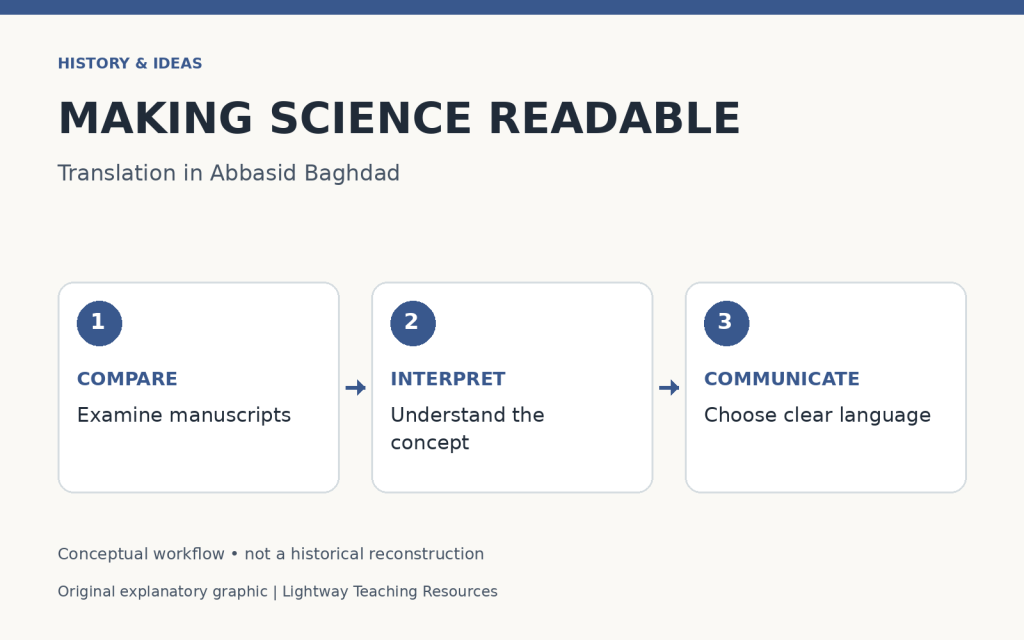
A translator encounters a Greek medical term. Should the Arabic reader receive its Greek sounds written in different letters, or words that explain what the term means? For ninth-century scholar Hunayn ibn Ishaq, this was a scientific problem, not merely a vocabulary exercise.
Understanding before substitution
Hunayn was a Christian Arab physician working in the intellectual world of Abbasid Baghdad. He and his collaborators helped make Greek medical knowledge available in Syriac and Arabic. In the British Library’s account on Qatar Digital Library, his achievement rests partly on his insistence that a translation communicate meaning rather than simply reproduce unfamiliar sounds.
That required knowledge of the subject. A translator who understood an anatomical structure could select words that made its function or shape intelligible. Someone merely exchanging words might preserve the appearance of accuracy while losing the explanation.
Hunayn also compared manuscript copies and sought better texts. The source itself needed scrutiny before its language could be changed. Translation thus involved decisions about what an author had written as well as how another reader should understand it.
A city of readers, patrons, and specialists
Baghdad, founded in 762, brought together people using different languages and possessing different kinds of expertise. Its role in translation cannot be reduced to one extraordinary individual or imagined as a single modern university.
As the British Library’s study of translators and patrons explains, the work depended on book culture, trained specialists, and people able to finance demanding projects. The Banu Musa brothers were among the influential patrons. Hunayn’s son Ishaq and nephew Hubaysh also belonged to this translating world.
These relationships matter because scholarly work has practical requirements. Someone must obtain a manuscript, support the time spent studying it, recognize a useful translation, and circulate copies. Patronage did not make every intellectual choice predictable, but it helped determine which work could be sustained.
The network is a better starting point than a picture of a lone scholar rescuing a lost book. Knowledge travelled through several hands, languages, and purposes.
Why religious identity belongs in the story
Many Greek-to-Arabic translators were Christians. That fact is sometimes treated as a surprising exception to “Islamic science,” but it helps explain the movement’s actual intellectual foundations.
The British Library’s discussion of Christian translators describes the importance of Syriac-speaking Christian educational traditions and their connections with Greek learning. These communities supplied linguistic and scholarly skills useful to Arabic readers. Muslims, Christians, and others participated in a wider scientific culture under Islamic rule.
This is not evidence that all communities always enjoyed equal power or that religious conflict disappeared. It shows something narrower and more concrete: expertise could cross confessional boundaries, and Arabic became a language in which scholars from different backgrounds worked.
More than a waiting room for European science
It is tempting to tell this history only as the preservation of Greek ideas for later readers elsewhere. Preservation was important, but that framing can make the scholars’ own questions vanish.
The Metropolitan Museum of Art’s science and art teaching material connects scientific learning with practical and intellectual concerns, including medicine and astronomy. Translation provided material that could be taught, discussed, applied, and developed, not simply stored.
Hunayn himself wrote medical works. His career makes the distinction between “translator” and “thinker” look less secure: deciding how to express a scientific concept was already an act of understanding.
A useful question for readers today is therefore not only “What knowledge survived?” Ask also: “Who made it readable, for whom, and with what choices?” The answers reveal translation as skilled historical work, shaped by language, patronage, and judgment.
For a classroom comparison of how networks move goods and ideas, see the Silk Roads network-relay activity.
Featured graphic: original explanatory diagram by Lightway Teaching Resources, not a historical reconstruction.
