
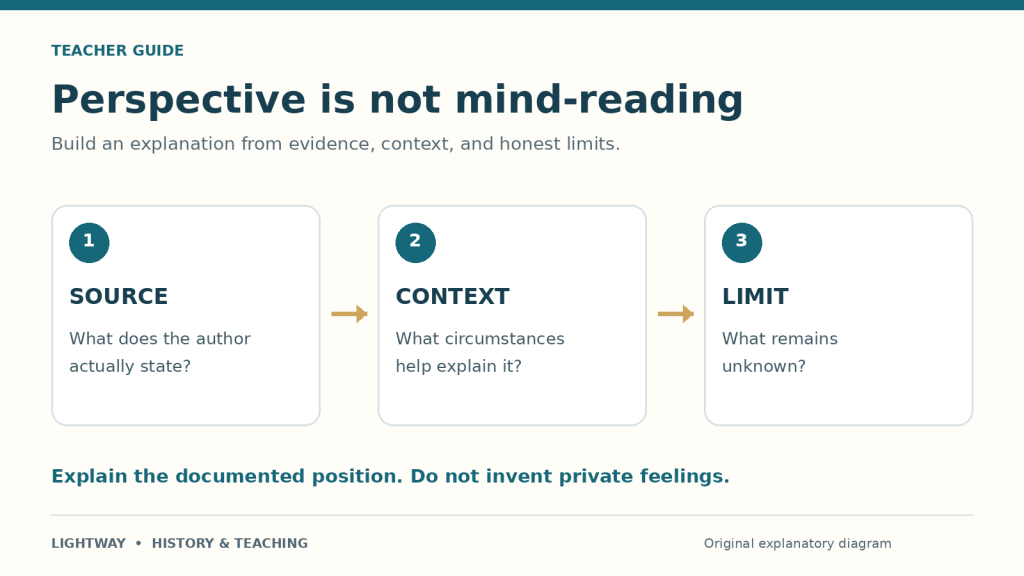
“I would have felt angry” sounds empathetic, but it may tell us more about a student today than about a person in the past. Historical perspective-taking begins with a harder question: what could this person know, value, fear, or choose in their particular circumstances?
The Historical Thinking Project distinguishes understanding a past context from simply identifying with another person. A useful classroom routine therefore needs evidence and boundaries, not just an invitation to imagine.
Replace an invented diary with a constrained explanation
For a first attempt, ask students to explain a documented decision in the third person. Avoid giving them a historical identity and asking for a private diary that the evidence cannot support. Creative writing has its place, but its invented details should not quietly become historical conclusions.
Choose one short source and a small context card. The card should identify the author, audience, date, relevant circumstances, and any important gap in our knowledge. Give students enough context to reason without burying the source under a second textbook chapter.
Try a 25-minute evidence-and-context routine
- Read for the stated position, 5 minutes. Students underline what the author explicitly wants, supports, or opposes. They do not label emotions yet.
- Identify the constraints, 5 minutes. In pairs, students select two details from the context card that could help explain the position. They must say how each detail matters.
- Test an explanation, 7 minutes. Students write three sentences: the documented position; a contextual explanation; and a limit to what can be concluded.
- Challenge and revise, 5 minutes. Partners mark any sentence that assumes everyone in the society agreed or uses knowledge unavailable at the time.
- Exit check, 3 minutes. Ask students to name one additional source that would help test their explanation, and explain why.
Model the difference between a position and a feeling
Suppose a source argues that a particular political reform will protect the community. A weak response says, “Everyone was frightened, so they supported it.” A stronger response says, “The author presents the reform as protection against this stated danger. The context helps explain why that argument might appeal to the intended audience, but the source does not show how every listener responded.”
This is a model sentence, not a quotation from a historical document. Ask students to replace its general wording with details from the source they actually read. The purpose is to make the chain of reasoning visible, rather than reward the most vivid imagined story.
Historian Steve Schwinghamer’s discussion of Acadian historical perspectives is a useful reminder that a group label cannot stand in for a single shared outlook. Relationships, local circumstances, and disagreements within communities matter.
Support precision without removing the challenge
Offer a three-part writing frame: “The source states… This makes sense in the context of… We cannot tell from this source whether….” For students who need reading support, gloss unfamiliar terms and read the source aloud, while keeping the same reasoning task. For a more demanding extension, add a second contemporary source that disagrees and ask which contextual difference best explains the contrast.
Assess three things: a specific piece of evidence, a relevant contextual connection, and an honest limit. Do not award extra credit merely for certainty or emotional language. Understanding why a position existed does not require endorsing it; explanation and ethical evaluation are different tasks.
Use the routine in an Athens lesson
The Ancient Athens: Aristocracy to Democracy lesson pack includes source-analysis cases alongside teaching slides and printable activities. Select one case, retain its provenance and limitations, and apply the routine above. For a companion assessment approach, see matching historical claims to the strength of evidence.
Featured graphic: original Lightway teaching diagram, not a historical source.
