
A citizen may have the right to help govern and still be unable to afford a day away from work. Classical Athens confronted that practical problem with a striking arrangement: citizens could receive public money for participating in its institutions.
The payment was not a modern salary for professional politicians. It belonged to a political system in which eligible citizens themselves debated, judged, and served. Looking at the money reveals both the ambitions of Athenian democracy and the limits of its promise.
A court required more than a legal right
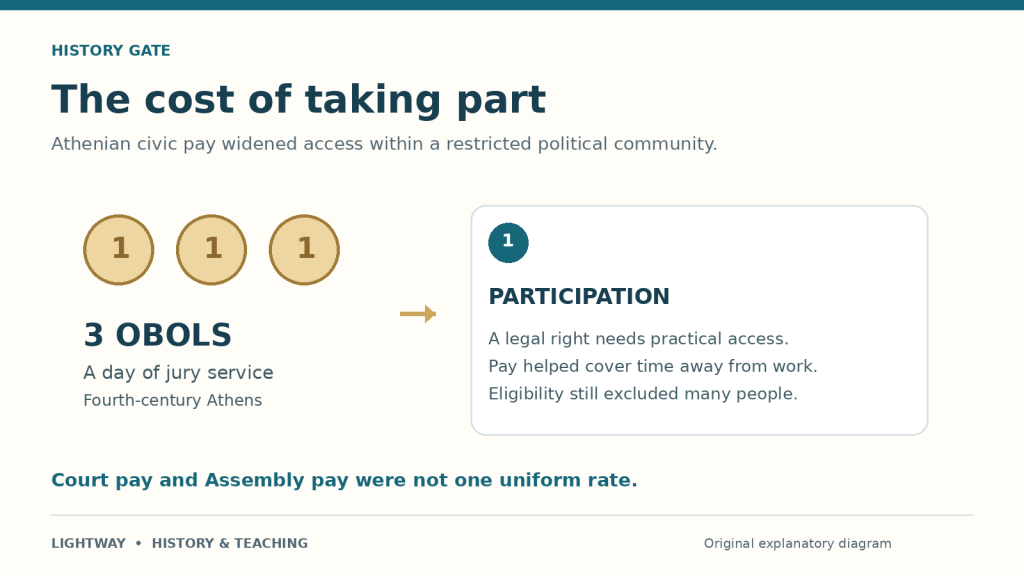
In his overview of Athenian institutions, historian Christopher Blackwell explains that fourth-century jurors received three obols for a day’s service, equivalent to half a drachma. Eligible male citizens aged at least thirty could serve without meeting a property qualification, although legal disqualifications applied.
Those details belong together. Removing a property barrier would mean less if only people with spare income could appear in court. Payment helped turn eligibility into a practical possibility for poorer citizens. It did not guarantee that everyone eligible could attend equally often.
The distinction matters whenever democracy is reduced to the question “Who could vote?” Participation also consumes time. Someone must cover work, travel, and household responsibilities while a citizen listens to a case. A formal right and the capacity to exercise it are not identical.
Payment did not make jurors professionals
The courts relied on citizen juries rather than a permanent professional jury service. Blackwell describes elaborate random allocation procedures designed to make bribery harder: prospective jurors did not simply choose their courtroom in advance. Pay and selection addressed different problems. One supported attendance; the other tried to protect the integrity of the decision.
We should resist picturing a modern courtroom with ancient clothing. The institutional arrangement was different, and the surviving descriptions concern particular periods. “Athens paid its citizens” is a starting point, not a complete account of how every democratic institution worked throughout its history.
Three obols did not always buy the same opportunity
Robert Sing’s 2021 study of fourth-century civic pay highlights a revealing contrast. Jury pay remained at three obols despite inflation, while payment for a principal Assembly meeting eventually reached nine obols. Courts and the Assembly should not be treated as if they had one uniform pay rate.
Sing argues that household circumstances help explain why men continued to volunteer for juries. Citizens with additional household labour could more readily spare the time, while those facing higher costs of absence may have participated less. This is a historical reconstruction, not a surviving attendance register proving the experience of every juror.
The implication is important: even a payment intended to broaden participation could benefit people differently. A fixed amount had different significance for different households, and its value changed over time.
Broader participation was not universal citizenship
The political community remained sharply bounded. Women, enslaved people, and resident foreigners were excluded from the citizen institutions discussed here, a boundary examined in the scholarly chapter “Other Sorts: Slaves, Foreigners, and Women in Periclean Athens.” Public pay expanded opportunities within a restricted body; it did not remove the boundary around that body. The same society could develop demanding forms of citizen participation while denying political membership to much of its population.
That tension makes Athens more instructive than either a celebration of a perfect origin or a dismissal of a failed modern democracy. Ask two questions separately: who was admitted, and what made participation possible for those admitted? The coins help answer the second question. They do not erase the first.
Explore the institutions behind the debate
The Ancient Athens: Aristocracy to Democracy lesson pack connects reforms, citizenship, political institutions, and exclusion through slides and source activities. Use civic pay as a focused question after students have distinguished the Assembly, Council, and courts.
Featured graphic: original explanatory diagram. The three coin symbols represent the documented three-obol jury payment, not reproductions of ancient coins.
