
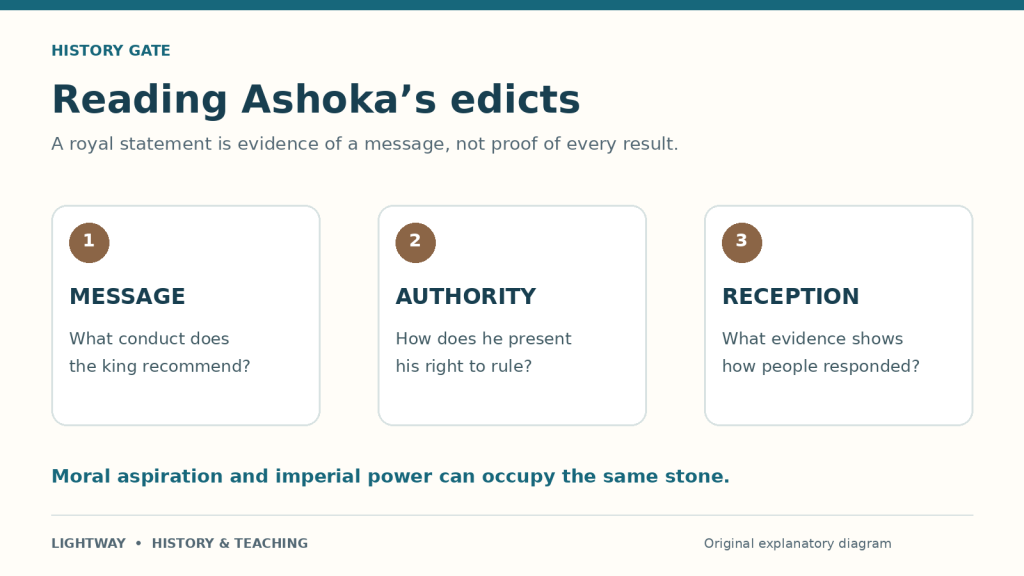
An emperor announces his remorse for a devastating conquest, then reminds people that he still possesses the power to punish. Both statements appear in Ashoka’s Rock Edict XIII. Reading them together produces a more revealing history than the simple story of a warrior who became peaceful.
Ashoka ruled the Mauryan Empire in the third century BCE. His inscriptions survive as unusually direct evidence of how a powerful ruler wanted his authority and moral programme to be understood. They are not, however, an unfiltered record of what every subject experienced.
Begin with what the inscription claims
Rock Edict XIII recounts the conquest of Kalinga and expresses sorrow over killing, deportation, and the suffering of those connected to the victims. The text then promotes conquest through dharma, or moral conduct. A translation published in Oregon State University’s ancient-civilizations sourcebook makes the tension clear: remorse does not erase the warning that royal punishment remains available.
This is a ruler speaking about his own actions. His account matters enormously, but its claims should remain attributed. The casualty figures in the edict are the inscription’s figures, not independently audited modern statistics. Its declaration of regret tells us what the king publicly communicated; it cannot give us direct access to every private motive.
A moral programme for everyday relationships
The edicts are not only about war. Rock Edict XI describes proper treatment of servants, respect for parents, generosity, and restraint toward living creatures. Rock Edict XII urges care in speech about other religious communities and a willingness to hear their teachings. These ideas can be compared in Columbia University’s selection of translated edicts.
That older translation uses “Law of Piety” for a central concept often rendered as dharma or dhamma. Translation choices matter. Readers should not assume that an English term captures every religious, ethical, and political association of the original word.
Nor should respect for different communities be automatically equated with a modern constitutional right. The instructions come from a monarch who presents himself as an authoritative moral guide. To understand their significance, keep the ancient form of government in view rather than quietly replacing it with our own categories.
Stone made the message public and durable
The Metropolitan Museum of Art’s account of the Mauryan Empire places the inscriptions within a wider programme of monumental royal communication. Messages were carved on rocks and polished sandstone pillars. Their physical form is part of the evidence: these were statements placed in the landscape, not simply thoughts preserved in a private manuscript.
A durable medium does not prove that everyone could read the words, encountered the same message, or obeyed it. It does show a commitment to making royal instructions endure. The distinction between a command and its reception is essential. To investigate reception, historians would need additional evidence, not just more confidence in the command itself.
Neither a simple confession nor an empty slogan
Calling the edicts propaganda and stopping there is no more useful than accepting every claim at face value. A public statement can serve political authority and still reveal genuine priorities, tensions, and changes in how rule is justified. The question is what each passage allows us to establish.
A careful reading separates three layers: the conduct the king recommends, the image of kingship he constructs, and the evidence still needed to judge results. Ashoka’s inscriptions are compelling precisely because those layers do not collapse into one another. Moral aspiration and imperial power occupy the same stone.
Bring the distinction into a source lesson
Lightway’s guide to teaching religious texts through distinct historical questions offers a practical starting point. Pair a short, properly attributed edict excerpt with questions about author, audience, purpose, and limits before asking students to evaluate its message.
Featured graphic: original reading framework, not a reconstruction or photograph of an Ashokan inscription. The linked translations are references; no source images or extended text are reproduced here.
