
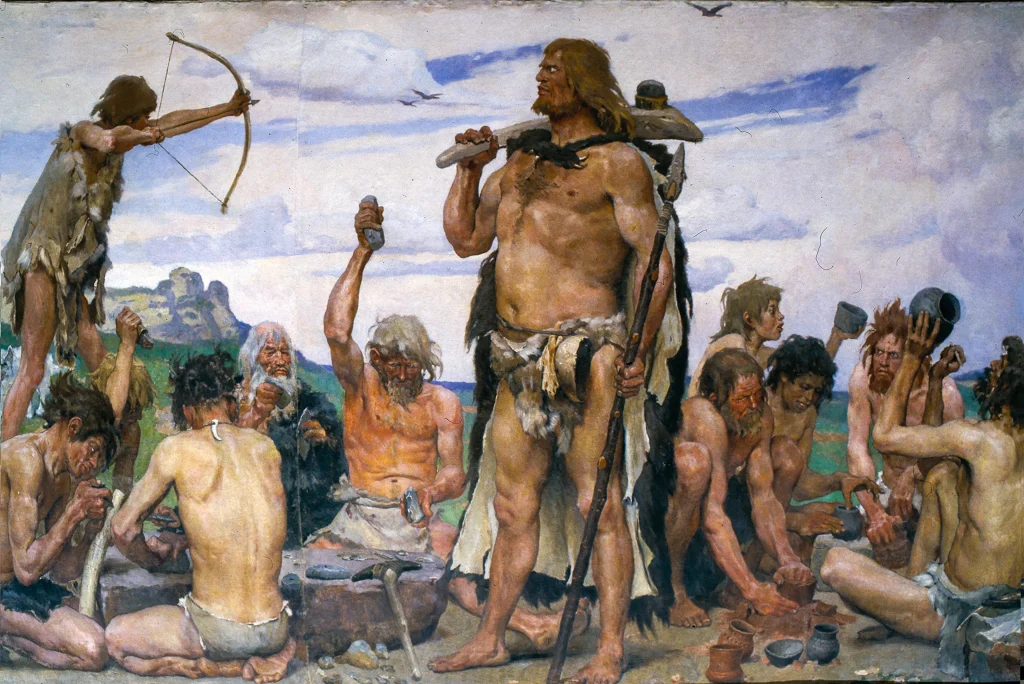
This guide is designed to help teachers use the Human Origins lesson as an evidence-based history inquiry. The emphasis is not on memorizing a long list of hominin species or dates. Instead, students learn how historians, archaeologists, paleoanthropologists, geologists, and geneticists reconstruct the deep human past from incomplete evidence.
| Recommended lesson length Two 45-55 minute class periods, or one extended 80-100 minute block. The slide deck, worksheet, interactive notebook, and task cards can be used selectively rather than all in one sitting. |
Contents
| Part | Section | What it provides |
| PART I | Teaching the Lesson | Purpose, learning goals, preparation, pacing, inquiry routines, differentiation, assessment |
| PART II | Teacher Background Information | Evidence, fossils, archaeology, dating, genetics, human family tree, Homo sapiens, migration, uncertainty |
This guide goes with our resources bundle for this lesson, you can check it here on TPT:
Human Origins: Fossils, DNA & Archaeological Evidence Lesson | Grade 6 History
Standards & Disciplinary Connection
This lesson strongly supports early-human history standards that ask students to describe what is known through archaeological studies of early human physical and cultural development. For example, California HSS 6.1 centers archaeological knowledge of human development from the Paleolithic era to the agricultural revolution, while HSS 6.1.1 includes tools and the use of fire.
- Historical inquiry: distinguish evidence from interpretation.
- Chronological reasoning: use relative and chronometric dating concepts.
- Cause and change: connect anatomy, technology, environment, migration, and population interaction.
- Evidence-based writing: support claims with fossils, artifacts, site context, or genetic evidence.
PART I – TEACHING THE LESSON
1. Instructional Purpose
Human origins can easily become either a biology lecture or a memorization-heavy timeline. For a middle school history course, the most productive focus is disciplinary: How do we know anything about people who lived before written records? The lesson therefore treats fossils, artifacts, archaeological context, dating methods, and DNA as historical evidence.
By the end of the lesson, students should understand both the power and the limits of evidence. They should be able to explain that a footprint, fossil pelvis, stone flake, hearth, or DNA sequence does not automatically provide a complete story. Researchers make carefully supported inferences, compare multiple lines of evidence, and revise explanations when new discoveries appear.
2. Learning Objectives
- Identify fossil, archaeological, and genetic evidence used to investigate the deep human past.
- Explain what different types of fossil eviadence can reveal about anatomy, movement, and possible diet.
- Explain how tools, hearths, food remains, and site context can reveal ancient behavior.
- Describe the basic difference between relative dating and chronometric dating.
- Explain how ancient and modern DNA provide evidence for ancestry, migration, and interbreeding.
- Describe human evolution as a branching family tree rather than a straight ladder.
- Distinguish a direct observation from an evidence-based inference and from an unresolved question.
- Construct a short claim supported by relevant evidence.
3. Core Vocabulary
| Term | Teacher-friendly meaning |
| prehistory | the period before written records |
| fossil | preserved remains or traces of past organisms |
| artifact | an object made, modified, or used by humans |
| archaeology | the study of past human life through material remains and their context |
| paleoanthropology | the study of human evolution using fossils and related evidence |
| hominin | humans and the extinct species more closely related to humans than to chimpanzees |
| bipedal | walking primarily on two legs |
| context | where evidence was found and what was associated with it |
| relative dating | placing evidence in an older-younger sequence |
| chronometric dating | using physical methods to estimate a numerical age |
| DNA | genetic information inherited across generations |
| inference | a conclusion drawn from evidence |
4. Materials & Preparation
- 30-slide lesson deck.
- Student worksheet set.
- Interactive notebook pages, if using the cut-and-paste review option.
- Task cards for stations, small-group discussion, or early finishers.
- Optional: printed or projected images of a fossil skull, Lucy, Laetoli footprints, a stone tool, a hearth excavation, and a DNA strand.
- Optional: three evidence labels posted around the room – FOSSIL, ARCHAEOLOGICAL, GENETIC.
Before class, decide whether students will complete the worksheet during direct instruction or after the lesson as independent practice. For a shorter class, use only selected worksheet pages and save task cards for the following day.
5. Recommended Teaching Sequence
| Phase | Time | Teacher move |
| A. Evidence Mystery Hook | 8-10 min | Show several clues without explanation: a fossil bone, footprint, stone tool, and ancient DNA sample. Ask students what each clue could reveal and what it could not reveal. Establish the essential question. |
| B. Build the Evidence Framework | 10-12 min | Teach the three evidence families: fossils, archaeology, and genetics. Introduce evidence versus inference. Use quick oral checks rather than lengthy note-taking. |
| C. Fossil Case Studies | 15-18 min | Use Lucy and Laetoli to model how anatomy and trace fossils support conclusions about bipedalism. Emphasize that one fossil is not the whole story. |
| D. Archaeology & Dating | 15-18 min | Move from bodies to behavior: stone tools, fire, site context, and dating. Ask students to infer activity from a small cluster of site evidence. |
| E. DNA & the Branching Human Family | 15-18 min | Introduce ancient DNA through Neanderthals and Denisovans. Use this to replace the old ‘ladder’ model with a branching-and-reconnecting family tree. |
| F. Synthesis & Exit Ticket | 10-15 min | Students classify evidence, match evidence to conclusions, then write a short response naming what one evidence type can and cannot establish. |
6. High-Leverage Teaching Routine: Evidence -> Inference -> Uncertainty
Use the same three-step routine repeatedly throughout the lesson. It keeps the content historical and prevents students from treating every reconstruction as a directly observed fact.
- Evidence: What was actually discovered or measured?
- Inference: What conclusion does that evidence reasonably support?
- Uncertainty: What can this evidence not establish by itself?
| Example Evidence: preserved Laetoli footprints. Inference: the individuals walked upright. Uncertainty: the footprints alone do not tell us their language, beliefs, or complete way of life. |
7. Discussion Questions
- Why might a partial skeleton be more useful for some questions than a single tooth?
- Why is the location of an artifact important?
- What makes two independent lines of evidence stronger than one?
- Why can scientists disagree even when they are studying the same fossils?
- How did ancient DNA change ideas about Neanderthals and Denisovans?
- Why is a branching tree a better model for human evolution than a ladder?
- When should a historian say ‘we do not know yet’?
8. Using the Companion Resources
| Resource | Best use | Teacher tip |
| Worksheet | Guided practice or independent check | Assign selected pages during the lesson; use the final synthesis page after the deck. |
| Interactive Notebook | Compact concept organization | Use after instruction to consolidate vocabulary, evidence categories, and key case studies. |
| Task Cards | Retrieval, stations, partner talk, early finishers | Mix factual cards with evidence-reasoning cards. Ask students to justify answers aloud. |
| Quick Review Slides | Whole-class formative assessment | Use thumbs, mini-whiteboards, or turn-and-talk before revealing or discussing answers. |
| Exit Ticket | Individual evidence-based response | Collect to identify whether students can distinguish what evidence shows from what remains uncertain. |
9. Differentiation & Support
For students who need more support
- Preteach only the highest-value terms: fossil, artifact, archaeology, DNA, inference, bipedal.
- Use sentence frames: ‘The evidence is ____. This suggests ____ because ____.’
- Allow students to sort illustrated evidence cards before writing definitions.
- Reduce writing load while preserving reasoning: one claim + one evidence sentence is sufficient.
- Pair abstract concepts such as DNA or dating with a concrete visual example.
For advanced learners
- Ask students to compare two evidence types and evaluate which is stronger for a specific question.
- Introduce preservation bias: some environments and materials survive much better than others.
- Have students distinguish ‘absence of evidence’ from ‘evidence of absence.’
- Ask students to revise a claim after receiving a new piece of evidence.
- Investigate a current debate about early Homo sapiens populations, Denisovan fossils, or early toolmakers.
For multilingual learners
- Use labeled diagrams and real evidence images before dense text.
- Keep recurring language structures consistent: evidence / suggests / cannot prove.
- Permit first-language discussion before English written responses.
- Use cognates where useful: archaeology, genetic, fossil, migration, species.
10. Common Misconceptions to Correct
| Misconception | Correction |
| Humans evolved from chimpanzees. | Humans and chimpanzees share an older common ancestor; living chimpanzees are not our ancestors. |
| Human evolution is a straight ladder. | The evidence shows a branching family tree with multiple lineages, some overlapping in time. |
| Lucy was the first human. | Lucy is an important Australopithecus fossil, not a single starting point for humanity. |
| Every stone tool can be matched to one species. | Many sites do not preserve enough evidence to identify the exact toolmaker. |
| A burned object automatically proves controlled fire. | Researchers must distinguish natural burning from repeated, patterned human fire use. |
| DNA gives a complete history. | DNA is powerful but preservation is uneven, samples are limited, and genetics cannot directly reveal every behavior or belief. |
| Scientists disagree because the evidence is unreliable. | Scientific disagreement often concerns how incomplete evidence should be interpreted, not whether evidence matters. |
11. Assessment Guidance
Prioritize reasoning over memorization. A student who remembers a date but cannot explain what the evidence supports has not yet reached the central goal of this lesson.
| Performance level | What to look for |
| Beginning | Identifies some evidence but mixes fossils, artifacts, and DNA or gives unsupported claims. |
| Developing | Correctly identifies evidence types and gives a basic inference, but explanation is incomplete. |
| Proficient | Uses relevant evidence to support a clear conclusion and states at least one limitation or uncertainty. |
| Advanced | Compares multiple evidence types, evaluates strength or limitations, and explains how new evidence could revise a conclusion. |
12. Handling Sensitive or Belief-Based Questions
Students may connect human origins to family, cultural, or religious beliefs. Keep the classroom discussion respectful and focused on the disciplinary task of the lesson: what empirical evidence can be studied using archaeology, fossils, geology, and genetics. Teachers do not need to ask students to compare or disclose personal beliefs. A useful redirect is: ‘In this history lesson, our question is what the available physical evidence allows researchers to conclude.’
PART II – TEACHER BACKGROUND INFORMATION
The following background is written as a teacher reference rather than student-facing text. It provides the conceptual and factual context needed to explain the lesson accurately, answer common questions, and avoid outdated models of human origins.
1. Reconstructing the Deep Human Past
Most of human history occurred before writing. For this reason, the study of human origins depends on material and biological evidence rather than written testimony. Archaeologists investigate sites, objects, food remains, sediments, hearths, and other traces of human activity. Paleoanthropologists study fossil members of the human family and compare their anatomy. Geologists help establish environmental context and chronology. Geneticists compare DNA from living people and, when preservation permits, DNA recovered from ancient bones, teeth, or sediments.
These fields do not operate independently. A strong reconstruction may combine a fossil’s anatomy, its geological age, nearby artifacts, chemical or microscopic traces, and genetic data. The most important habit for students to learn is that evidence has to be interpreted. A fossil is an observation; a statement about how its owner moved is an inference. A stone flake is an observation; a statement that it was used to butcher an animal requires additional evidence such as edge wear, residues, or cut marks on associated bones.
| Teacher framing The deep past is not ‘unknown’ simply because it lacks writing. It is known differently – through converging physical evidence. |
2. Fossils and the Human Family Tree
Fossils provide direct anatomical evidence from extinct populations. Teeth, jaws, skulls, pelvises, limb bones, hands, feet, and even fossilized footprints can answer different questions. Pelvis and leg anatomy are especially informative about bipedal locomotion; teeth can offer clues about diet and development; skulls allow researchers to compare face shape, braincase form, and chewing adaptations.
The fossil record is substantial but incomplete. Fossilization is rare, erosion destroys evidence, many ancient landscapes are inaccessible, and discoveries are often fragmentary. As a result, scientists may disagree about whether two groups represent separate species or about the precise relationships among branches. This uncertainty concerns the details of the tree, not the existence of an evolutionary history. Modern evidence strongly rejects the old ‘march of progress’ image in which one species simply turns into the next in a straight sequence.
The term hominin is useful in this lesson. It refers to humans and extinct species on the human side of the family tree after the lineage shared with chimpanzees and bonobos diverged. Teachers should avoid describing living apes as human ancestors. Humans and chimpanzees share an older common ancestor; neither living species evolved from the other.
3. Bipedalism: Lucy and Laetoli
One of the clearest long-term changes in early human evolution is habitual bipedalism. Upright walking appeared long before the large brains, complex technologies, and global dispersal associated with later members of the genus Homo.
Lucy, cataloged as AL 288-1, is a partial skeleton of Australopithecus afarensis discovered at Hadar, Ethiopia, in 1974 and dated to about 3.2 million years ago. The skeleton combines features associated with upright walking – including the pelvis and femur – with upper-body and toe features consistent with substantial climbing ability. This makes Lucy especially useful for showing students that evolutionary change is a mosaic: different features can change at different rates.
The Laetoli footprints in Tanzania provide another line of evidence. Footprints preserved in volcanic ash around 3.6 million years ago show a bipedal walking pattern. They are powerful for teaching evidence versus inference because students can see the physical trace and then ask what locomotion it supports. They do not, by themselves, reveal the full social life, language, or identity of the individuals who made them.
4. The Genus Homo: A Short Teacher Orientation
Middle school courses often introduce a small number of representative Homo species. The purpose should be to show change and diversity rather than require students to memorize every taxonomic debate.
| Group | What teachers should emphasize |
| Homo habilis | Traditionally associated with early Homo and Oldowan stone technology. The exact boundaries of the species and which hominins made the earliest tools remain debated. |
| Homo erectus | A long-lived and geographically widespread Homo lineage associated with larger bodies, efficient bipedalism, dispersal beyond Africa, and major technological changes. Some classifications distinguish African fossils from Asian H. erectus; taxonomy remains debated. |
| Neanderthals | A distinct Eurasian human lineage with sophisticated technologies and strong adaptations to varied environments. They overlapped and interbred with Homo sapiens. |
| Denisovans | An ancient population first recognized through genetic evidence from Denisova Cave. Fossils remain comparatively scarce, making their anatomy and geographic range an active research area. |
| Homo sapiens | Our species, present in Africa by roughly 300,000 years ago and later dispersed widely. Fossil and genetic evidence indicate interaction and interbreeding with other human populations. |
5. Archaeology: From Objects to Behavior
Archaeological evidence helps move the lesson from anatomy to behavior. Stone tools can reveal planning, raw-material choices, cutting or processing activities, and technological traditions. Animal bones may preserve cut marks or percussion marks. Plant remains, ash, hearths, postholes, pigments, beads, and shelters can provide clues about diet, fire use, occupation patterns, symbolism, or social life.
Context is essential. An isolated object has less interpretive value than an object whose geological layer, associated remains, and position are documented. For example, a sharp stone flake beside animal bones with cut marks provides a stronger case for butchery than a stone flake found alone. Students should learn that archaeologists record spatial relationships before removing objects because excavation is destructive: once a layer is dug, its original arrangement cannot be recreated.
6. Stone Tools and the Problem of the Toolmaker
Stone technology extends deep into the hominin past. The earliest widely discussed stone-tool traditions include very early sites more than three million years old. This creates an important historical reasoning problem: the earliest tools are older than, or overlap with, several candidate hominin species. A tool therefore cannot always be assigned to a particular species merely because a fossil species lived in the same broad region and period.
This is an excellent place to teach cautious language. ‘This species made the tool’ may be too strong; ‘this species is one possible toolmaker’ may fit the evidence better. Later technologies, such as Acheulean handaxes and more specialized stone industries, show long-term changes in tool production, but technological traditions do not map perfectly onto biological species.
7. Fire: Strong Evidence, Difficult Beginnings
Controlled fire profoundly affected human life by providing heat, protection, light, new food-processing possibilities, and potentially social gathering places. Determining the earliest controlled fire is difficult because natural wildfires also burn vegetation, bones, and stone. Researchers therefore look for repeated burning, patterned concentrations, hearth-like features, altered artifacts, and other contextual clues.
For middle school students, avoid presenting a single date as ‘the invention of fire.’ A better formulation is that evidence for controlled fire becomes clearer at some later archaeological sites, while the exact timing of its first use and the point at which it became habitual remain areas of research.
8. Dating the Evidence
Relative dating establishes sequence. In undisturbed sedimentary layers, lower layers are generally older than those above them. Cross-cutting features, erosion, animal burrows, later digging, or geological disturbance can complicate that simple rule, so archaeologists study stratigraphy carefully.
Chronometric methods estimate numerical ages using measurable physical processes. Different techniques work over different time ranges and on different materials. Radiocarbon dating is valuable for relatively recent organic remains but is not used to date fossils millions of years old. Much older sites may be dated using volcanic deposits, potassium-argon or argon-argon methods, paleomagnetism, luminescence, or other techniques. A date is usually an estimate with a range of uncertainty, not a perfectly exact birthday for an artifact or fossil.
| Common classroom correction Do not say that ‘carbon dating’ is how scientists date all ancient human fossils. Radiocarbon has a limited time range; much older sites require other methods. |
9. Genetics and Ancient DNA
Genetic evidence transformed human-origins research because it provides a different kind of record from bones and tools. Comparisons among living people can reveal shared ancestry and population history. Ancient DNA, when preserved, allows researchers to compare genomes from people who lived thousands or tens of thousands of years ago.
Ancient DNA survives unevenly. Cool, stable environments often preserve it better than warm, humid settings, and contamination must be carefully controlled. For this reason, the genetic record is also biased. A region with little ancient DNA is not necessarily a region where few people lived.
Genetics has been especially important for understanding Neanderthals and Denisovans. Neanderthal genomes showed that some Homo sapiens populations interbred with Neanderthals. Denisovans were initially recognized as a distinct ancient population largely through DNA from very limited fossil material. Later genetic work also demonstrated gene flow among Denisovan, Neanderthal, and Homo sapiens populations. The resulting picture is not one of permanently isolated species boxes, but of branching populations that sometimes met and exchanged genes.
10. Homo sapiens and African Origins
Fossil and genetic evidence strongly support an African origin for Homo sapiens. Fossils attributed to early Homo sapiens show that our species was present in Africa by roughly 300,000 years ago. Jebel Irhoud in Morocco is especially useful for teaching because its fossils combine a relatively modern-looking face with a more elongated braincase. The site helped push the recognized age of Homo sapiens further back and broadened discussion of where within Africa important populations lived.
Teachers should avoid replacing one oversimplification with another. Current research does not require imagining a single tiny ‘birthplace’ where fully modern humans suddenly appeared. A more accurate middle-school framing is that Homo sapiens emerged through populations living and interacting across Africa over long periods. The exact population structure and relationships are still being refined as new fossils and genomes are studied.
11. Migration Beyond Africa
Homo sapiens eventually dispersed beyond Africa and established populations across Eurasia, Sahul, and later the Americas. This expansion was not a single one-directional journey. Evidence points to multiple movements, changing routes, population contractions, later migrations, and gene flow back and forth between regions.
For a general history lesson, broad arrows on a map are more defensible than a single precise migration line. Routes depended on climate, coastlines, sea levels, food availability, and geographic barriers. During Ice Age periods, coastlines and land connections differed from those of the modern world. Migration maps should therefore be presented as models summarizing evidence rather than literal records of the exact path taken by every population.
12. What Is Well Supported – and What Remains Open?
| Level | Examples |
| Strongly supported | Humans belong to a branching evolutionary family; bipedalism appeared millions of years before Homo sapiens; Homo sapiens has African origins; multiple human lineages coexisted; some Homo sapiens populations interbred with Neanderthals and Denisovans. |
| Often inferred from context | Specific tool functions, repeated site occupation, social uses of fire, some aspects of diet and activity. |
| Active research / uncertainty | Precise relationships among some fossil groups; taxonomic labels; exact makers of some early tools; timing and frequency of the earliest controlled fire; detailed structure of early Homo sapiens populations and some migration episodes. |
This distinction is pedagogically important. Science becomes more trustworthy, not less, when researchers identify uncertainty. A claim can be well supported while details remain open. New discoveries may change a date, add a branch, connect two populations, or overturn an older explanation without erasing the larger body of converging evidence.
13. Language Choices That Improve Accuracy
| Avoid | Use instead |
| ‘Primitive people’ | ‘early humans,’ ‘ancient human populations,’ or the specific group name |
| ‘Missing link’ | ‘fossil species,’ ‘population,’ or ‘branch of the human family tree’ |
| ‘Humans came from chimpanzees’ | ‘humans and chimpanzees share an older common ancestor’ |
| ‘Evolution is a ladder’ | ‘human evolution is a branching family tree’ |
| ‘Scientists proved exactly…’ | ‘the evidence strongly supports…’ when uncertainty remains |
| ‘The first person to…’ | ‘the earliest evidence currently known for…’ |
14. Teacher Reference: Key Case Studies at a Glance
| Case study | Place | Approx. age | Why it matters |
| Lucy (AL 288-1) | Hadar, Ethiopia | ~3.2 million years ago | Partial Australopithecus afarensis skeleton; locomotion and mosaic anatomy. |
| Laetoli footprints | Tanzania | ~3.6 million years ago | Trace fossils supporting upright, heel-to-toe bipedal walking. |
| Gesher Benot-Ya’aqov | Israel | ~790,000 years ago | Important evidence for patterned fire use at an archaeological site. |
| Jebel Irhoud | Morocco | ~300,000 years ago | Early Homo sapiens fossils; important to the timing and geography of our species’ origins. |
| Denisova Cave | Siberia | Late Pleistocene | Ancient DNA helped identify Denisovans and reconstruct interaction among ancient human populations. |
15. Selected Teacher Sources
For updating examples or checking current scientific interpretations, consult primary institutional resources rather than unsourced diagrams or simplified commercial timelines.
- Smithsonian Institution, Human Origins Program – Human Evolution Evidence: https://humanorigins.si.edu/evidence
- Smithsonian Institution, Human Origins Program – Human Fossils: https://humanorigins.si.edu/evidence/human-fossils
- Smithsonian Institution, Human Origins Program – Genetics: https://humanorigins.si.edu/evidence/genetics
- Smithsonian Institution, Human Origins Program – Ancient DNA and Neanderthals: https://humanorigins.si.edu/evidence/genetics/ancient-dna-and-neanderthals
- Smithsonian Institution, Human Origins Program – Homo sapiens: https://humanorigins.si.edu/evidence/human-fossils/species/homo-sapiens
- Smithsonian Institution, Human Origins Program – Lucy (AL 288-1): https://humanorigins.si.edu/evidence/human-fossils/fossils/al-288-1
- California Department of Education – History-Social Science Standard HSS 6.1 and 6.1.1: https://www2.cde.ca.gov/cacs/history
| Final teacher takeaway Teach students to ask three questions again and again: What is the evidence? What conclusion does it support? What remains uncertain? |
