
Practical teaching ideas
Help middle-school students distinguish religious meaning, literary interpretation, and historical evidence through a practical question-sorting routine.
A religious text can matter to a believer, interest a literary reader, and provide evidence for a historian. Those uses overlap, but they do not ask exactly the same questions. In a middle-school history classroom, confusion often begins when students think they must decide whether a religion is true before they can study a text connected to it.
A more useful opening is: “What kind of question are we trying to answer, and what evidence would help?” This lesson routine gives students three question types: religious meaning, literary interpretation, and historical investigation. It supports academic discussion without requiring students to share their beliefs or speak for a religious community.
Set the purpose before displaying a passage
Tell the class: “We are studying how texts have been read, used, and understood. Your assessment concerns evidence and explanation. You are not being graded on personal belief.” This is a classroom framing suggestion, not a substitute for your school’s curriculum or local guidance.
The American Academy of Religion’s K–12 teaching guidelines distinguish an academic, nonsectarian approach from devotional instruction. For practical planning, that means keeping historical and literary tasks explicit and avoiding activities that require students to enact religious observances.
Before teaching, check the translation, edition, date, and permission to reproduce the passage. An ancient work can be out of copyright while a modern translation is protected. Use a lawful classroom excerpt or an accessible authorized link. Keep the excerpt short enough that students can inspect its wording closely.
Use three question types, not three sealed boxes
Religious meaning: How has a particular community understood the passage’s significance? The answer needs an identified tradition, community, or interpreter. It is different from asking a student to affirm that interpretation personally.
Literary interpretation: How do features such as repetition, imagery, a narrator, or the organization of a passage shape meaning? The passage itself supplies evidence, although translation choices and context matter.
Historical investigation: What can the text, its surviving manuscripts, or evidence of its use help us understand about a particular period? This requires questions about when something was written, copied, collected, translated, or interpreted.
One passage can support all three kinds of inquiry. The point is to choose evidence that fits the question rather than treating the categories as ranks of importance.
A 30-minute question-sorting routine
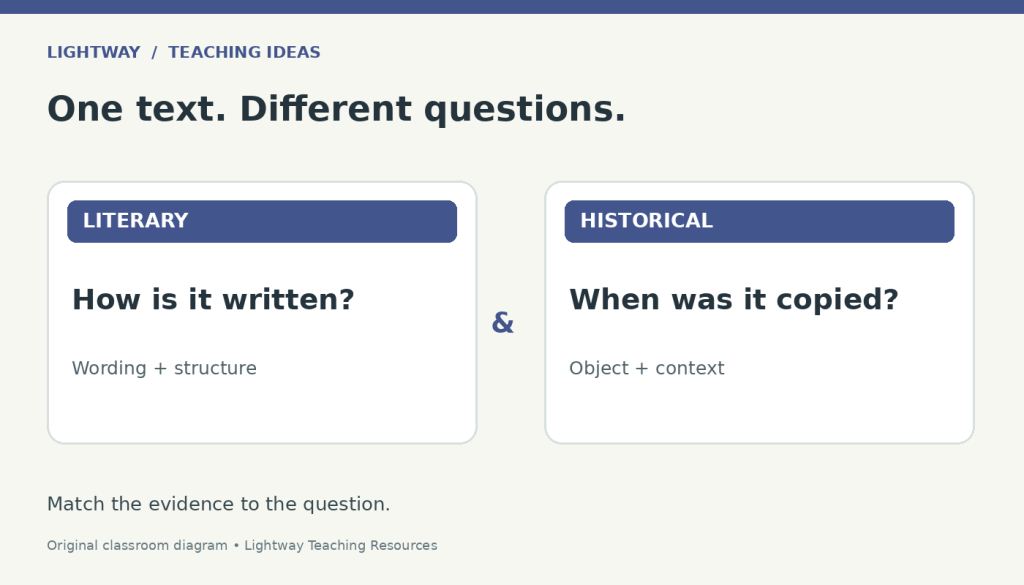
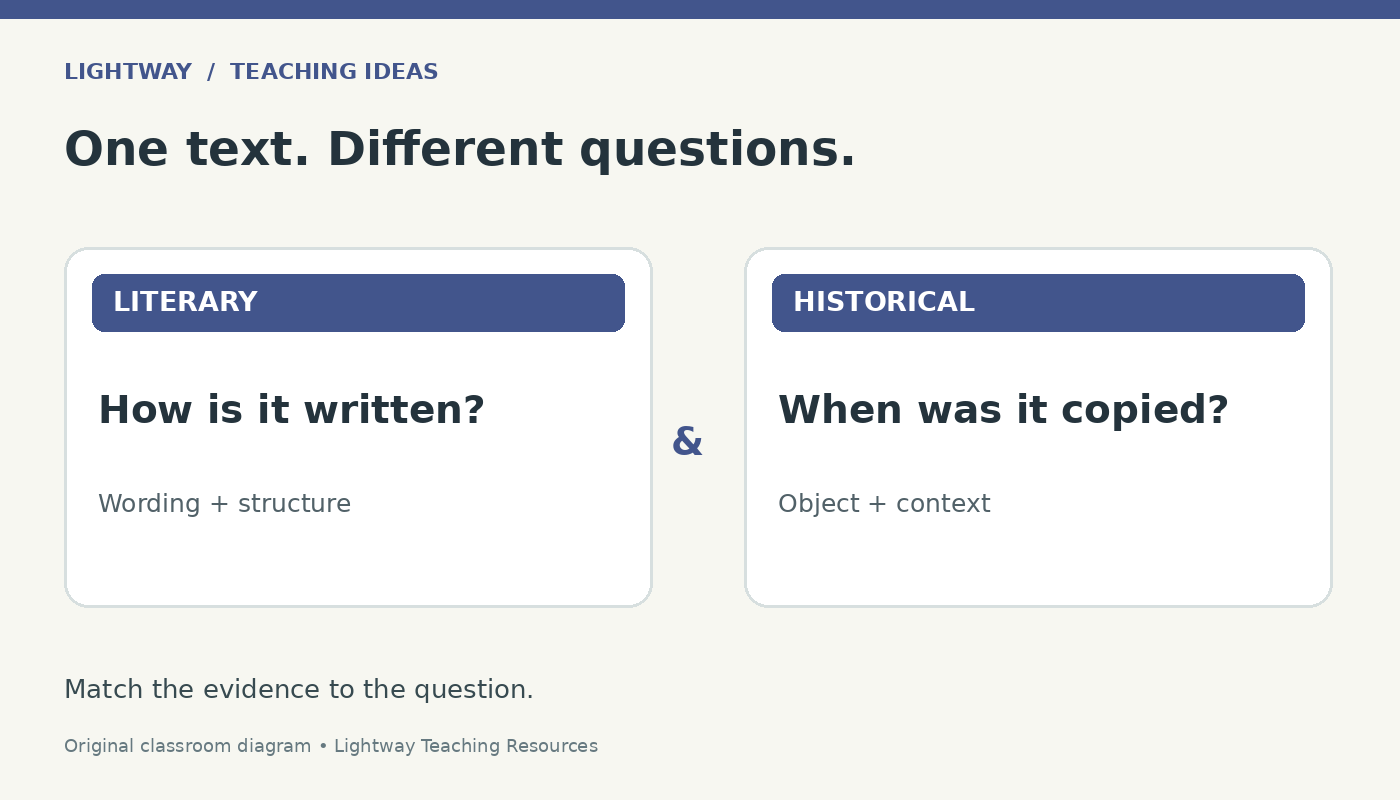
Begin with five minutes of modeling. Write this teacher-created question on the board: “Why does this poem repeat a phrase?” Classify it as primarily literary because students would examine wording and structure. Then write: “When was this surviving copy produced?” Classify it as historical because answering it requires information about the manuscript and its dating.
Next, give pairs these six prompts. They are original classroom prompts, not quotations from a religious source:
- Which repeated image creates a contrast in this passage?
- How does one named community interpret this passage today?
- What language is used in the surviving manuscript?
- How does the narrator present a character’s decision?
- What evidence dates the physical copy we are viewing?
- How did a particular interpreter explain this passage in a documented setting?
Allow eight minutes for pairs to classify each prompt and name the evidence they would consult. Do not award points simply for placing a card under a heading. The evidence explanation is the important part.
During the next seven minutes, compare answers. Prompts 1 and 4 are mainly literary; 3 and 5 are historical/material. Prompt 2 primarily concerns religious interpretation, though the community’s context matters. Prompt 6 can connect religious meaning and history. Accept an overlapping classification when students explain it precisely.
Spend the final ten minutes applying one literary question and one historical question to your selected authorized passage or manuscript image. End with a short written reflection about why the two answers require different evidence.
Keep three dates distinct
A text may describe an event, have a complex history of composition, and survive in a physical copy made later. Put those three labels on the board: period described, composition or development, and surviving copy. Do not assume one date establishes the other two.
For a source-based example, the Library of Congress exhibition on the Dead Sea Scrolls gives students a way to examine manuscript objects with contextual information. This is an archived 1993 exhibition, so distinguish its object information from newer scholarly debates. Preview the specific scroll record before class and use its stated dating rather than inventing an exact year. A copy is evidence for the text’s transmission at that time; additional reasoning and evidence are needed to make claims about the period narrated in the text.
Ask students to finish this sentence: “The date of this manuscript tells us ____, but it does not automatically tell us ____.” A suitable answer is: “It helps date the physical copy, but it does not automatically date the events described.”
Improve language that makes whole traditions sound uniform
Harvard’s Religion and Public Life core principles emphasize diversity within traditions, change over time, and the connection between religion and culture. Turn these ideas into an editing habit rather than a list students memorize.
Compare “All members of this religion understand the passage the same way” with “This interpreter presents one understanding of the passage.” Ask what evidence would be required for the word “all.” Usually, students will recognize that a single text or speaker cannot establish universal agreement.
Similarly, replace timeless statements with located ones: identify a place, period, community, and source where possible. “This text was important” becomes more useful when students explain to whom, for what purpose, and according to what evidence. Do not treat a living student as the missing source. Invite analysis of supplied materials instead of asking anyone to represent an entire tradition.
Respond to difficult questions without turning the lesson into a debate over belief
If a student asks, “But did this miracle really happen?”, acknowledge the question and return to the task: “Different people approach that through faith and other commitments. Our historical question today concerns what the source says, when this copy was produced, and how it was used.” Avoid claiming that historical methods settle every theological question.
If students disagree about an interpretation, ask them to identify whose interpretation it is and which evidence supports their description. You can assess whether they accurately represent a viewpoint without deciding that the viewpoint is religiously correct.
For students needing language support, provide “The passage suggests…,” “This interpreter argues…,” and “The object record dates…” as distinct sentence starters. For extension, ask students to show how a translation choice could affect a literary observation and what they would need to investigate that possibility.
A three-point exit ticket
Ask students to write one question about literary form, one about historical context, and one evidence limitation. A strong response might ask how repetition works, when a manuscript was copied, and why one manuscript does not demonstrate how every community interpreted it.
For a prepared sequence using the Hebrew Bible, Lightway’s religion, literature, and historical-source lesson develops these distinctions. Teachers planning a later historical setting can also consult the Rome and Christendom series overview.
The goal is a classroom in which students can ask precise questions, describe perspectives fairly, and explain the limits of evidence. That is useful historical work whether students share a faith, follow different traditions, or do not identify with a religion.
Quick check: Does the date of a manuscript automatically date the events it describes?
No. The physical copy, the development of the text, and the period described may belong to different times. Each needs evidence suited to that question.
Sources for teachers
- American Academy of Religion’s K–12 teaching guidelines
- Library of Congress exhibition on the Dead Sea Scrolls
- Religion and Public Life core principles
The classroom sequence and diagrams are original teaching suggestions, not a tested intervention or a guarantee of learning outcomes.
