
Practical teaching ideas
Use a later Persian relief to challenge a common misconception about Salamis. A 35-minute timeline inquiry with evidence cards, model answers, and an exit ticket.
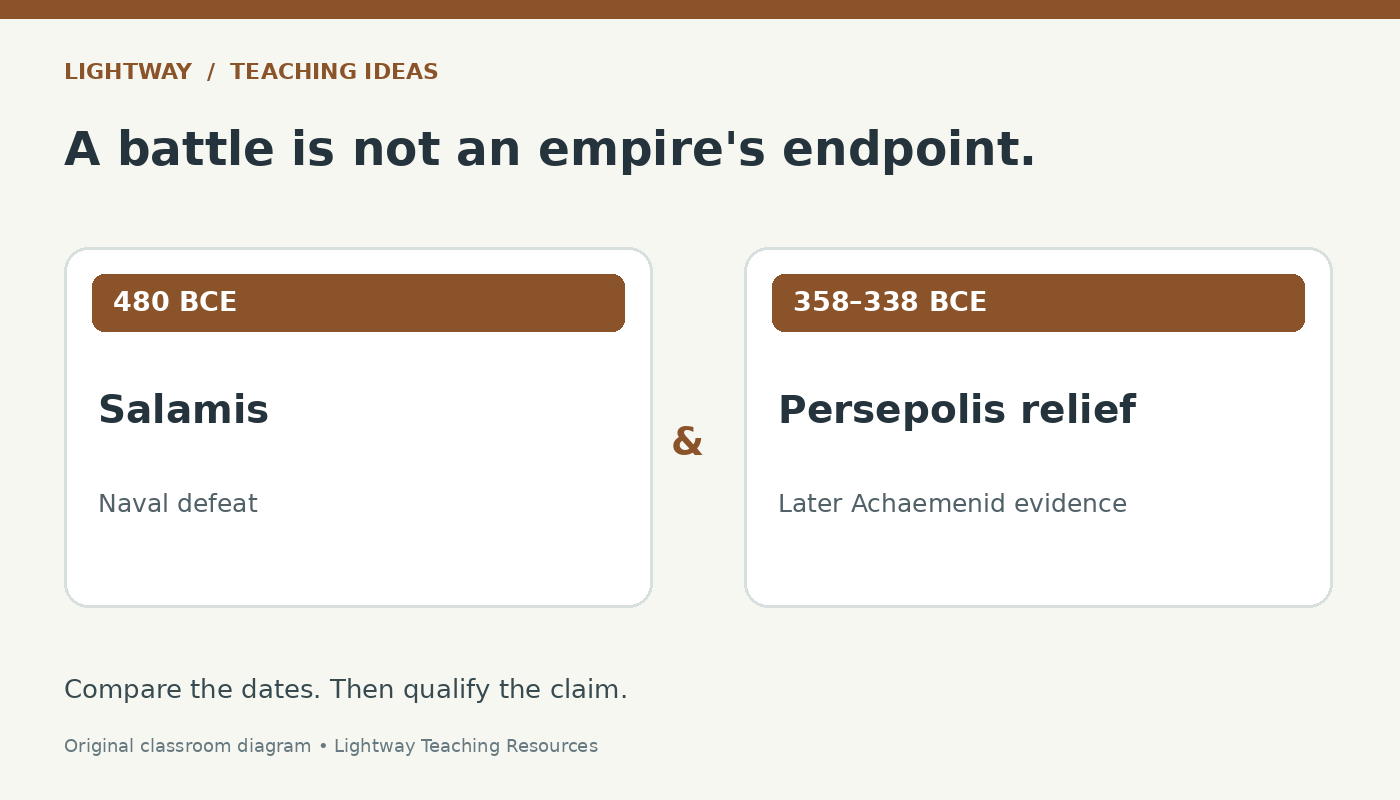
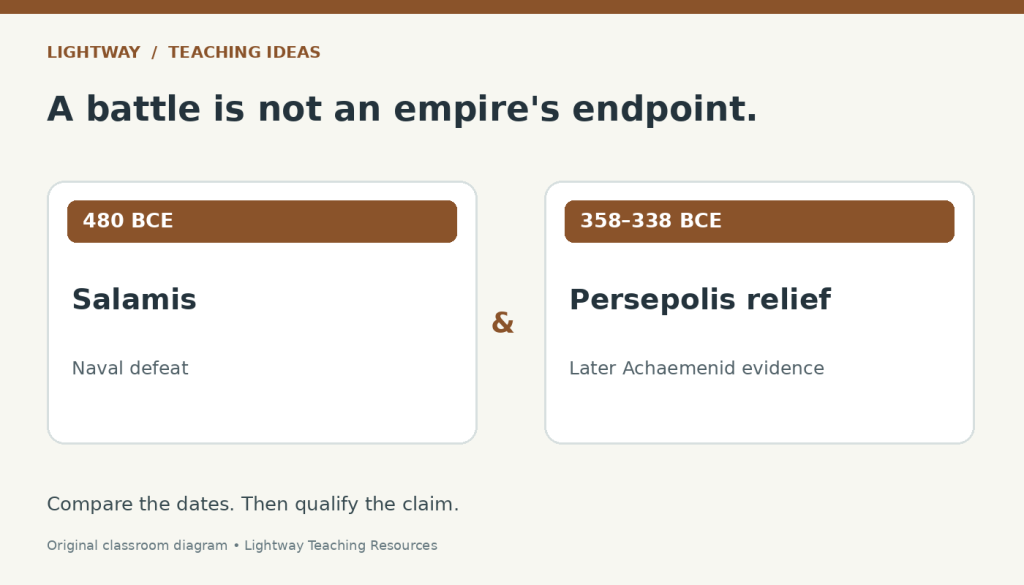
Students often turn the last event on a classroom slide into the end of a civilization. A Persian Wars lesson finishes with Greek victories, and Persia seems to disappear. The problem is partly one of scale: a battle, a military campaign, and the history of an empire are different kinds of stories. A useful follow-up activity asks students to test a specific claim: “The Persian Empire ended when the Greeks won at Salamis.”
The claim is wrong, but simply correcting it misses a teaching opportunity. Let students work out why it is wrong by comparing a battle date with a much later Persian object. This 35-minute activity combines chronology, artifact observation, and cautious historical writing. It needs a projected museum image, paper, and a timeline. No reenactment or elaborate map is necessary.
The historical correction to establish first
The naval Battle of Salamis took place in 480 BCE. Greek forces defeated the Persian fleet; this was a major event in the invasion of Greece, not the destruction of the Achaemenid Empire. The Oxford Bibliographies overview of Salamis identifies the battle and its date. The Achaemenid political story continued into the fourth century BCE, ending with Alexander’s conquest and the death of Darius III in 330 BCE.
The Metropolitan Museum’s overview of the Achaemenid Empire helps teachers place Greek campaigns within this longer history of imperial government, building, and political change. One detail requires care: its essay gives Salamis as 479 BCE. Use 480 BCE, corroborated by Oxford, for the classroom timeline. This small discrepancy is also a reminder that reputable sources still need checking.
Do not replace one oversimplification with another. The empire’s survival does not make Salamis unimportant. The better question is: important for which people, in which place, and over what period?
Prepare three evidence cards
Write the following cards in your own words. These are teacher-created summaries of the linked sources, not ancient quotations.
- Card A: A battle. At Salamis in 480 BCE, a Greek allied fleet defeated Persian naval forces.
- Card B: A later object. The Met holds a limestone relief from Persepolis, dated approximately 358–338 BCE, showing two servants carrying food and drink.
- Card C: A longer political timeline. Achaemenid kings continued ruling after the campaigns in Greece. Alexander’s conquest brought the empire to an end in the 330s BCE; the conventional terminal date is 330 BCE.
Keep the source label on every card. Ask students to distinguish a modern museum description from the ancient object it describes. The photograph, the carved stone, and the museum’s dating are related evidence, but they are not identical things.
Minutes 0–5: Diagnose the misconception
Display the claim about Persia ending at Salamis. Ask students to choose “supported,” “contradicted,” or “not enough information yet,” and write one sentence explaining their choice. Do not grade the first response for factual recall. Use it to uncover their reasoning.
A student may say, “They lost, so their empire was gone.” Record that causal step on the board: military defeat → end of empire. Ask what additional evidence would be needed to establish the second part. Possible answers include the loss of government, the removal of rulers, or conquest of the empire’s territories. A battle result alone does not supply all of that evidence.
Minutes 5–12: Build a timeline that makes the gap visible
Mark 500 BCE and 300 BCE on a horizontal line. Have students place 480 BCE near the earlier end, then shade the interval 358–338 BCE, and finally place 330 BCE. Explain that larger BCE numbers come earlier: the numbers decrease as the timeline moves forward.
Ask: “Was the relief made before or after Salamis?” The answer is after. “Approximately how much later?” The range is about 122–142 years after 480 BCE. Students do not need to force an approximate museum date into one exact year. Represent the uncertainty as a band.
Then ask: “If this is an Achaemenid royal-site object from that later period, what does it do to the claim?” It contradicts the claim that Achaemenid imperial life ended in 480 BCE. It does not, by itself, explain every political event between those dates.
Minutes 12–22: Read the object before reading the caption
Project the Met’s relief of two servants bearing food and drink. First hide the description and ask for observations: two figures, containers, steps, clothing, and carving in stone. Require students to separate visible features from interpretations. “I see a container” is different from “this proves everyone had plenty to eat.”
Reveal the museum information: Persepolis, limestone, approximately 358–338 BCE, and the identification of the figures as servants carrying provisions. Ask students to revisit one observation in light of that context. A staircase relief in a royal setting can tell us about how court service and royal ceremony were represented. It is not a photograph of an ordinary household.
Give pairs two prompts: “What can this object help us investigate?” and “What can it not establish by itself?” Useful answers include royal representation and the organization of ceremonial space. Unsupported conclusions include the feelings of every person shown, the welfare of all inhabitants, or the outcome of a battle fought more than a century earlier.
Minutes 22–30: Write a qualified correction
Provide this structure: “The claim is inaccurate because ____. Evidence from ____ shows ____. However, that evidence does not tell us ____.”
A model response is: “The claim is inaccurate because Persian imperial history continued long after Salamis. A relief from Persepolis dated approximately 358–338 BCE shows that Achaemenid royal artistic production belongs to a later period. However, that object does not tell us everything about the empire’s strength or its subjects’ experiences.”
For stronger writers, ask them to add a distinction between battlefield consequences and imperial continuity. For students needing support, offer the dates and sentence openings but leave the historical relationship for them to explain.
Minutes 30–35: Check transfer, not just memorization
Use a new, general statement: “A kingdom lost an important battle; therefore its government immediately ceased to exist.” Ask what further evidence would be necessary. Students should request information about rulers, administration, territory, or later dated records rather than accepting the inference automatically.
A second exit question can ask why “Persia was unaffected by the wars” is also too strong. A sound response explains that surviving after defeat does not mean escaping consequences. The evidence corrects a claim about an endpoint; it does not erase military losses or political change.
Fit the activity into your unit
Use this after a battle overview or as a brief historical-thinking revisit. If students need the wider teaching sequence, Lightway’s Persian Wars lesson includes slides and print/digital practice on the conflict. The activity above works independently of that resource.
For a broader unit-planning starting point, see these Ancient Greece teaching ideas. The transferable habit is simple: before saying that a society “ended,” ask what ended, where, when, and according to which evidence.
Quick check: Does a later royal relief prove the empire was unchanged after Salamis?
No. It supports continuity after the battle, but one object cannot show that political conditions, territory, or everyday life remained unchanged.
Sources for teachers
- Oxford Bibliographies overview of Salamis
- Metropolitan Museum’s overview of the Achaemenid Empire
- relief of two servants bearing food and drink
The classroom sequence and diagrams are original teaching suggestions, not a tested intervention or a guarantee of learning outcomes.
