
Two students turn toward each other. One gives an answer, the other says “me too,” and both look back at the teacher. They have taken turns, but the idea has barely developed.
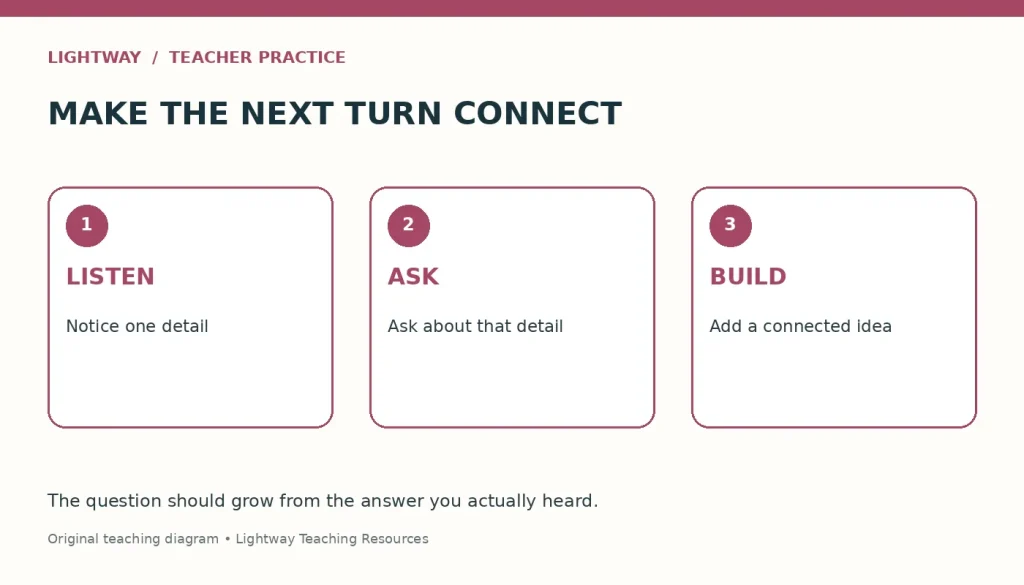
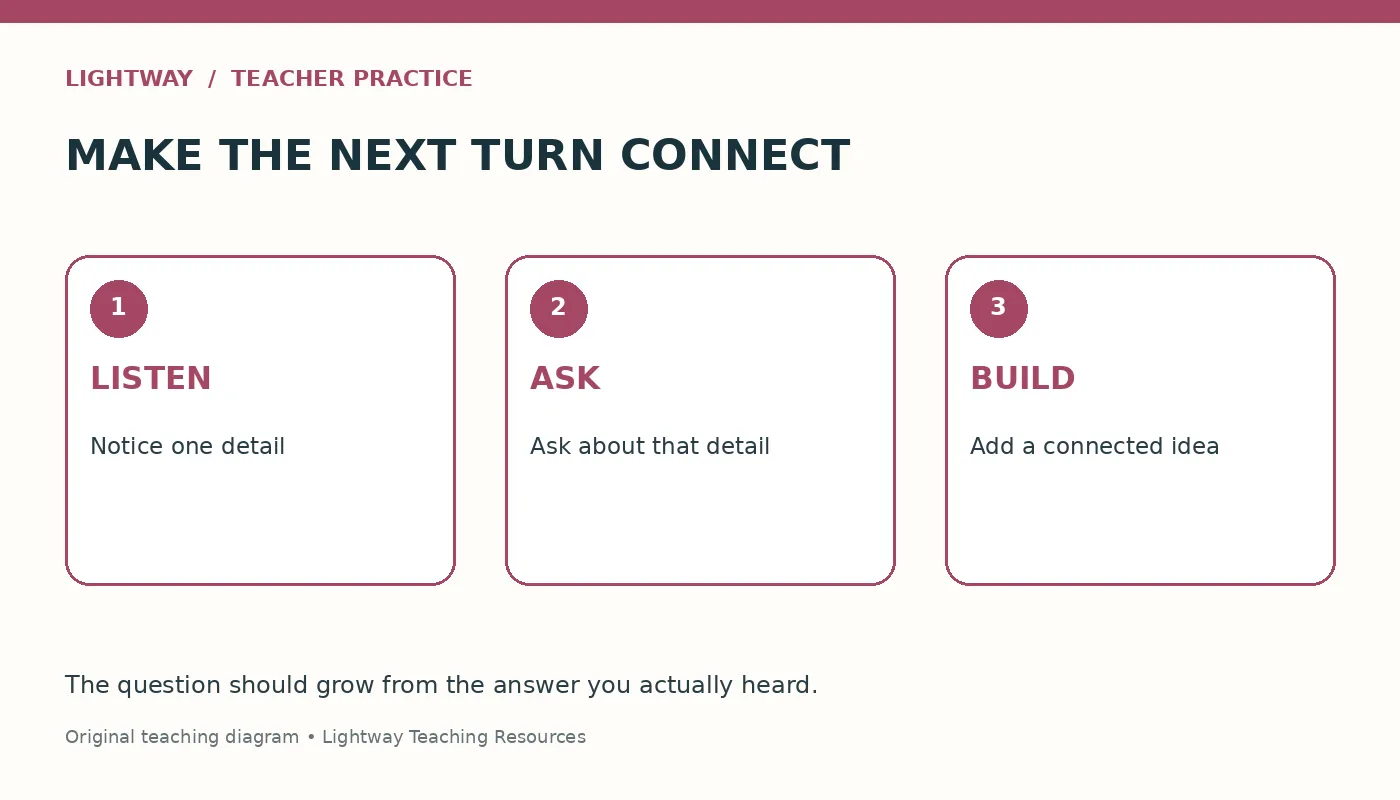
Productive partner talk takes explicit teaching. Students need to notice something in a partner’s answer, ask about it, and use the reply to move their thinking forward. The routine below teaches those actions through a shared classroom task. It works with ordinary paper, a teacher-made prompt, and a few rehearsed sentences.
Make the listening goal specific
For an early-elementary lesson, use this goal: “I can ask about my partner’s idea and add something connected to the answer.” This aligns with the Grade 1 Common Core speaking-and-listening expectations for responding across several exchanges and asking questions to clarify or gather information. Read the Grade 1 standards.
Teach two actions separately before combining them:
- Ask a follow-up: Choose a detail from the answer and request clarification, a reason, or an example.
- Build on the reply: Connect another detail, explain an agreement, revise an idea, or offer a reasoned alternative.
The Education Endowment Foundation describes collaborative talk as purposefully supported interaction in which children share, reason, and build on ideas. It also cautions that the early-years evidence is limited. The sequence here is an original teaching suggestion informed by that guidance, rather than a tested intervention with a promised result. See the EEF evidence summary.
Choose a task both partners can discuss
Start with a concrete question that permits reasons: “Which classroom object would make a useful ramp surface, a flat folder or a rolled towel? Explain your choice.” Show both objects and a toy car. Let children observe a brief demonstration before talking. Avoid a prompt that depends on experiences or materials only some children have.
For reading, use a short shared text that everyone has heard. For mathematics, display a worked example. Keep the content manageable while students learn the conversation routine; a new subject and several new speaking moves can compete for attention.
Model how a follow-up grows from an answer
Give an initial answer yourself: “I would choose the folder because its surface is smoother.” Show students how a listener could select the word “smoother” and ask, “How would a smoother surface help?”
Continue the model: “The wheels might move across it more easily.” Then add a connected response: “I can build on that. We could raise one end of the folder so the car has a slope to travel down.” Treat this as a prediction to investigate, not a result already proved.
Ask the class what the listener heard that shaped the follow-up. The expected response is the idea about a smoother surface. That check matters: memorizing a question stem does not show that a child has connected it to the partner’s answer.
Model an unrelated question once: “What is your favorite color?” Ask why it would not help this discussion. Then invite a repair: “Which part of the folder do you think will help the wheels?” Keep the example playful and avoid using a real child’s mistake as the demonstration.
Run a short practice with changing roles
Allow roughly ten minutes for the first supported rehearsal. Shorten or extend it according to the students’ communication needs.
- Think individually. Give everyone a quiet moment to decide, sketch, point to a choice, or rehearse an answer. Ask students to prepare one reason.
- Partner A explains. Partner B listens for a word or detail worth exploring. Keep the shared object or text visible.
- Partner B asks one follow-up. Offer a choice of two stems: “What do you mean by…?” and “What makes you think…?” The student fills the stem with something actually heard.
- Partner A responds. Allow time. If the question is unclear, A can ask, “Which part are you asking about?”
- Partner B builds on the reply. Try “That makes me think…” followed by a connected idea, or “I agree because…” followed by a reason.
- Switch roles. Partner B gives a starting answer or another reason; Partner A practices listening, questioning, and adding. Both students should experience both roles.
During the first attempts, pause between steps and coach one action at a time. Later, remove those pauses so the exchange can flow. The steps are a temporary teaching support, not a script students must recite in every conversation.
Use precise feedback: “You asked about the wheels after your partner mentioned them. Then you suggested a way to test the idea.” This tells students what to repeat more clearly than “Great talking.”
Show what building on an answer sounds like
Here are two original exchanges using content you can reproduce without a purchased lesson.
Mathematics: Draw six circles as two rows of three.
A: “There are six. I saw three on top and three below.”
B: “How did the two rows help you find the total?”
A: “I know three and three make six.”
B: “I can see that. I also see three pairs going down. Each pair has two.”
The final comment adds a second way of seeing the same representation. B can point to the pairs while speaking.
Reading: Display this teacher-made text: “Mina put a paper sign beside the wet paint. She moved the chairs away from the wall.” Ask what Mina is trying to do.
A: “She wants people to stay away from the paint.”
B: “Which detail makes you think that?”
A: “She moved the chairs away.”
B: “The sign could help too. It might warn people before they touch the wall.”
Point out “could” and “might.” The passage does not tell us the sign’s words, so the students should present that part as an inference.
Provide support without taking over the thinking
Keep a small choice of useful stems visible. Add “Can you give an example?” when students are ready. A long poster of twenty phrases can make choosing harder; initially, model the same two question types across several lessons.
Preview essential words with objects or pictures. Allow multilingual students to plan in a familiar language, rehearse with a supportive partner, and use a partial sentence while developing English. The What Works Clearinghouse recommends integrating oral and written English-language instruction into content teaching. These supports are practical ways to keep the content discussion accessible. See the English-learner practice guide.
Welcome pointing, drawing, typing, signing, or an established communication device as appropriate. CAST recommends varied means of expression when the learning goal does not require a particular medium. See its communication guidance. A student can select a follow-up on a device and add an idea through a drawing while still participating in the exchange.
Do not make eye contact, loud speech, or fast responses conditions for success. Agree on workable ways to signal a turn and to request more time. Choose partners thoughtfully, rotate responsibilities, and avoid assigning one student to speak for the other.
Listen for understanding, then choose the next teaching move
Observe a few pairs closely rather than trying to hear everyone at once. Record three things: whether the follow-up connected to the answer, whether the reply addressed the question, and whether the final contribution added relevant meaning. Note the support used.
If a student asks “why?” repeatedly, prompt them to name the detail they want explained. If a partner repeats an answer, model a clarification request. If the final contribution changes the topic, ask, “Which part of your partner’s answer connects to that?”
Check the subject learning separately. After the ramp discussion, have each child indicate a surface choice and a reason. After the reading exchange, ask each child to identify a detail from the text. A smooth conversation can still contain a misconception that needs teaching.
End by asking, “What did your partner help you notice?” Accept a brief spoken, drawn, or selected response. Revisit the same conversation moves with new content, gradually reducing prompts. The useful change to look for is a question and response that genuinely depend on what the partner contributed.
Sources and further reading
- Common Core State Standards: Grade 1 Speaking and Listening
- EEF: Teaching Through Collaborative Talk
- What Works Clearinghouse: Teaching Academic Content and Literacy to English Learners
- CAST: Use Multiple Media for Communication
Quick check: does the question connect?
After “I chose the folder because it is smoother,” ask which follow-up develops the idea: “What is your favorite color?” or “How would a smoother surface help?” The second connects to the stated reason. Ask students to explain the connection rather than merely select it.
Before moving children into pairs, explicitly teach how to change activities. Our four-step classroom transition routine can help you plan that part of the lesson.
