
A medieval social pyramid can help students remember a few labels. It does much less to explain who owed what to whom, how a household obtained food, or why two peasants might hold land on different terms. When every arrow simply points upward, “medieval society” becomes a stack of people rather than a set of relationships.
This middle school activity replaces the single pyramid with a small, evidence-conscious relationship map. Its question is concrete: What does a diagram need to show if we want to explain work, land, and obligations on a manor? Plan about 45 minutes and a later source-reading extension. The model is deliberately limited to an introductory English manorial context; it is not a map of all medieval Europe.
Keep the two teaching concepts distinct
Teachers often introduce feudalism and manorialism together because land connects them. For this lesson, use “manorialism” to organize questions about estates, tenants, agricultural production, dues, and local jurisdiction. Use “feudal relationships” cautiously for relationships involving landholding and service among elites. The terms are teaching tools, not proof of one uniform system operating everywhere for a thousand years.
Before drawing anything, specify place and period. “An introductory model for parts of medieval England” is more defensible than “How everyone lived in the Middle Ages.” Explain that surviving manorial records vary in date, purpose, and completeness. The Manorial Documents Register is an index to English and Welsh records, not a single medieval rulebook.
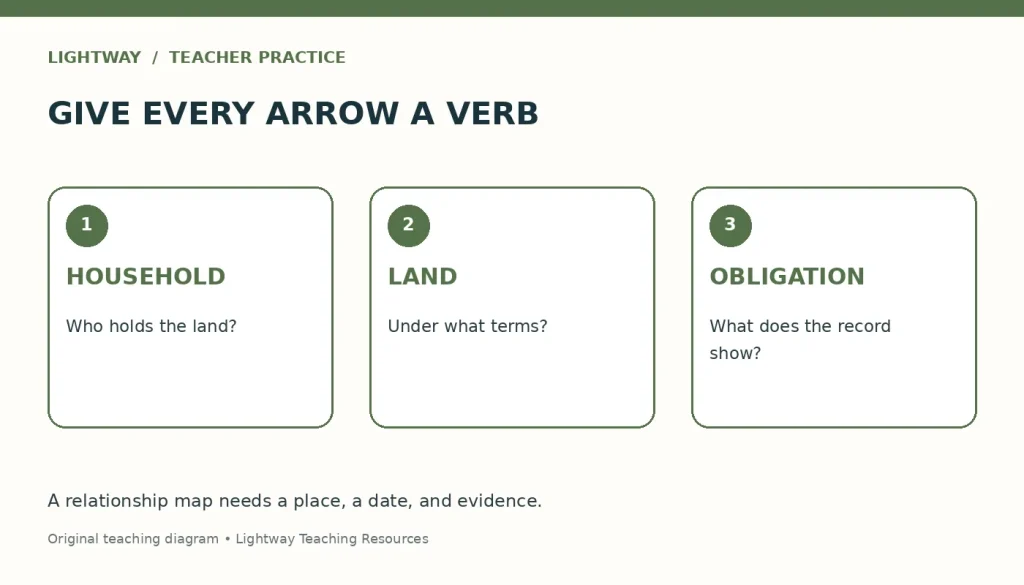
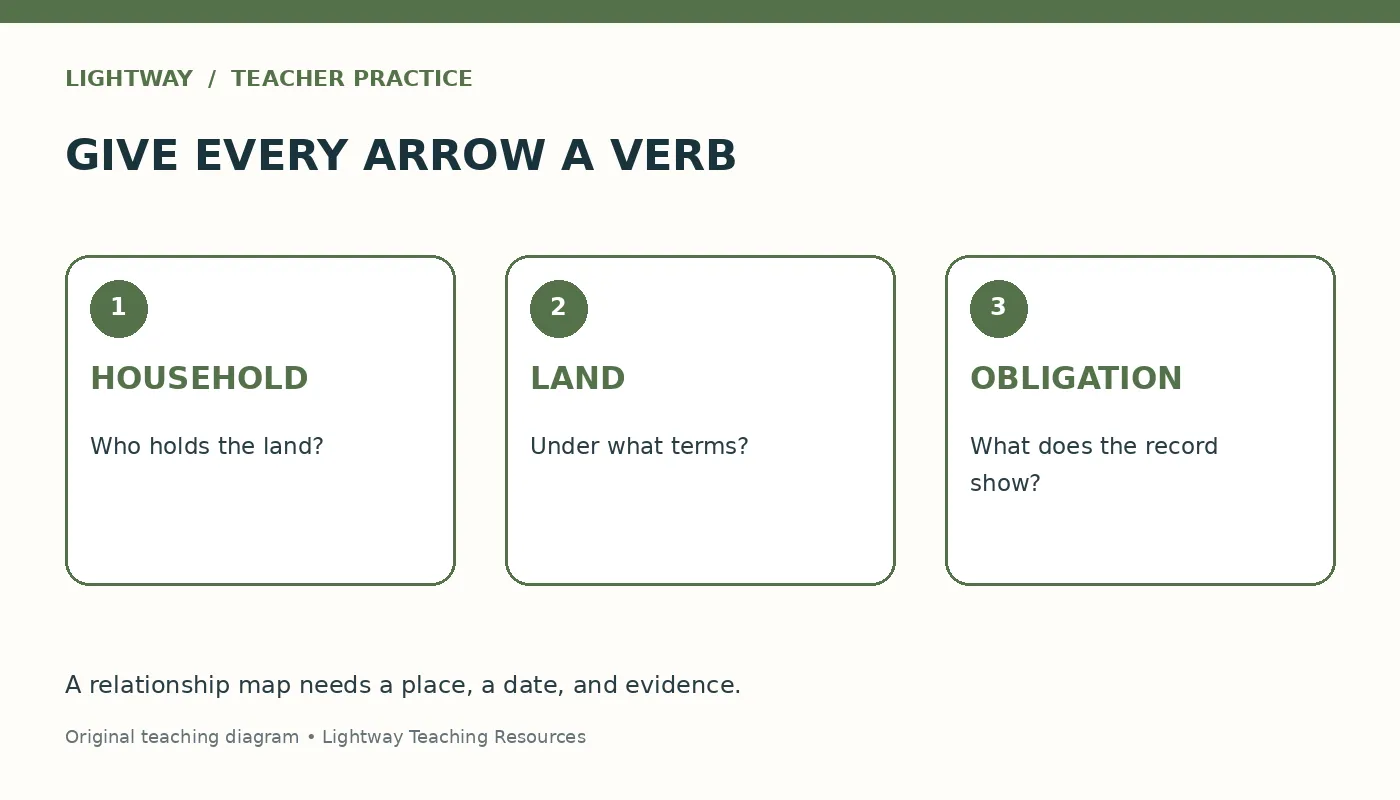
Give every arrow a verb
Begin with four blank cards: lord or landholder, tenant household, cultivated land, and manor court. Give pairs three different arrow labels: “holds land on specified terms,” “owes a recorded payment or service,” and “records or adjudicates local business.” Let students place the cards and attach labels.
Do not begin by telling students that the lord supplies guaranteed safety and the peasant supplies food in an equal exchange. That wording can hide coercion, legal inequality, and the variation in obligations. Instead, ask: What would we need to know about this particular holding? Who recorded the obligation? What might happen if it was disputed? The goal is to make the diagram generate historical questions.
Insist that an arrow has a direction and a meaning. A line labeled “land” is too vague. A line labeled “household holds a parcel under specified terms” explains more. Students can use everyday language before learning “tenure.” If they cannot say the relationship aloud, the diagram is not yet doing useful work.
Use a fictional comparison, clearly labeled
Present the following as a simplified scenario created for this lesson, not as a transcription of a real manor roll. Household A holds land with a specified money payment. Household B holds land with a specified labor obligation. Both households also need time and resources to produce food for themselves. The cards intentionally omit exact amounts because those would need evidence from a named manor and date.
Ask pairs to draw two versions of the relationship map. What changes when an obligation is paid in money rather than labor? What remains unknown? Students might identify time, access to money, and the need to meet obligations as questions. They should not infer that A is rich, B owns nothing, or either household is representative of every peasant.
Teacher response: what the scenario permits
The scenario supports a comparison of the stated obligations. It does not establish the households’ total wealth, legal status, family size, harvest, or freedom to move. A good answer distinguishes information supplied by the model from information that would require another source.
Add the people a pyramid leaves out
Invite students to add a mill, a market connection, a steward or bailiff, and a household member doing work not named on the original cards. Each addition needs a question rather than a made-up historical statistic: Was use of a particular mill required? What was sold or purchased? Who collected rents? Whose labor is not individually named?
The National Archives’ guide to manorial documents explains that records can illuminate rights, obligations, and ordinary life. Such records are valuable partly because they contain specific transactions and disputes. They are also selective: a court entry is not a complete account of a family’s daily experience.
For a contrasting household context, English Heritage’s account of Goodrich Castle shows the range of people involved in an aristocratic household. Use it to challenge a diagram containing only a king, a lord, a knight, and an undifferentiated group of peasants. Do not transfer every feature of Goodrich to an ordinary manor or claim that one castle household represents all medieval people.
Move from the model to a documented record
Choose a short, accessible record description from a local archive or the Manorial Documents Register. Retain the manor name, date, repository, and reference. If the class cannot read the original handwriting or Latin, provide the archive’s published summary and identify it as a modern summary. Do not label a teacher-written paraphrase an exact medieval quotation.
Have students identify the record’s purpose before extracting facts. Does it concern a holding, payment, transfer, dispute, or court business? Who produced it, and whose interests shaped what was recorded? Ask students to add only the relationships that this source actually supports to their diagram. Use a different line style for questions still unanswered.
A later record can show the long life of manorial administration, but it must not be presented as direct evidence for the thirteenth century. The Surrey History Centre guide, for example, discusses records extending well beyond the medieval period. Date labels are part of the historical argument, not decoration.
Use a diagram audit as the assessment
Give groups a deliberately weak diagram with these three statements: “All peasants were serfs”; “All manors worked in exactly the same way”; and “A court record tells us everything about daily life.” Students revise each statement, name the missing evidence, and change one arrow or label in the diagram.
What stronger answers should show
Students should recognize variation among tenants and obligations, limit the model by place and date, and explain that a record has a particular purpose. “Some,” “in this record,” and “we would need” are useful only when attached to a precise claim. Replacing every statement with “it depends” is not enough.
Make the final explanation small and testable
Finish with a six-sentence explanation of one relationship. Students identify the people or institutions, describe the obligation, explain how it affected work or resources, cite the supplied evidence, and state one limit. This is a more informative check than asking them to redraw a social pyramid from memory.
Offer preprinted arrow labels, a vocabulary strip, and an oral-response option. For an extension, compare two documented records from different dates or places and ask which parts of the first diagram need revision. Avoid role-play that makes students perform humiliation or treats coerced labor as a game. Historical reasoning comes from explaining relationships with evidence, not from assigning children unequal classroom identities.
Students can still use a pyramid later, but now they have a question to ask of it: What has this model left out? That question makes a familiar classroom visual more useful and less likely to become an oversimplified picture of the past.
For a wider sequence around the medieval world, browse the Rome and Christendom teaching series. For checking the explanations students produce, our exit-ticket guide helps distinguish missing evidence from a specific misconception.
