
“Write your name in hieroglyphs” is an appealing activity, but it can leave students with the wrong model: ancient Egyptian writing was English with different pictures. A stronger middle school lesson begins with a different problem. How can a visible sign carry a sound, a word, or a clue to meaning? Students can investigate that question without pretending to translate an ancient inscription.
This 40–50 minute sequence uses a clearly labeled modern analogy, a museum explanation, and a source-checking task. It works before a longer study of scribes, papyrus, or the Rosetta Stone. The intended outcome is a better explanation of how writing works, not fluency in Egyptian.
Make the misconception visible
Write three statements on the board: “Each Egyptian picture always means the thing it shows”; “Every hieroglyph stands for one English letter”; and “A sign can do different jobs within a writing system.” Ask students to choose the statement they currently find most plausible and explain why. Collect the explanations before correcting them. This gives you something specific to revisit at the end.
Explain that Egyptian is a language and hieroglyphic writing is one way of recording it. English is not the hidden language underneath the symbols. The Met’s educator resource on Egyptian art explains that signs can represent consonantal sounds and that additional signs help distinguish meanings. Avoid suggesting that one classroom chart captures the entire system.
Use an analogy with its limits printed beside it
Prepare four cards: a drawing of an eye, the printed word “see,” a drawing of a bee, and the word “leaf.” These are modern English classroom materials. They are not Egyptian signs or an ancient text. Put that label above the cards and leave it visible throughout the activity.
First, show the eye drawing and ask what object it depicts. Then say the name aloud. In English, “eye” sounds like “I,” so a picture can be borrowed for its sound rather than its literal meaning. Similarly, “bee” and “leaf” can suggest the sounds in “belief,” although the match is imperfect. The imperfection is useful: students can see that the spoken language controls whether the analogy works.
Ask what happens if a person uses a different language for the same pictures. The sound relationship may disappear. That is the reason an English picture puzzle cannot be treated as an authentic translation of Egyptian. It illustrates one principle, not the ancient vocabulary, grammar, or spelling system.
Check the analogy
If a student says the bee always means an insect, ask which job it is doing in the sound puzzle. If the student says this proves Egyptians wrote “belief” using those pictures, ask which language makes the puzzle work. The expected distinction is between a modern analogy and historical evidence.
Introduce three useful sign functions
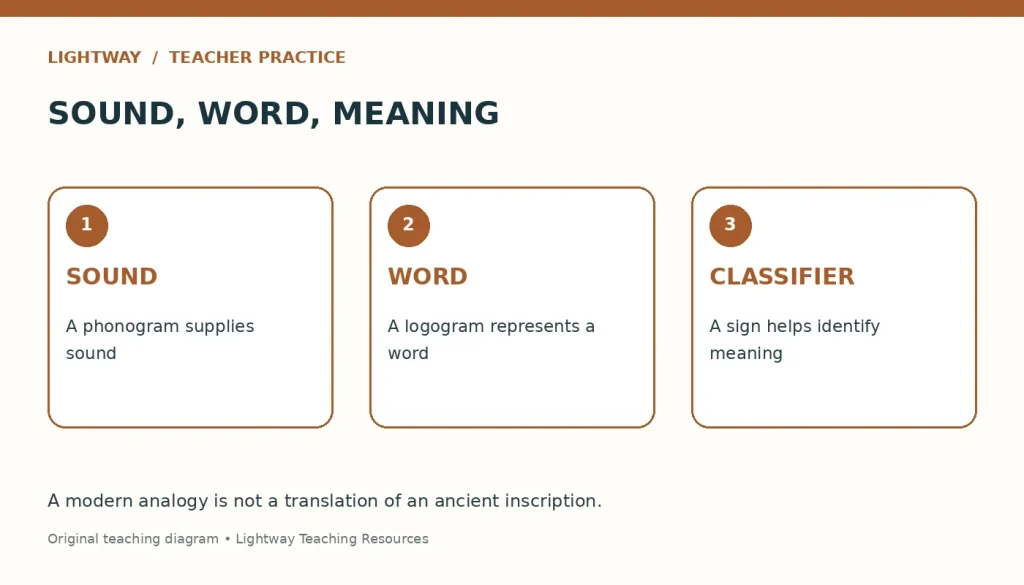
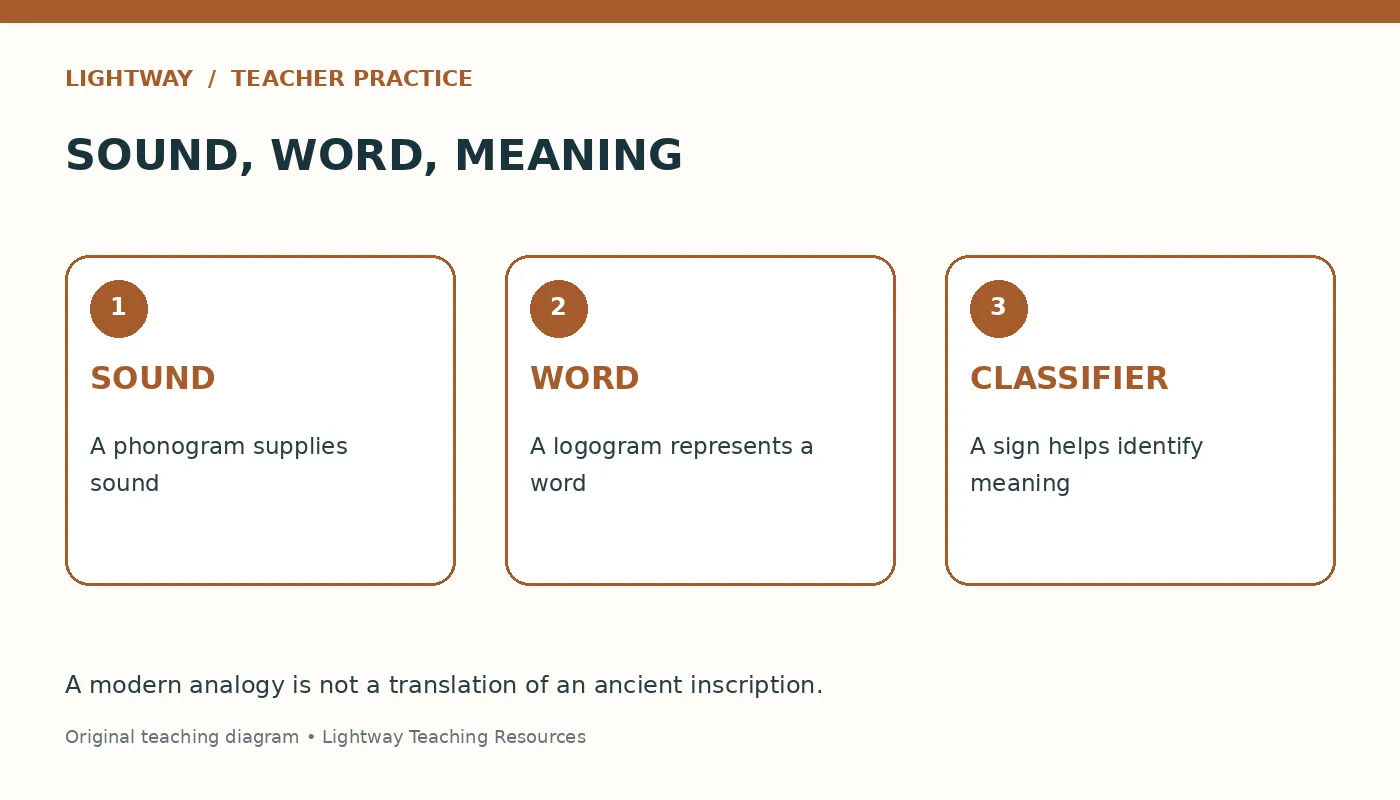
Teach three terms with short explanations: a phonogram represents sound; a logogram represents a word; and a classifier, often called a determinative, helps identify a category of meaning and is not pronounced. These are functions to investigate, not three boxes into which every sign can be permanently locked.
The British Museum’s account of decipherment explains why the combination mattered. Signs could include both phonetic and non-phonetic elements. A sign sequence identifying a place, for example, could contain sound information and an additional indication that it was a place name. Keep the classroom summary brief and send interested students to the museum’s examples.
Use three original description cards rather than invented Egyptian sentences: “This sign supplies a consonant sound”; “This sign represents the word itself”; and “This sign helps the reader recognize the kind of thing meant.” Students match the descriptions to the three terms and explain the difference aloud. Then add a fourth card: “This sign’s job depends on its context.” Ask why a single symbol-to-English-letter key would be inadequate.
Read the Rosetta Stone as a document
Display the British Museum’s Rosetta Stone record or its introductory explanation. Students should first identify what kind of object it is and what information the museum supplies. The inscription is a decree from 196 BCE, presented in hieroglyphic, Demotic, and Greek scripts. The three scripts do not mean three different languages: the first two record Egyptian, while the third records Greek.
Draw two headings, “language” and “script.” Place Egyptian beneath language and connect it to hieroglyphic and Demotic beneath script. Place Greek in the language column and connect it to Greek writing. This is a schematic relationship diagram, not a reproduction of the stone’s layout.
Now ask why a text known in Greek could help researchers investigate the other inscriptions. Students should explain the value of comparison rather than say that the stone instantly supplied a complete alphabet. The decipherment involved years of work, additional evidence, and contributions from more than one scholar. A museum record is a better starting point than a legend about a single sudden discovery.
Separate the ancient document from its later history
Give students three event cards: the production of the ancient decree; the stone’s discovery by French soldiers in 1799; and nineteenth-century work on decipherment, including Champollion’s 1822 announcement. Have them arrange the cards and label the gaps. The long gap prevents a common mistake: treating the discovery date as the date the text was written.
Ask which questions belong to each event. “What was the decree trying to communicate?” concerns the ancient document. “Where was the stone found?” concerns discovery. “How did researchers test the values of signs?” concerns decipherment. Students do not need to answer every question today; they need to keep them separate.
A short source-checking challenge
Offer this invented museum-label draft: “This stone contains three languages and was written in 1799. Its pictures each stand for an English letter, which made translation simple.” Partners identify at least three problems and use the museum sources to write a corrected label. Tell them explicitly that the draft is a modern teaching exercise, not a genuine museum quotation.
Possible correction
The Rosetta Stone preserves a decree from 196 BCE in three scripts representing two languages. It was discovered in 1799. Comparing its inscriptions contributed to the decipherment of Egyptian writing, but the writing system cannot be reduced to pictures standing for English letters.
Assess understanding through an explanation
Return to the opening statements. Ask students to revise their choice and explain one reason. Then use the exit prompt: “Why can an English name-writing chart be a classroom approximation without teaching us to translate an Egyptian inscription?” A satisfactory answer names the language difference and at least one additional feature of the writing system.
For support, provide the two-column language/script diagram and let students give an oral answer. For extension, compare hieroglyphic and hieratic examples in the museum resources, keeping their uses and dates attached. Do not turn a handwriting exercise into a claim that students have recreated a scribe’s training. The most useful achievement here is conceptual: students understand why reading an ancient text requires more than recognizing pictures.
To connect writing to the wider Egyptian setting, follow this with our Nile geography causal-reasoning lesson. Keep the question about writing distinct from the question about land, food, and human choices.
