
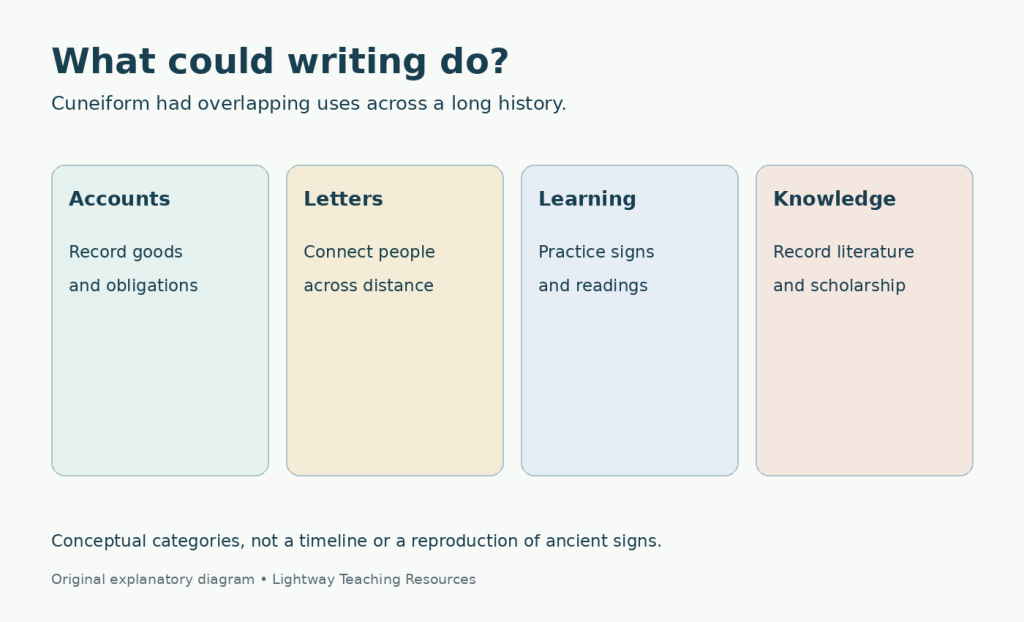
A list of grain allocations is not the document most people would choose to represent a revolution. Yet some of the earliest surviving Mesopotamian writing concerns precisely such unglamorous matters: goods, quantities, and the people or institutions responsible for them. Before writing became a vehicle for celebrated literature, it helped make transactions durable.
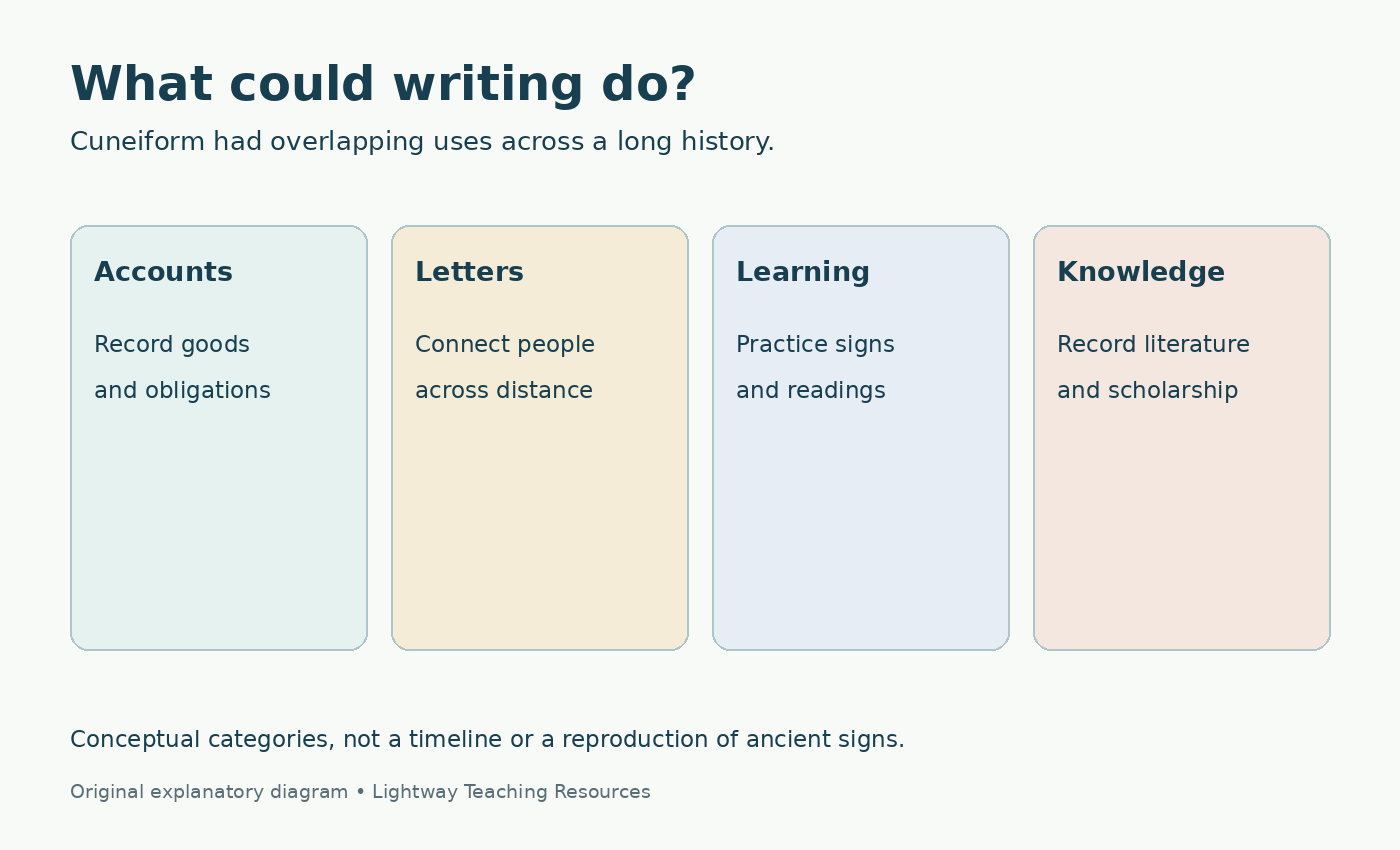
That beginning changes the question. Instead of asking only who invented writing, we can ask what people needed it to do, who learned to use it, and whose lives became visible in its records. The answer takes us from administrative tablets to letters and school exercises, without turning thousands of years of change into a single neat invention story.
A city needed records that could outlast a conversation
In its account of the origins of writing, the Metropolitan Museum of Art places early proto-cuneiform in the late fourth millennium BCE. Some signs identify things that could be counted, including grain and animals. The surviving tablets illuminate the practical problems of managing goods in growing urban societies.
A record makes it possible to return to an earlier transaction. Someone can compare an expected delivery with a recorded one, or check what has been allocated. Those are observations about what record-keeping enables, not evidence that every early tablet performed the same function. Nor does the usefulness of accounts establish a single inventor or one universally accepted path from counting to writing. The Met explicitly notes that the origin and spread of writing were complex.
Christopher Woods’s scholarly overview in Visible Language discusses the early documents from Uruk and the long history of cuneiform. The material matters: signs were placed on clay with a stylus, creating an archive very different from one made entirely of fragile organic materials. Survival has helped make ancient Mesopotamia unusually well documented, while still leaving enormous gaps.
A script is not the same thing as a language
“Cuneiform” describes a writing tradition associated with wedge-shaped marks, not a single language spoken by everyone who used it. The Met’s tablet recording the distribution of copper knives explains that the script was adapted for numerous languages across a wide region. The particular tablet dates to approximately 2600–2350 BCE and was excavated at Nippur.
This distinction is easy to miss because a modern label can make the past seem more uniform than it was. Sharing a script does not mean sharing one government, identity, or spoken language. It also does not mean that the oldest and latest texts were written in exactly the same way. An archive is evidence of change as well as continuity.
From things to the sounds of speech
Writing had to do more than show an object if it was to record names, relationships, and complicated statements. The Met’s origins essay explains the importance of signs used for their sounds as well as their meanings. Later cuneiform combined signs for words with signs for sounds and syllables. That flexibility supported a much wider range of expression than a list of pictured goods alone could manage.
We should resist telling this as a straight ladder on which a supposedly primitive picture system inevitably climbs toward our own alphabet. Different scripts solve the problem of recording language in different ways. The historical question is how particular users made a system work for their needs, not how closely it resembled modern English writing.
The person at the other end of the letter
An Old Assyrian private letter in the Met’s collection offers a different window. In the early second millennium BCE, merchants from Ashur participated in trading settlements in Anatolia. They used tablets, envelopes, and seals to manage business and to communicate with family and partners. The museum notes that this written evidence records loans, disputes, and aspects of everyday life as well as commercial exchange.
Here, writing is not merely an impersonal technology of the state. It connects people who are apart. A message can carry instructions, complaints, or expectations into a relationship that cannot be managed face to face. Yet the surviving correspondence is still selective. The people whose letters were kept and recovered do not stand for everyone who lived in those settlements.
The British Museum’s discussion of Assyrian trade and contraband makes the human dimension especially vivid through letters and commercial problems. Reading such material alongside administrative records complicates the easy division between a bureaucratic ancient world and a personal modern one. Transactions could be embedded in family relationships, trust, frustration, and negotiation.
Learning the signs took work
A small Old Babylonian exercise tablet preserves repeated writing of the deity Urash’s name. The museum describes a teaching practice in which a model was written on one side and an exercise repeated on the other. It also explains that a sign could carry more than one word or sound value. Learning the system therefore involved much more than memorizing a short list of letters.
The object offers a recognizable glimpse of practice without licensing a sentimental invented scene. We do not know the learner’s emotions from the repetition. We should not turn the tablet into evidence that every child attended school. What it does preserve is material evidence of learning within a particular scribal tradition.
Reading the archive against its silences
The administrative tablets considered above also invite a question about power: who decided which people, goods, or obligations belonged in the record? An allocation list is not a neutral cross-section of society. It organizes information around the transaction its maker needed to preserve. That gives historians valuable evidence while also setting limits on what the document can answer.
An account may tell us what was issued without telling us how recipients experienced the arrangement. A letter may preserve a merchant’s complaint without preserving the other person’s answer. The absence of a voice is not proof that the person had nothing to say. It is a reason to ask how the record was made, kept, recovered, and interpreted.
The significance of early writing lies partly in that tension. It expanded what could be communicated and remembered, but it did not preserve the past evenly. The oldest accounts deserve attention not because they already contain everything later literature would offer, but because their ordinary details reveal new ways of organizing human relationships.
For another source-focused classroom sequence, see our cuneiform tablet inquiry.
