
Mesopotamia · Historical thinking · Grades 6–8
What can one small clay tablet tell us?
A 35-minute cuneiform activity that helps students slow down, support a claim, and recognize what a source cannot answer.
Put an ancient tablet on the screen and someone may immediately announce, “It is a law!” Another student may see a map. Those guesses give you a useful starting point: What did you actually notice, and what are you interpreting?
In this middle school Mesopotamia activity, students examine a museum photograph, read a short context card, and revise a claim about why people recorded information. They do not need to translate the signs. Their task is to explain how a conclusion changes when new evidence becomes available.
Inquiry question: How could keeping records help people manage goods in an early city?
Prepare one image and a page of notes
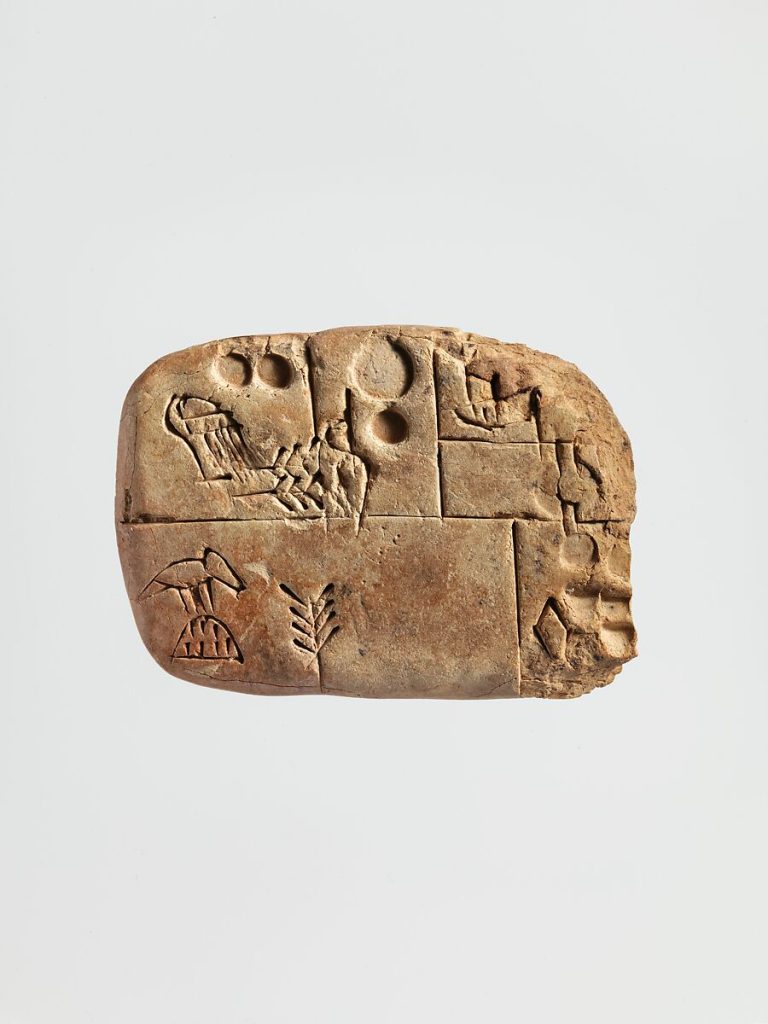
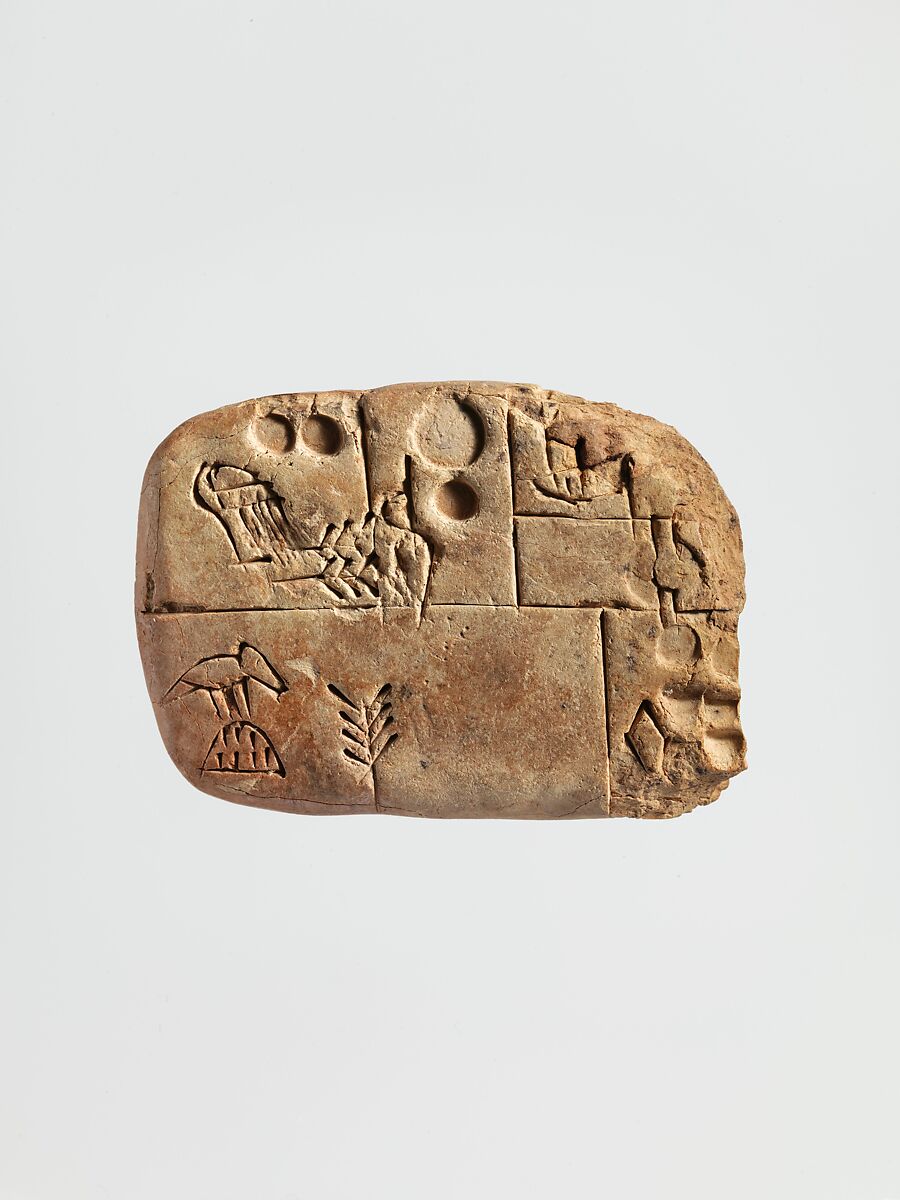
Before class, open the Metropolitan Museum of Art’s tablet record and check that the image displays on your classroom device. Project the photograph below or use a printed copy. Students need paper, a pencil, and three labeled spaces: Observe, Infer, and Still need to know.
First show only the photograph. Cover or scroll past its caption and the context card until the second stage. Keep the source credit on any copies you distribute; revealing it after the opening observation is part of the lesson, not a reason to remove it.
Materials
- The tablet photograph and context card below
- Paper divided into three sections
- A timer and a board for collecting claims
Useful vocabulary
- Artifact: an object made or changed by people
- Inference: an explanation based on evidence and reasoning
- Record: information preserved for later use
This routine draws on the Library of Congress approach to observing, reflecting, and questioning primary sources. The timing, claim sort, and classroom prompts here are a suggested lesson sequence. Adjust them to your students.
Teach the 35-minute tablet inquiry
1. Collect observations before explanations
Give students one silent minute to inspect the image. Ask them to write three details that a partner could point to. Then have partners check one another’s notes.
- Where do you see repeated shapes?
- How is the surface divided?
- Which small detail would you want to enlarge?
Model the distinction: “I see round impressions” describes a visible feature. “Someone was counting food” proposes a purpose. Record both, but place the second in the inference section.
If a student says “It is made of clay,” ask whether that comes from the photograph or from other information. A photograph can suggest a material; the museum record will help confirm it.
2. Reveal the source card
This clay tablet comes from ancient Mesopotamia and dates to about 3100–2900 BCE. The Met identifies its signs as proto-cuneiform, an early form of writing. Its circular impressions represent numbers. The museum interprets the tablet as probably recording deliveries or distributions of barley and emmer wheat. That interpretation is qualified: early texts without verbs can be difficult to interpret precisely. The tablet is only about 6.5 centimeters wide.
Teacher paraphrase of The Met’s object record, not a translation of the inscription.
Have students mark one idea they can now support and one guess they need to revise. Explain that the artifact is ancient evidence; the museum description is a modern explanation based on specialist study. Students should identify which of those two sources supports each part of their answer.
3. Sort three statements
Read the statements below aloud. For each, pairs decide whether it is a visible observation, a supported interpretation, or a claim that goes beyond this evidence. Require a reason before opening the answer.
A. The tablet has repeated circular impressions. What kind of statement is this?
Visible observation. Students can point to those marks in the image. They do not need to know what the marks mean to describe them.
B. This tablet probably helped people keep track of grain. Is this supported?
Supported interpretation. The museum’s description connects the tablet with grain deliveries or distributions. “Probably” preserves the uncertainty in that description. The photograph alone does not establish the meaning of the signs.
C. Everyone in Mesopotamia could read and write. Does the tablet prove this?
Beyond this evidence. One written object cannot tell us how widespread literacy was. Students would need evidence about who learned, used, and had access to writing.
Listen for the phrase “because it looks like.” Follow up with: “Which feature? What other explanation could fit? What does the source record add?”
4. Try a paper record-keeping challenge
Give pairs this invented scenario:
Pairs exchange papers. The receiving pair identifies the starting amount, both transfers, and the remaining four pencils. Then each pair revises one confusing part of its record.
Discuss: What had to be recorded besides a number? How did labels or a consistent layout help? What might happen if two people interpreted the marks differently?
Make the boundary explicit: this is a modern model of a record-keeping problem. The invented marks are not historical cuneiform, and the challenge does not recreate how writing actually developed. Return to the tablet and ask which comparison is useful, and where the analogy stops.
5. Answer the inquiry question with a limit
Ask students to complete three sentences independently:
- Keeping records could help people manage goods because…
- The tablet or its museum description supports this idea by…
- This source does not tell us…
Open a sample response
Keeping records could help people track goods after a delivery or distribution. The museum interprets this tablet as a grain record, which supports that possible use of writing. It does not tell us whether everyone could read it or whether all the grain was shared fairly.
Accept different answers when the evidence and reasoning fit. A student does not need to mention every historical detail to make a careful claim.
A quick check that shows what to teach next
Use this three-point check on the final response:
- 1 point: gives a plausible reason to preserve information about goods
- 1 point: identifies relevant evidence and whether it comes from the image or museum description
- 1 point: names something the source cannot establish
If students cite only their pencil challenge, return to the ancient source. If they use a strong detail but jump to “everyone” or “always,” ask them to narrow the claim. If they name a limit without explaining their claim, model a complete evidence-and-reasoning sentence.
Support without removing the thinking
Read the context card aloud. Offer “I notice…,” “The record explains…,” and “We still cannot tell….” Allow a labeled sketch or a spoken rehearsal before writing. Keep the same evidence question for everyone.
Add challenge
Have students propose one additional source that could test their claim: another tablet, an excavated storage space, or evidence about scribal training. They must explain what that source might clarify and what it might still leave uncertain.
Teacher FAQ
Do students need to decode cuneiform first?
No. This activity develops source analysis rather than translation. Students inspect the photograph and use a clearly identified museum interpretation. Avoid presenting an English-letter substitution chart as a translation of this tablet.
Can I teach this in 20 minutes?
Yes. Use four minutes for observation, four for the context card, six for the claim sort, and six for independent writing and feedback. Omit the modern record-keeping challenge.
How does this connect to a Mesopotamia unit?
Use it after students meet early cities, specialized work, or the movement of goods. It also makes a useful opening inquiry before a writing lesson. Revisit students’ first claims after they learn more about scribes and record keeping.
Can I use the image on a classroom handout?
The Met labels this image public domain, and its Open Access policy allows reuse. Include the object number and museum credit so students can trace the evidence. Check the rights statement again if you substitute another image.
Carry the habit into your next history lesson
Keep the same three questions visible: What do we notice? What can we support? What remains uncertain? The routine can transfer to an object, building, map, or written account, but students should reconsider who made each source and what kind of evidence it offers.
For another ancient-history context, explore our Human Origins teacher guide. When your class moves ahead in time, the Rome & Christendom lesson sequence offers a setting for revisiting questions about evidence and historical change.
Planning a longer Mesopotamia sequence?
This activity stands on its own. If you want connected lesson materials, browse Lightway’s eight-lesson Ancient Mesopotamia unit, including Cuneiform & the Invention of Writing. Review the linked lesson previews to decide what fits your class.
Sources and image credit
- The Met: tablet 1988.433.2, artifact details, photograph, and curatorial interpretation
- The Met Open Access, image reuse policy
- Library of Congress: Teacher’s Guides and Analysis Tool, guidance for observing, reflecting, and questioning
Classroom sequence and modern record-keeping scenario by Lightway Teaching Resources. Historical context checked against the linked museum record.
