
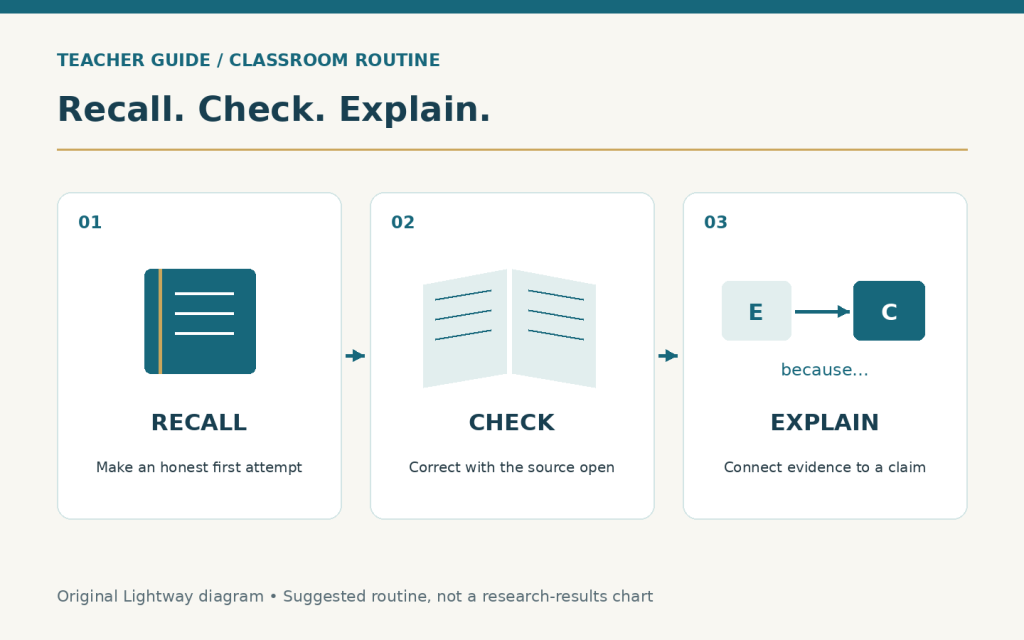
A student can remember that a river flooded and still struggle to explain why the flood mattered. Another can make a thoughtful argument while confusing the order of events. A short retrieval routine can help you notice both problems, provided you separate what students are recalling from what they are interpreting.
This twelve-minute routine for middle-school history moves through three stages: recall without notes, check against the taught material, and use the corrected knowledge in an evidence-based explanation. It is a suggested classroom design, not a separately tested intervention or a substitute for teaching the topic.
Choose the knowledge before writing the questions
Start with the next piece of historical thinking you want students to do. If they will explain a decision, they may need the people involved, the options available, and the sequence of events. If they will evaluate a source, they may need its creator, date, audience, and relationship to the event. Select three small pieces of already-taught knowledge that the next task genuinely requires.
Do not begin with a large list of interesting facts and hope an argument emerges. Write the final application question first. Then ask which information a student would need to answer it responsibly. A date belongs in the retrieval set when its position changes the explanation, not simply because dates are easy to mark.
The Institute of Education Sciences practice guide on organizing instruction and study recommends using quizzes to revisit key content and asking explanatory questions. Those recommendations support the broad combination here; they do not establish that this exact timetable or set of history prompts is optimal.
Prepare one small answer key
Use a topic your class has already encountered. Prepare three prompts and a short key tied to the class text, lesson notes, or source packet. Distinguish answers that should be precise from answers that can reasonably vary.
- Locate: Name the place or institution relevant to the question.
- Sequence: Put two taught events in order and identify which happened first.
- Connect: State one relationship discussed in the lesson, using a complete sentence.
For example, after a taught lesson about a particular trade network, the first prompt could ask students to name one connected region. The second could ask which of two dated developments came earlier. The third could ask how a particular transport condition affected movement. Supply the actual names and dates from your verified teaching material; this outline is not a historical source.
Your key should include acceptable alternatives and the location of the supporting information. If a prompt invites an interpretation, label it accordingly. Do not mark a defensible explanation wrong merely because it differs from the wording on your slide.
Minutes 1–3: recall privately, without a speed race
Put the three prompts where everyone can see them. Students close the relevant notes and make a quiet individual attempt. Explain that the purpose is to strengthen and inspect learning, not to rank the class. Allow a question mark for something they cannot yet retrieve.
Keep the task short enough that the checking stage still happens. Avoid awarding points for finishing first. If writing is not the intended target, accept a brief oral response or an accessible response format. Record any cue you provide: recalling after a cue and recalling independently give you different information.
Research on retrieval concerns the act of bringing knowledge to mind, rather than only encountering it again. Roediger, McDaniel, and McDermott’s account of test-enhanced learning explains this use of testing as an aid to learning. That is a different purpose from a high-stakes examination. The practical implication here is to protect an honest first attempt before displaying the answers.
Minutes 4–7: reopen, check, and repair
Now students open the relevant material. Reveal the key and the supporting location together. Ask them to keep their first response visible and add a correction or missing detail beside it. “Checked” should mean that they compared the substance, not that they copied the answer into an empty space.
Use three simple annotations: accurate, partly accurate, and needs correction. For a corrected sequence, students should rewrite the relationship: “A happened before B, so B cannot explain the beginning of A.” For a mixed-up source creator, they should replace the name and reconsider whether the source’s position in the argument changes.
Ask for one sentence about the repair: “I changed ___ because the material shows ___.” This makes checking visible. It also gives you something more useful than a show of hands asking who got everything right.
If many students cannot recall a central idea, pause and reteach it. Repeated unsuccessful guessing is not the goal. The Education Endowment Foundation’s cognitive-science review highlights the importance of task difficulty, prior learning, and feedback, as well as gaps between promising principles and everyday classroom implementation. Use the responses to adjust your lesson rather than treating the routine as a fixed script.
Minutes 8–12: use the knowledge with the evidence open
Give students one short application question. Leave the sources open. The demand now is to build an explanation, not to reproduce an exact quotation from memory. A useful frame is: “___ mattered because ___; source ___ supports this by showing ___.” Students should supply a mechanism and relevant evidence, not merely join two nouns with “led to.”
For the trade-network example, ask how the recalled transport condition could affect a particular journey or exchange. A strong response names the condition, explains its effect, and points to the supplied evidence. A weaker one repeats that trade was important without identifying how anything changed. Discuss that difference using two anonymous responses or teacher-written examples.
Keep the two judgments separate in your notes. A student may recall accurately but need help connecting evidence to a claim. Another may reason well after correcting a factual gap. Those students need different next steps; one total score would hide the distinction.
Return to it later, then change the application
Revisit a small part of the same knowledge in a later lesson, alongside other essential content. Do not simply repeat the identical application sentence until students can recite it. Ask them to use the knowledge with another source or a narrower question. Check whether they can explain the connection without borrowing the previous model’s phrasing.
Keep a compact planning note: the knowledge checked, the common error, and the next opportunity to use it. The routine has earned its place when it helps you decide what to reteach and helps students produce a more accurate explanation. If it consumes the lesson while leaving no time for inquiry, reduce the number of prompts.
Featured graphic: an original Lightway Teaching Resources diagram of the recall, check, and explain routine. It is a classroom model, not a representation of a research result.
