
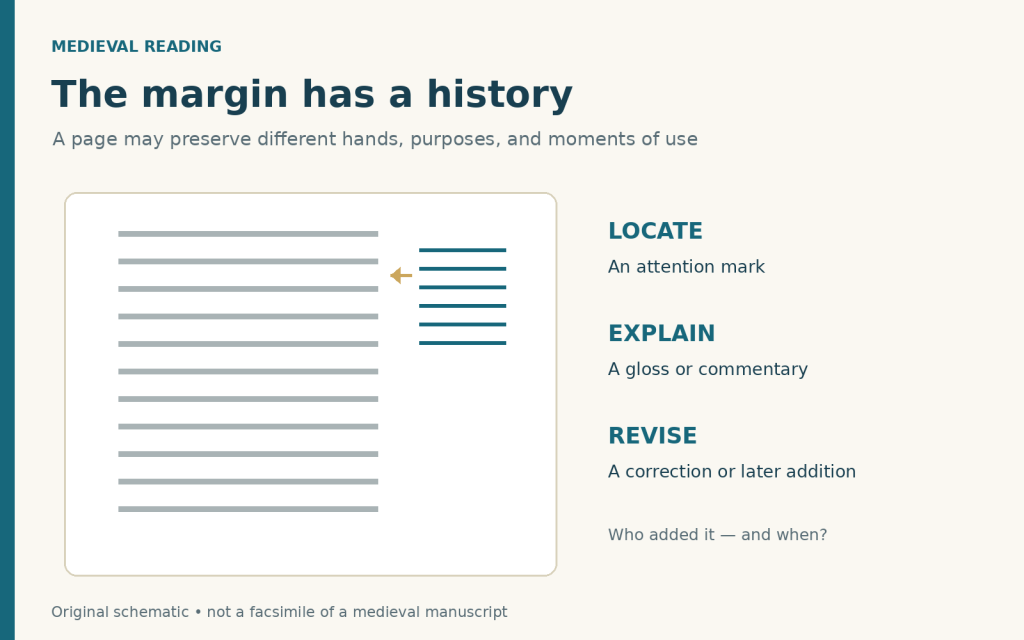
A pointing hand in the margin of a medieval book looks immediately understandable: look here. But understanding the gesture is only the beginning. Who drew it, which passage mattered, and did the mark arrive when the book was made or centuries later? The space beside the text can carry a history of reading that the text alone cannot tell.
Featured illustration: original explanatory diagram created for LightwayEdu, not a historical source or reconstruction.
Medieval manuscripts are often presented through their most elaborate paintings. Gold, vivid color, and carefully formed letters reward attention. Yet a book was also something people consulted, corrected, taught from, and returned to. Its margins could become working space. Notes and signs sometimes helped preserve an authoritative interpretation; at other times they recorded a reader’s objection, a practical reminder, or an attempt to find a passage again.
The page was made, not merely filled
A manuscript page was the result of decisions about materials, layout, writing, and decoration. The Getty’s explanation of medieval book-making describes the preparation of animal skin for parchment and the use of pens and pigments. These were material processes, not abstract stages in the transmission of an idea. The surface on which a reader later wrote already embodied skilled work.
That investment does not mean every owner treated an unmarked page as the ideal. A note could make a book more useful to its user. The important question is not whether annotation looks tidy to modern eyes, but what a particular addition was intended to accomplish. A correction, a decorative border, and a hurried reference in a later hand may occupy neighboring spaces while belonging to different moments in the object’s life.
The University of Virginia Library’s manuscript guide makes that chronological problem explicit: marginalia may have been added by an early reader or by someone handling the volume much later. A book’s date is not automatically the date of every mark inside it. “Medieval manuscript” identifies the object broadly; it does not settle the authorship or timing of every addition.
Notes could help readers navigate an argument
The research exhibition The Art of Reasoning in Medieval Manuscripts shows how commentary could be arranged around a main text. Some pages reserved orderly spaces for glosses; others accumulated so many additions that their relationships became difficult to follow. Matching signs could connect a marginal note to the passage it explained. Layout was part of the intellectual work, not merely its packaging.
The same exhibition documents keywords, diagrams, and attention marks used to organize material. Such additions could help a reader identify a subject or recover the structure of a difficult argument. This makes the margin more than a place for a private reaction. It could function as an aid to navigating a text, especially when a book was consulted repeatedly rather than read straight through once.
There is a difference between a sign that directs attention and a statement that explains why attention is deserved. A pointing hand tells a historian that someone selected a passage. Unless accompanied by other evidence, it may not tell us whether the reader agreed, disagreed, intended to memorize it, or planned to use it elsewhere. Recognizing a familiar gesture should not encourage an overconfident reading of an unfamiliar person.
Some notes belonged to the book’s teaching life
Medieval annotation could also be a vehicle for explanation passed between readers. A gloss might define a word, clarify an argument, or connect one authority with another. Once copied into another manuscript, an explanation was no longer just a fleeting response. It could become part of the material that later readers expected to encounter with the main work.
That possibility complicates the tempting description of a manuscript as a conversation between an author and an individual reader. Sometimes the visible exchange includes teachers, previous commentators, scribes copying older notes, and readers who added a different layer. The page may contain several voices without labeling them in a way that is immediately obvious to us. Determining which voice belongs where is a historical problem.
A specific example comes from Saint Louis University’s exhibition on manuscript margins. Its account of a thirteenth-century English Bible, MS 56, distinguishes corrections by the scribe from notes made by a reader. The distinction matters. One addition belongs to producing and checking the text; another reveals its subsequent use. Treating all marks as one person’s commentary would flatten the object’s history.
A strange picture might be a memory device
Not every marginal image is an illustration of the neighboring words. In a Folger Shakespeare Library study, Amy Cooper examines a copy of Aristotle’s Physica, V.b.32, dated around 1300. Its readers added conventional marks as well as detailed figures and animals. Cooper relates such imagery to the study of medieval memory practices, drawing on the work of historian Mary Carruthers.
The proposed connection is not that an animal automatically translated a nearby sentence into a picture. A distinctive image could help make a location on a page memorable. In Cooper’s analysis, at least two readers annotated this manuscript, and one used elaborate visual marks associated with such practices. The interpretation gives a serious intellectual role to details that might otherwise be dismissed as idle drawing.
It should not become a universal decoding key. A figure in one book does not prove that every unusual creature in every margin served the same purpose. Decorative programs, personal marks, and practical reading aids can overlap visually. An explanation earns its strength from the manuscript and its context, not from how neatly it solves all marginal pictures at once.
What a margin cannot tell us by itself
A collection image can make every surviving mark appear equally available to interpretation. But visibility is not the same as certainty. Before explaining a note, a reader needs to distinguish what is visible from what a catalogue or specialist has established. The apparent age of a page, the language of its main text, and the shape of an added mark do not by themselves identify the person who used it.
Silence is difficult to read too. A clean surviving margin does not prove that a passage had no readers or mattered to none of them. Readers could discuss, remember, or use a text without writing beside it. Conversely, a heavily annotated opening does not establish that the whole book was studied equally closely. The distribution of marks is evidence to investigate, not a direct meter of enthusiasm.
The most rewarding way to look at a manuscript is to hold two questions together: what work does the text perform, and what work have people performed on the book? Marginal notes can connect those questions. They show that the history of an idea includes the effort to understand, locate, correct, and remember it. The surrounding space is not always outside the main story.
