
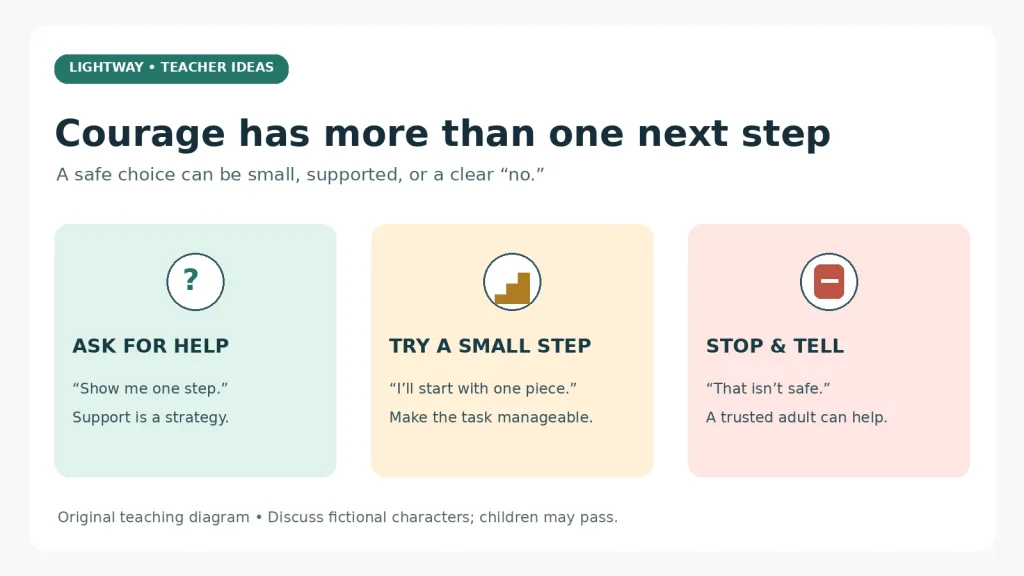
“Be brave” sounds encouraging, but it leaves a young child with a difficult question: what, exactly, should I do next? A useful kindergarten courage lesson gives children a safe action they can name, rehearse, and choose. It does not ask them to hide fear or prove themselves in front of the class.
How can children recognize courage in asking for help, trying a manageable step, and speaking up about an unsafe situation?
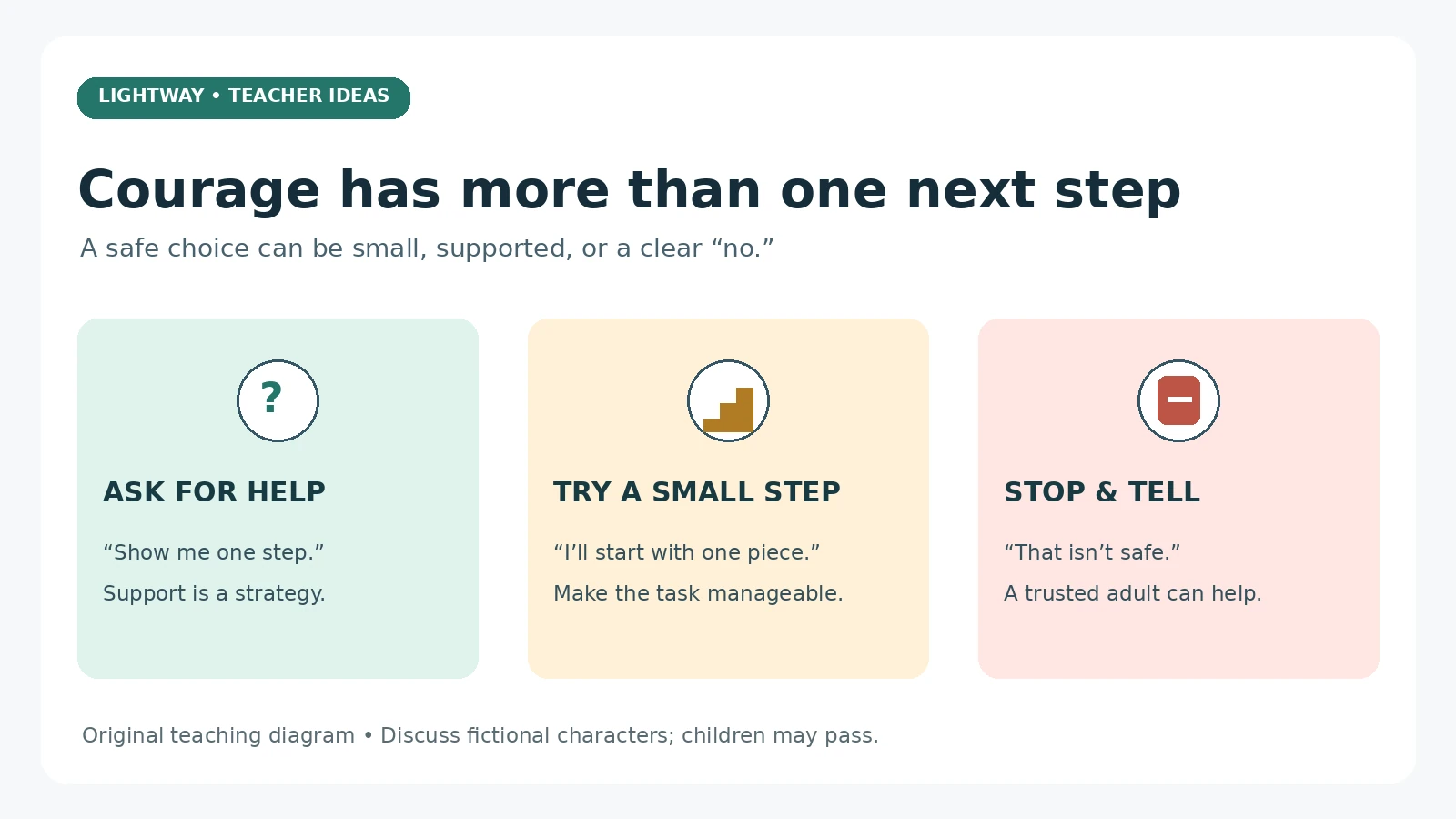
Start with a choice, not a personality label
For this lesson, describe courage as taking a helpful, safe step even when something feels difficult. Keep the emphasis on an action. “You asked for help when the task felt hard” tells a child more than “You are the brave one.” It also leaves room for the same child to need support tomorrow.
This is a classroom conversation, not an assessment of a child’s character or anxiety. Children do not need to disclose a frightening experience. They can talk about a fictional character, draw a possible response, point to a picture, or pass. A quiet answer is not less courageous than a public speech.
NAEYC’s guidance on young children’s social and emotional health emphasizes supportive relationships, emotional language, and opportunities to discuss story characters’ problems. The routine below is an original classroom application of those broad principles, rather than a tested intervention or a promise of behavioral change.
A 20-minute story-and-choice routine
Prepare a familiar picture book about a manageable challenge, two simple puppets, and three response cards: ask for help, try a small step, and stop and tell a trusted adult. Preview the story first. If it presents danger as a test of courage, discuss that distinction explicitly or select a different text.
- Notice the feeling, about three minutes. Ask, “What might the character be feeling? What in the picture or words makes you think so?” Accept more than one plausible answer. Model “might” so a facial expression is not treated as proof of an inner feeling.
- Name the difficulty, about four minutes. Ask, “What is hard for this character right now?” Separate a new learning task from an unsafe situation. They call for different actions.
- Offer choices, about five minutes. Show the response cards. Children select a card for the character and explain or point to the reason. More than one safe choice may fit.
- Rehearse language, about five minutes. Use puppets or partner practice. Children may watch first. Practice one usable sentence rather than an elaborate performance.
- Check understanding, about three minutes. Present a new fictional situation. Look for a suitable action, not for a declaration that everyone feels brave.
Three fictional situations you can use tomorrow
A new puzzle
Jo wants to try a puzzle but cannot find the corner pieces. Jo says, “I can’t do any of it.” What is one small next step?
Possible words: “Can you help me find one corner?”
A turn to speak
Amir has an idea about the story but does not want to tell the whole group yet. How could Amir share the idea?
Possible words: “Can I tell my partner first?”
An unsafe dare
A story character is asked to climb a high shelf to prove they are brave. What should the character do?
Possible words: “No. That isn’t safe. I’ll get an adult.”
The third example matters. If every answer is “try it anyway,” children may connect courage with ignoring safety or their own boundaries. Stopping, refusing, and seeking adult help can be the appropriate response. Do not stage an actual risky activity to make this point.
Teacher response notes: what counts as a good answer?
For the puzzle, a child might choose help, sorting a few pieces, or watching a model first. For speaking, drawing the idea, telling the teacher privately, or waiting for a later turn can also be reasonable. For the shelf, accept refusing and telling a trusted adult; do not praise climbing as persistence. Ask one follow-up: “How does your choice help the character stay safe or take part?”
Use feedback that describes the action
Keep feedback precise: “You noticed that you needed help and asked for it.” “You chose a smaller first step.” “You said no to something unsafe.” Avoid turning the discussion into a contest over who has the most dramatic story. A wall chart can record helpful phrases without naming or ranking children.
If a child chooses an unexpected response, ask what problem they are trying to solve. “Run away” might mean moving away from a dangerous situation, or it might mean avoiding a puzzle. The context changes the discussion. Model the safer or more useful alternative without shaming the child.
Make participation accessible
Offer picture choices before expecting full sentences. A multilingual learner can rehearse an idea in a familiar language, use a partner, or combine gesture and English. A child who communicates using a device should have the same response options. Keep the learning target separate from speaking speed, eye contact, or willingness to perform.
Repeat one sentence in an ordinary classroom moment later in the week. For example, before a new building activity, remind the class that asking for a demonstration is an available strategy. Do not announce that a particular child is being given a “bravery challenge.”
A small check that informs your next lesson
Say, “A character wants to join a drawing activity but doesn’t know where to start. Show one helpful choice.” Record whether each response identifies an appropriate action and, when possible, a reason. If several children choose the same card mechanically, change the situation and ask them to reconsider. The goal is flexible judgment, not memorizing a slogan.
For a longer story-based sequence, the Courage & Bravery Story Bundle on TPT is a related option. Check its public preview against your children’s language needs and the specific story you plan to use. The scenarios and routine in this article can also be taught with materials you already have.
Looking for a different kind of early-learning check? Our letter-matching routine similarly separates what children understand from how quickly they respond.
