
Ancient Mesopotamia · A source-based classroom activity
What can three everyday rules tell us about Babylon?
A Hammurabi lesson can quickly become a debate about shocking punishments. Start instead with a neglected field, an irrigation mistake, and a deposit of valuables. Students can investigate work, responsibility, and evidence before making a judgment about fairness.
This Hammurabi’s Code activity for middle school includes three short law paraphrases, a 40-minute sequence, discussion prompts, and an exit ticket you can use from this page.
Prepare the context before the debate
Hammurabi was a king of Babylon in Mesopotamia. The Louvre dates the famous inscribed stone monument, or stele, to about 1750 BCE. Its carved scene shows the king standing before Shamash, the sun god associated with justice.
The Louvre’s explanation of the stele describes a collection of legal judgments covering subjects such as property, trade, labor, and family. The familiar name “Code of Hammurabi” is useful, but students should not imagine a modern law book.
Project the photograph and ask: What might a ruler communicate by combining an imposing monument, a religious scene, and a long written text? Keep student interpretations separate from details they can actually see.
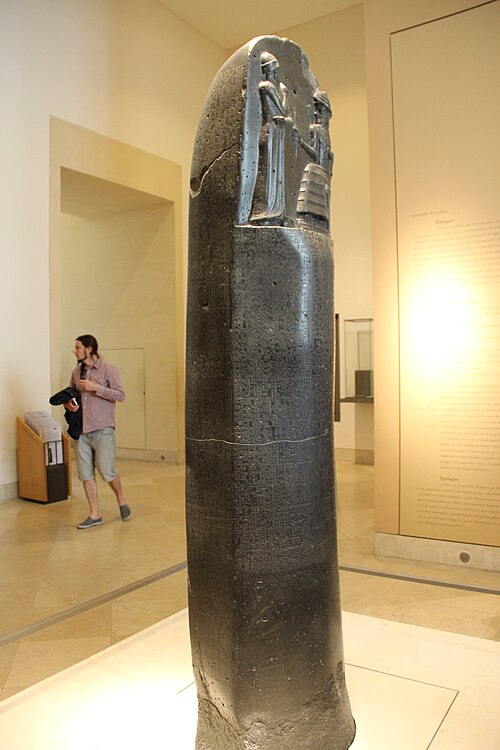
Before class: display or copy the three cards below, prepare a map showing Babylon and the Tigris–Euphrates region, and put four headings on the board: Problem • Required action • Inference • Limit. Students can make the organizer in their notebooks.
Vocabulary to teach: irrigation means supplying water to crops; compensation is payment for a loss; a witness observes an event and can give evidence about it; a contract records an agreement.
Three law cards for student analysis
These are modern classroom paraphrases, not direct quotations or a new translation. They follow laws 42, 55, and 122 in the older English translation hosted by Yale Law School’s Avalon Project. Keep the law numbers attached so students can check the source. In that translation, “corn” means grain, not specifically maize.
Law 42 · Work and responsibility
Card A: The field that produced no harvest
Classroom paraphrase: If someone takes a field to cultivate and it produces no harvest, and it is established that the person did not work the field, that person must give the owner grain in line with what neighboring fields produced.
Ask: What must be established before the payment follows? Why might neighboring fields be used as a comparison?
Law 55 · Water and neighboring farms
Card B: Water that damages another field
Classroom paraphrase: If someone opens irrigation ditches carelessly and floods a neighbor’s field, that person must compensate the neighbor with grain for the loss.
Ask: How could one farmer’s decision affect another household? What information would you need to work out the loss?
Law 122 · Agreements and evidence
Card C: Valuables left for safekeeping
Classroom paraphrase: Before handing silver, gold, or other property to someone for safekeeping, a person should show it to witnesses and draw up a contract.
Ask: What later disagreement might these steps help address? Does the use of a written contract tell us that everyone could read and write?
Run the 40-minute lesson
1. Open with a problem, not a verdict · 5 minutes
Give students this invented classroom scenario: Two neighboring farms use irrigation water. One farmer opens a ditch and water damages the other field. What would you need to know before deciding what should happen?
Collect questions about cause, care, damage, and evidence. Label this a modern teaching scenario, not a recorded Babylonian court case. Save students’ first reactions for the final comparison.
2. Establish who, where, and what · 5 minutes
Locate Babylon, introduce the stele, and read the context above. Ask students to complete: “This source presents ______ from the perspective of ______.” A workable response identifies legal judgments associated with a king. It should not treat the monument as a survey of everyone’s experience.
3. Investigate the three cards · 12 minutes
Pairs spend about four minutes on each card. For every law, record:
- Problem: What situation does the rule address?
- Required action: What payment, preparation, or responsibility does it describe?
- Inference: What might this suggest about the concerns represented in the collection?
- Limit: What question remains unanswered?
Model the difference between a detail and an inference. “Law 55 mentions grain compensation” is a detail. “Protecting a neighbor’s harvest mattered in this rule” is an inference grounded in that detail.
4. Compare explanations · 10 minutes
Invite pairs to support one claim using two cards. Then ask another pair to challenge its scope. Useful questions include:
- Which rules address a loss after it happens? Which tries to prevent a dispute?
- What kinds of work and relationships appear across these selections?
- Would the existence of a rule prove that people always obeyed it?
- Whose voices would help us evaluate how these rules affected people?
Return to fairness after the evidence discussion. Ask students to name their criterion: preventing harm, repairing a loss, treating people equally, or requiring evidence. Students can evaluate a historical rule while explaining its context.
5. Write, then revise · 8 minutes
Use the exit ticket below. Leave the last two minutes for students to replace an overstatement such as “all Babylonians” or “always” with a claim that their evidence can support.
Check understanding without another worksheet
Exit ticket
Prompt: What do these laws suggest about the concerns of Hammurabi’s law collection? Use two numbered examples, and identify one limit of the evidence.
Sentence frame: “Laws ___ and ___ suggest that ______ mattered because ______. These laws alone cannot tell us ______.”
Quick scoring: One point for an accurate claim, one for each of two relevant numbered examples, and one for a valid limitation. Use the four points to decide what needs reteaching, rather than grading the student’s opinion about fairness.
Teacher check: What might a strong answer include?
“Laws 42 and 55 suggest that responsibility for agricultural losses mattered in this collection. Law 42 links a grain payment to failure to work a field, while law 55 requires grain compensation for careless irrigation damage. The written rules alone do not tell us how often these situations occurred or how consistently decisions followed them.”
Other evidence-based claims are possible. Look for a connection between the examples, rather than a list of law numbers.
Self-check: Does Card A say every failed harvest was the farmer’s fault?
No. This card includes a condition: failure to work the field must be established. Ask students to underline that condition before explaining the payment. Do not turn one selected rule into a statement about every crop failure.
Self-check: Does Card C prove universal literacy?
No. A requirement for a written agreement does not identify who wrote it or establish everyone’s ability to read. Students would need additional evidence about writers, readers, and record-making.
Support readers and extend the inquiry
- For students needing reading support: read each card aloud, mark the condition in one color and the required action in another, and let students rehearse an explanation with a partner before writing.
- For multilingual learners: pair the vocabulary with simple sketches and allow a first explanation in a familiar language. Keep the law number and evidence in the final response.
- For a shorter class: use Cards B and C for a 20-minute comparison of compensation and written evidence.
- For an extension: compare one paraphrase with the matching numbered passage at Yale. Ask what wording became easier and what nuance needs checking. Then identify another kind of source that could test the class’s claim, such as a contract or a record of a specific dispute.
Teacher questions
Should students begin with “Was Hammurabi fair?”
Use it after students have examined the source. Begin with what a rule says, what problem it addresses, and whose perspective it presents. Then ask students to state a fairness criterion and defend their evaluation with evidence.
Do these three laws represent the whole collection?
No. They are a deliberately narrow, non-graphic entry point into work, property, and responsibility. Explain that the wider collection covers many other topics and includes social inequalities. Do not describe Babylonian society as uniformly fair on the basis of these cards.
Can I run the activity without printing or student devices?
Yes. Project or read the cards one at a time while students use a notebook organizer. The essential response is a claim supported by numbered evidence and a limitation. Open the teacher checks yourself when you are ready to discuss them.
Sources and teaching notes
- Musée du Louvre: The Code of Hammurabi supports the monument’s date, imagery, and explanation of the law collection.
- Yale Law School, Avalon Project: Code of Hammurabi provides the numbered English text used for Cards A–C. Its older wording is useful for source comparison; it should not be mistaken for a current critical translation. Review the full text before assigning it because it includes sensitive material.
- The lesson sequence, classroom scenario, organizer, and assessment are teaching suggestions. The cards are labeled paraphrases so students can distinguish an ancient source in translation from a modern adaptation.

