
Practical teaching ideas
Teach oral blending and segmenting with a ten-minute kindergarten routine, clear teacher prompts, sound-counter practice, and separate checks for each skill.
A child who can repeat three separate sounds may still need help putting them together. Another child may recognize the spoken word “sun” but struggle to pull it apart. Blending and segmenting move in opposite directions, so it helps to teach their purposes clearly and check each one separately.
This short routine gives you a practical way to do both. Use it with a small group or adapt it for a whole-class warm-up. You need a few counters, familiar words, and ten minutes. The timing is a suggested classroom structure, not a research-tested program or a promise about how quickly children will progress.
Make the difference visible
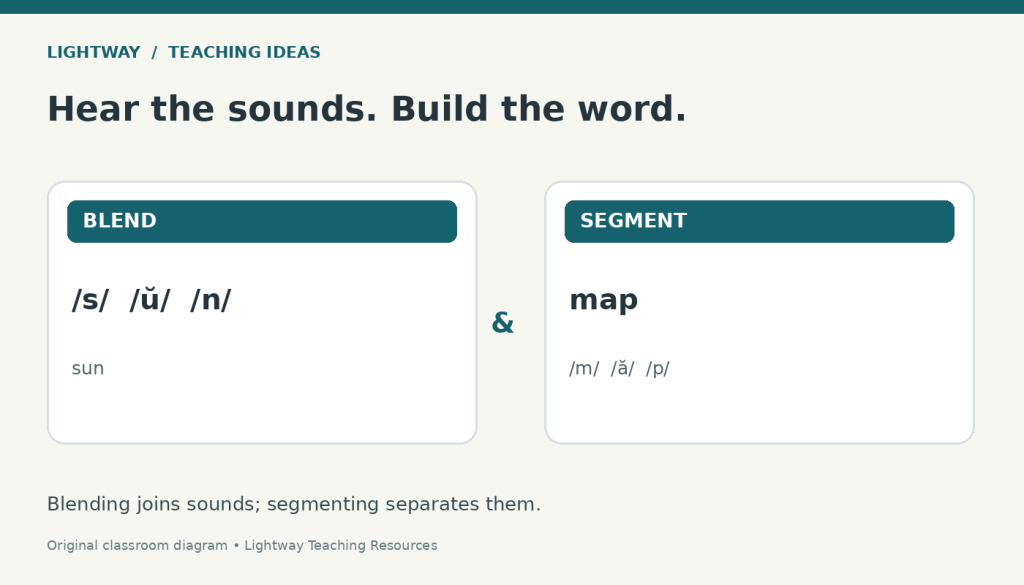
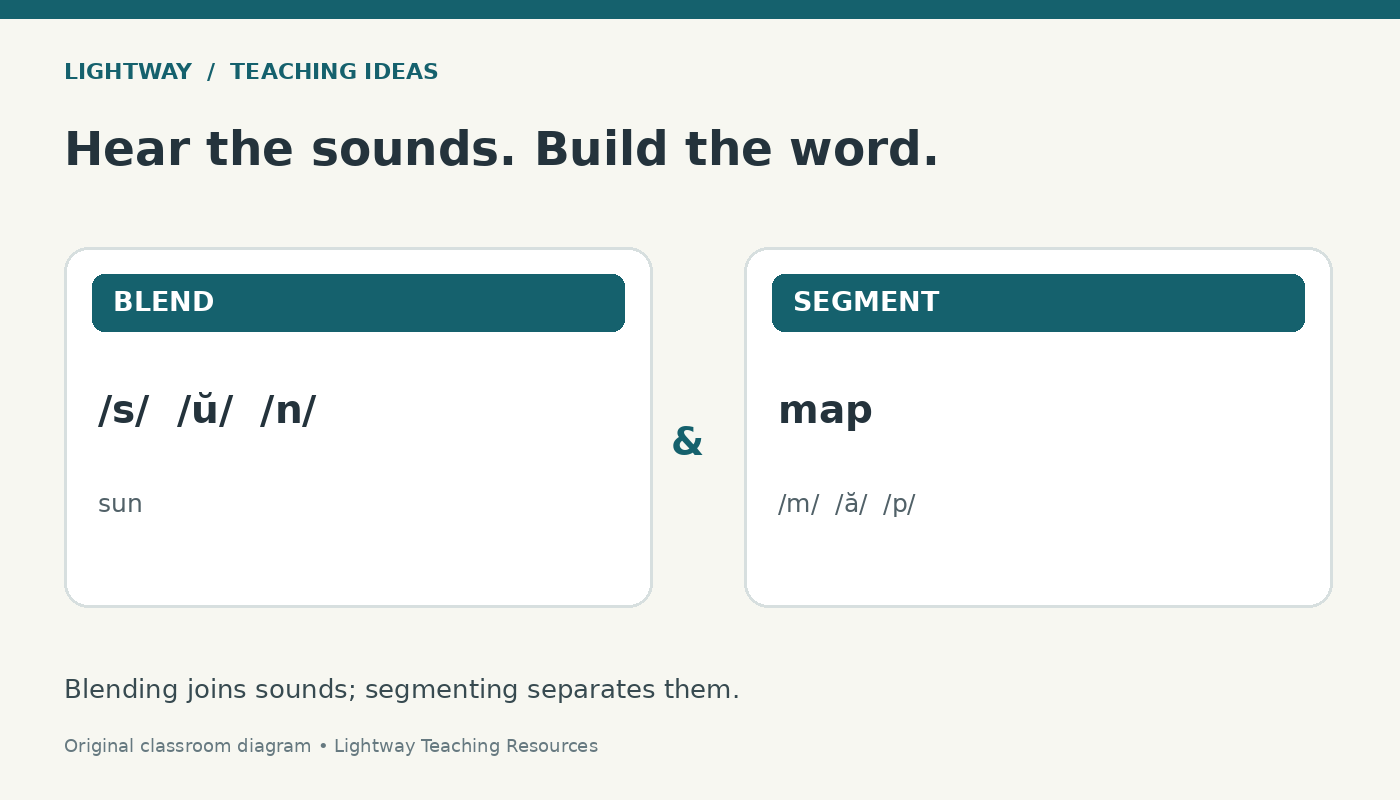
Oral blending means combining spoken sounds into a word: /s/ /ŭ/ /n/ becomes “sun.” Oral segmenting means starting with the word and identifying its individual sounds: “sun” becomes /s/ /ŭ/ /n/.
Both are phonemic-awareness tasks because they involve individual speech sounds. Phonological awareness is the broader term that also includes larger sound units, such as syllables. Counting the syllables in “sun” gives one; identifying its phonemes gives three.
For children, keep the explanation simple: “When I give you sounds, put them together. When I give you a word, tell me its sounds.” Bring your hands together for blending and move three counters apart for segmenting.
The IES foundational-reading practice guide recommends developing awareness of speech sounds alongside their connections to letters. This routine therefore ends with a brief link to already-taught letter–sound relationships. Oral practice should sit within broader literacy instruction, including phonics, vocabulary, reading, and writing.
Prepare before the timer starts
Give each child three counters and a strip of paper with three empty boxes. Have two-box strips available for children starting with two-phoneme words.
Select four familiar words: “am,” “sun,” “map,” and “sat.” Check that children know their meanings. Keep extra words ready rather than making the lesson longer: “in,” “sit,” and “fan.” Say each word yourself before teaching to check its sound sequence in your pronunciation.
Slashes below indicate spoken sounds, not letter names. Say /m/ rather than “em,” and avoid adding an extra “uh” to consonants. Stretch sounds that can be sustained, such as /s/ and /m/. Keep stop sounds, such as /t/ and /p/, brief.
Minutes 0–1 Build a shared meaning
Say “sun” naturally and use a quick picture or gesture to confirm its meaning. Ask: “What word are we going to listen to?” Children answer, “Sun.”
Explain the two actions, then demonstrate each once. Avoid asking children to guess a picture’s label while also trying to analyze an unfamiliar word. A child who calls a picture “sunshine” is working with a different sound sequence.
Minutes 1–3 Blend sounds into words
Model “am”: “Listen: /ă/ /m/. When I put those sounds together, I say ‘am.’” Repeat with the group, then use “sun.”
For “sun,” say /s/ /ŭ/ /n/ with very short gaps. Sweep a finger across the empty boxes as children say the whole word. Ask individuals, “What word?” before inviting the class response, so louder voices do not hide uncertainty.
If a child repeats the separate sounds, provide the missing model: “Those are the sounds. Listen as I join them: sssŭŭŭnnn, sun. Now you try.” Return to “am” if three sounds are too much. Success with a supported example gives you a better next step than repeated guessing.
Minutes 3–5 Segment words into sounds
Change the cue: “Now I give you the whole word: map. Tell me each sound.” Say /m/ /ă/ /p/, moving one counter into each box as you speak.
Have children repeat the word naturally, then push one counter for each sound. Ask, “How many sounds did we hear?” The model answer is “Three: /m/ /ă/ /p/.”
If a child moves one counter for the whole word, say, “You showed the word. Watch me show the sounds inside it.” Model slowly and let the child try again. Avoid clapping here if clapping has previously meant counting syllables; use the counter movement consistently.
Minutes 5–7 Switch the job
Use two short rounds to make the direction explicit:
- Teacher: “Blend: /s/ /ă/ /t/.” Child: “Sat.”
- Teacher: “Segment: sun.” Child: “/s/ /ŭ/ /n/,” moving three counters.
Ask, “Did we start with a word or with separate sounds?” A correct answer helps show that children understand the task rather than copying a movement.
For a child needing more support, keep one task at a time and use a fresh word after another model. Switching quickly is optional; clear understanding matters more than finishing every example.
Minutes 7–9 Connect sounds to taught letters
Choose “map” only if children have already learned the relevant letter–sound relationships. Replace the counters with m, a, and p. Say the sounds while pointing to the letters, then blend and read the word.
Ask, “Which letter represents the first sound?” The answer is m for /m/. Have children build the word from the three letters and read it again. With written letters now included, this part also practices phonics.
If those letters are unfamiliar, use a different word your phonics sequence supports. Do not hold children in oral-only practice until they achieve perfect performance on every sound task. Keep the oral examples manageable while teaching appropriate sound–letter connections explicitly.
Minutes 9–10 Take a tiny individual check
In a small group, ask each child one blending question and one segmenting question. For example, “Blend /s/ /ĭ/ /t/” and “Tell me the sounds in map.” Expected answers are “sit” and /m/ /ă/ /p/.
Record each skill separately as independent, supported, or not yet demonstrated. In a large class, check a few children individually and rotate across sessions. A correct chorus alone cannot tell you what each child can do.
Use tomorrow’s lesson to respond
If a child blends successfully but needs segmenting support, spend more time moving counters after a clear model. If segmenting is stronger, practice joining two sounds with minimal gaps before adding a third.
For multilingual learners, teach word meanings and accept relevant accent or dialect differences. For children with speech-production difficulties, use responses that distinguish understanding from pronunciation, such as selecting a named picture during blending, and coordinate with the child’s usual support team when appropriate.
Children ready for extension can segment “fish”: /f/ /ĭ/ /sh/. It has three sounds, even though its spelling has four letters. Introduce that spelling connection only when it fits your phonics teaching.
For additional practice options, explore the Florida Center for Reading Research’s kindergarten and first-grade activities and IES family reading activities. Choose activities that match what you have taught, then use individual responses to decide what comes next.
For optional teacher-led picture-choice practice, Lightway’s Kindergarten Oral Blending Practice provides 36 visual PowerPoint slides.
For broader classroom planning, see our guide to supporting a mixed-ability classroom. Keep the skill goal shared while adjusting the number of sounds, modeling, and response support.
Quick check: How many sounds are in fish?
Three: /f/, /ĭ/, and /sh/. Four letters represent those three sounds. Connect that spelling to phonics only when the letter patterns have been taught.
Sources for teachers
- IES foundational-reading practice guide
- Florida Center for Reading Research’s kindergarten and first-grade activities
- IES family reading activities
The classroom sequence and diagrams are original teaching suggestions, not a tested intervention or a guarantee of learning outcomes.
