
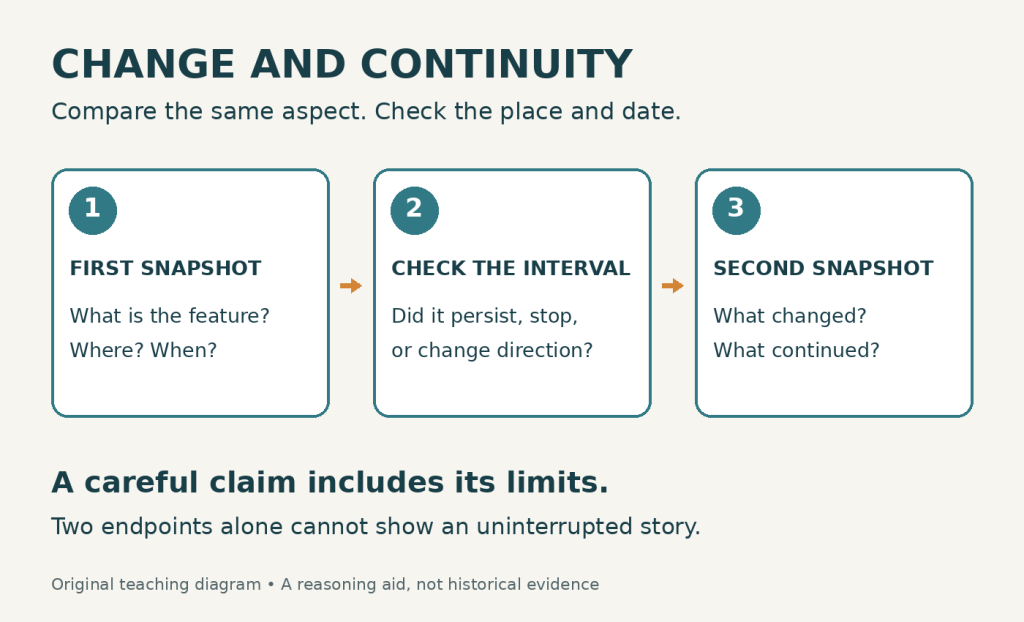
A pupil compares two dates and writes, “Before, Rome was powerful. After, everything had collapsed.” The sentence has a contrast, but its subject keeps shifting: a city, an empire, and everybody’s lives have become one thing. A useful change-and-continuity lesson teaches pupils to hold the aspect being compared steady, identify where a claim applies, and look between the endpoints.
This 35-minute sequence suits a Grade 7 or lower-secondary class with introductory knowledge of Rome. It uses selected evidence from the Roman world between about 300 and 600 CE, with working snapshots around 300 and 550.
Make the comparison smaller than the topic
“How did Rome change?” invites an unmanageable answer. Start with: How far did imperial government and its public imagery change between about 300 and 550 CE? Define imperial government as government under an emperor. Public imagery means the images rulers put before people, including on coins.
The Historical Thinking Project’s guidance on continuity and change encourages attention to changes and continuities occurring together. Turn that principle into three classroom questions: What aspect are we comparing? Where does the evidence apply? What happened between the dates?
Continuity requires a named feature: “emperors still appeared on coins” is useful; “some things stayed the same” is not. Likewise, a change in official religious imagery does not establish that every person changed their beliefs.
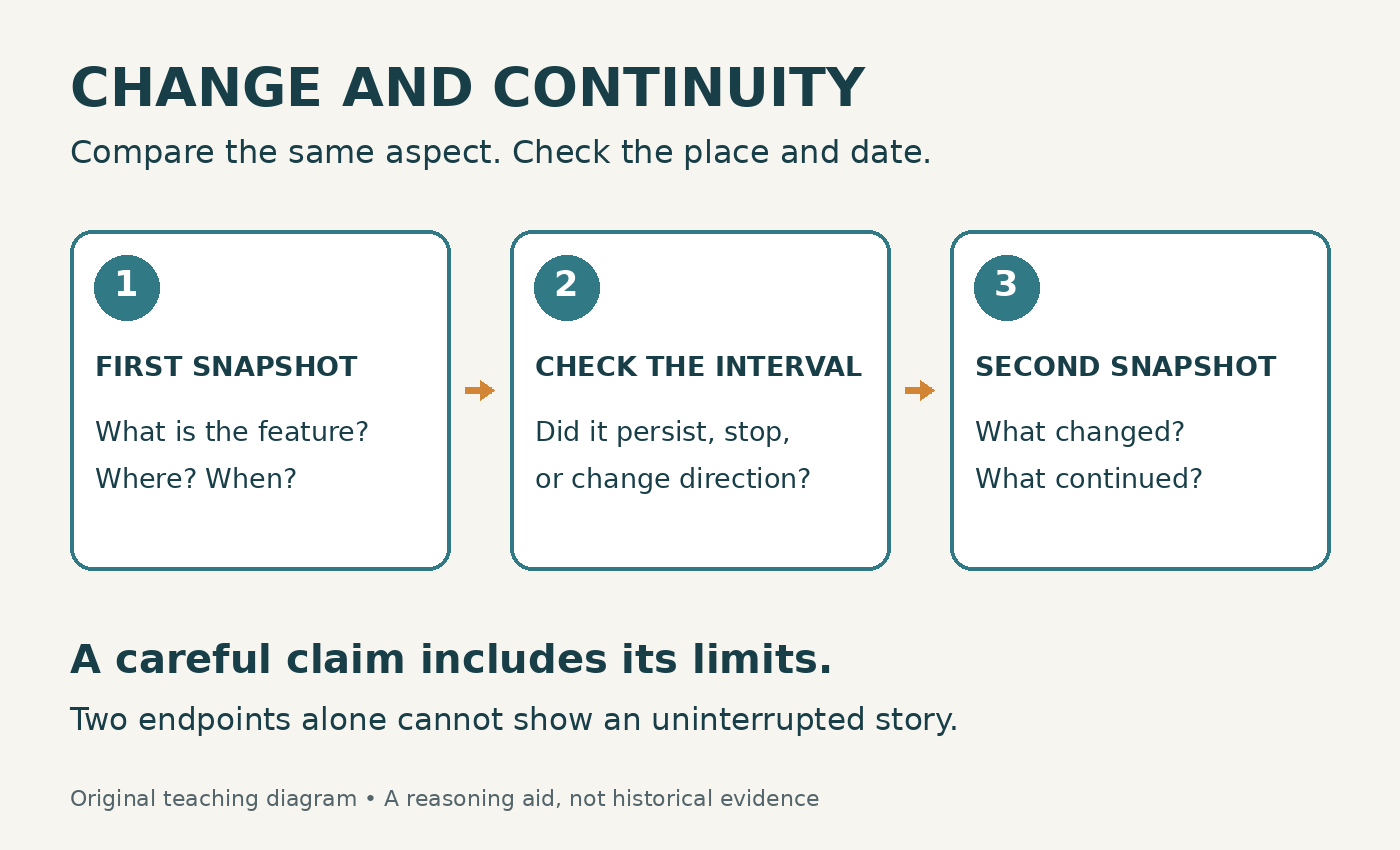
- First snapshot: name an aspect, place, and date.
- Between the snapshots: check for persistence, interruption, or reversal.
- Second snapshot: compare the same aspect and state the claim’s limits.
Prepare four short evidence cards
Give pairs the following summaries with their source links. Label Cards A and B “modern descriptions of surviving objects” and Cards C and D “modern historical accounts.” Keep the supplied date ranges: “about 550” is a classroom comparison point, not an exact minting date. The cards below are modern classroom paraphrases, not quotations from ancient witnesses.
- Card A: an emperor’s coin, 300–303. The American Numismatic Society records a gold coin issued under Diocletian at Thessalonica, in today’s Greece. One side shows the emperor’s head; the other shows Jupiter with a thunderbolt and sceptre. Record the named ruler, mint, date range, and religious figure.
- Card B: an emperor’s coin, about 545–565. The Cleveland Museum of Art’s solidus of Justinian I was made at Constantinople, today’s Istanbul. It shows the emperor holding a cross-topped orb, with another cross-bearing figure on the reverse. Compare ruler imagery and religious symbols. These are two selected coins from different mints, not a complete sample of imperial money.
- Card C: changing political arrangements. Around 300, Diocletian shared imperial authority through the four-ruler arrangement established in 293. In 476, Odoacer deposed Romulus Augustulus in Italy. The eastern empire continued. These points appear in the Metropolitan Museum’s Roman Empire overview. A separate Met essay on Byzantium describes government centred on Constantinople, continuing Roman law, and Justinian’s sixth-century territorial gains. “Roman” remained an identity claimed in the eastern empire.
- Card D: a regional check. Roman imperial rule in Britain ended in the early fifth century, according to English Heritage’s Roman Britain overview. Britain therefore cannot stand for the eastern empire, where imperial government survived. Nor can Constantinople stand for every former western province.
Add one checkpoint from OpenStax’s account of the eastward shift: Constantine supported Christianity during the fourth century, while Julian later attempted a revival of traditional polytheist worship. This makes a simple, uninterrupted religious transition harder to assume. Explain “polytheist” as worship involving multiple gods.
Run the 35-minute classroom sequence
- Minutes 0–4: expose the oversized claim. Display: “After 476, Roman government and Roman ways of life disappeared everywhere.” Ask pupils to underline words that require especially wide evidence. Expect “ways of life,” “disappeared,” and “everywhere.” Tell them their job is to replace this sentence with a smaller, defensible judgment.
- Minutes 4–9: model one comparison. Read Cards A and B aloud and, where available, project the linked museum images. Model: “Both selected coins show an emperor. Their religious imagery differs.” Separate observation from inference: the images support claims about official representation; they cannot reveal everybody’s private beliefs.
- Minutes 9–16: build matched rows. Pairs make two rows on paper, headed “imperial government” and “official coin imagery.” Give each row four spaces: earlier evidence, later evidence, change or continuity, and geographical limit. Allow “both” in the third space, but require pupils to explain which feature changed and which persisted.
- Minutes 16–23: investigate the interval. Introduce Cards C and D and the religious checkpoint. Ask: “Does our endpoint comparison conceal an interruption or a different regional story?” Pupils add one intervening development and revise one overgeneralisation. Keep Britain and the eastern empire separately labelled. Two snapshots alone cannot establish the speed of change across the whole interval.
- Minutes 23–31: write and challenge. Pupils write 80–110 words answering the enquiry. Require one change, one continuity, two specific pieces of evidence, and a scope limit. Partners circle the geographical wording and ask, “Does this evidence support that whole claim?” Give writers two minutes to improve their answer after that challenge.
- Minutes 31–35: collect an individual exit check. Use the three prompts below. Read them for comparison quality rather than the number of dates remembered.
Show what a supported pupil answer sounds like
Model answer, written for this guide: “Imperial government changed unevenly between about 300 and 550. Diocletian shared authority with other rulers around 300. The deposition in Italy in 476 was a major western political change, but emperors continued to rule from Constantinople. The selected coins also show change and continuity: Diocletian’s coin depicts Jupiter, whereas Justinian’s carries Christian symbols. Both put the emperor on gold money. This supports continuity in representing imperial authority, alongside changed religious imagery. It does not show that everyone’s beliefs changed together. Britain had already lost Roman imperial rule, so the eastern example cannot describe the whole former empire.”
Ask pupils to identify the comparison words and the sentence that limits the conclusion. The final limitation earns its place because it changes what the answer can legitimately claim.
Correct three predictable mistakes
- Comparing different aspects: “The early empire had emperors; the later period had Christianity.” Ask for earlier and later evidence about government, then do the same for religion.
- Treating a label as proof: “Byzantine” does not by itself demonstrate a complete break with Rome. Ask what institutions or practices the evidence identifies.
- Assuming a smooth line: matching features at two dates show similarity at those points. Evidence from the interval is needed before claiming uninterrupted continuity.
Support, extend, and check understanding
For support, pre-highlight the dates and places on each card, explain “mint” as a place where coins are made, and provide: “In ___, ___ changed, as shown by ___. However, ___ continued.” Let pupils rehearse aloud before writing. Keep the requirement to qualify a claim.
For extension, ask which evidence would help investigate whether a political change represented improvement or decline for a particular group, such as taxpayers in one province. Pupils should name the group, the criterion, and the additional evidence needed. The supplied coins cannot settle that question.
Exit check: Name one continuity supported by both coins. Explain why Britain and Constantinople need separate geographical labels. Identify one question that two endpoint snapshots cannot answer. A successful response makes a precise comparison, limits its reach, and recognises what remains unknown.
Related Lightway lesson
For a broader exploration of the western empire’s decline, see Lightway’s Fall of Rome & Roman Empire Decline | Grade 7 History Full Lesson on Teachers Pay Teachers. The product listing describes slides, worksheets, interactive notebook activities, task cards, assessment materials, and digital games. The comparison routine in this guide is an additional teaching suggestion.
