
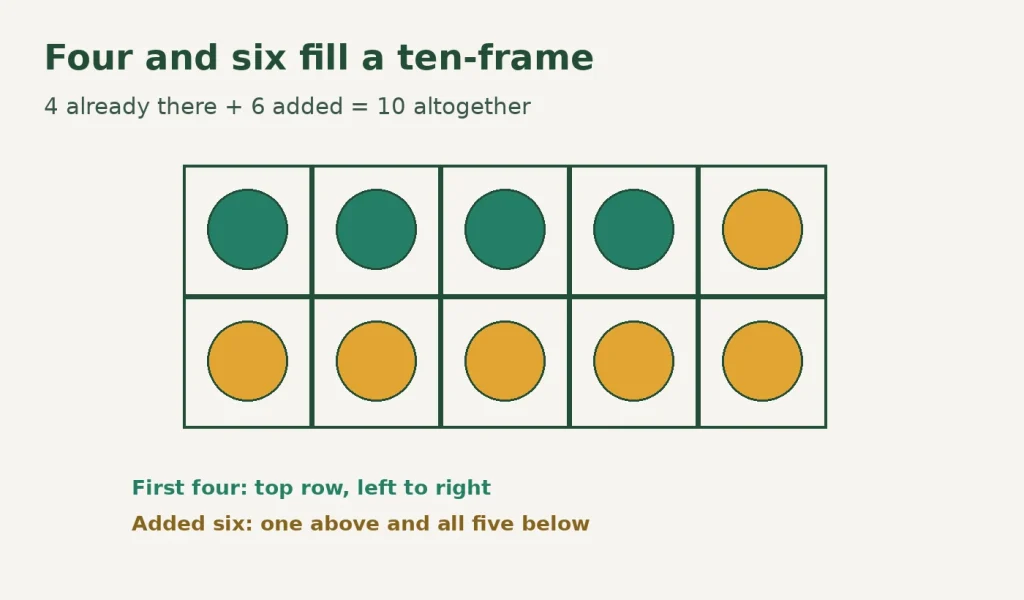
Put four counters on a table and ask how many more are needed. The question is incomplete. Four needs two more to make six, but six more to make ten. Children who remember a number partner without checking the whole can look confident while solving a different problem from the one you intended.
A useful make-ten lesson therefore begins before the missing-part question. Establish the whole, build the known part, and make the unfilled space visible. Then ask children to explain how the parts belong to that whole. This gives counting, drawing, moving counters, and equations a common meaning instead of treating them as separate activities.
Name the whole before hiding a part
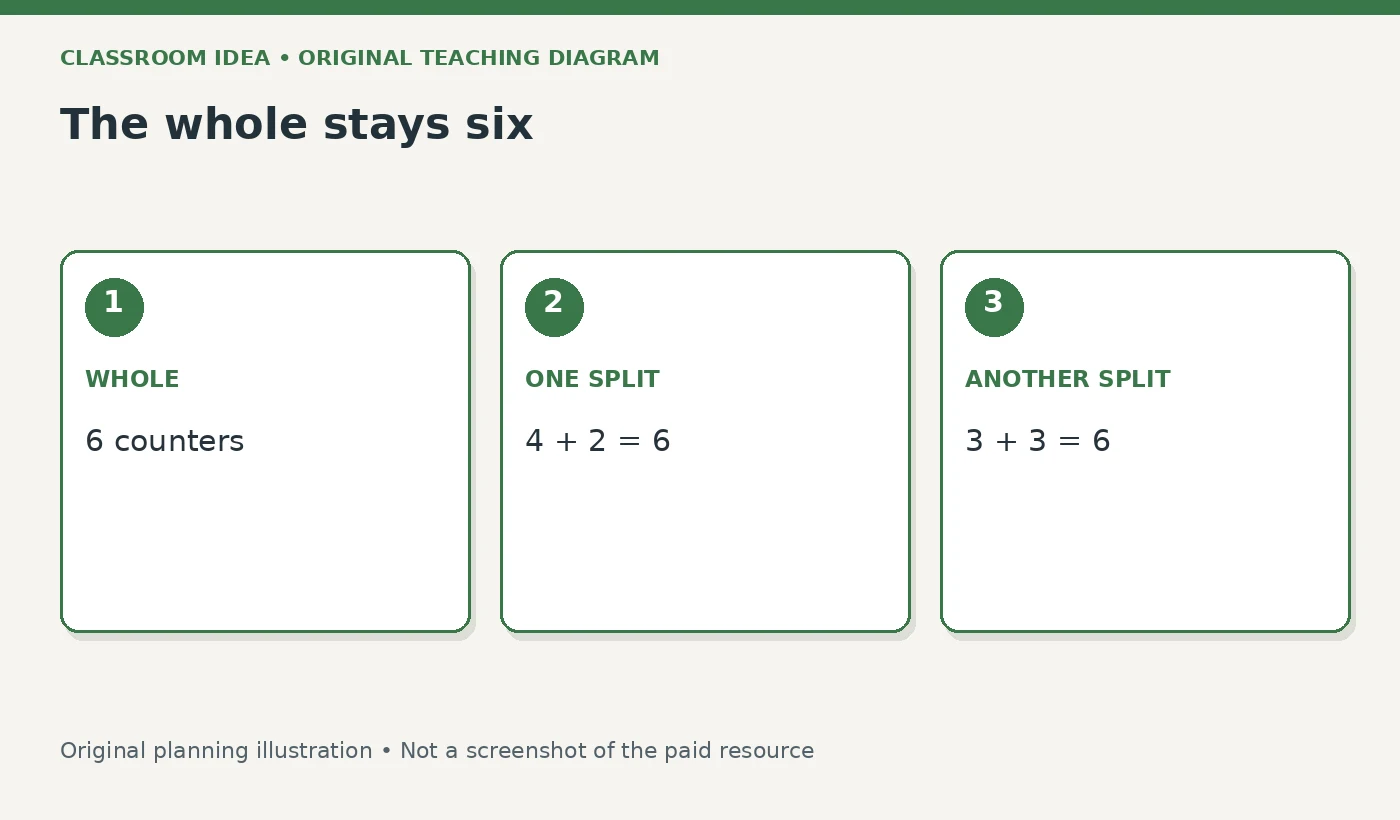
Start with a whole the child can count and keep track of comfortably. Place six counters together and count them once, matching each spoken number with one object. Move the counters into two groups without adding or removing any. Ask, “How many are here altogether? How do you know we still have six?” Recounting is acceptable while the child develops confidence in the relationship.
Record a clear statement: the whole is six; the parts are four and two. Do not require numerals from a child who can explain with objects, gestures, pointing, or speech. An adult can record an equation after the relationship is established. The IES guide to teaching math to young children recommends a developmental progression in number and operations. It supports choosing a starting point from observed understanding rather than assuming every child is ready for the same abstraction.
Move from a two-part workspace to a ten-frame
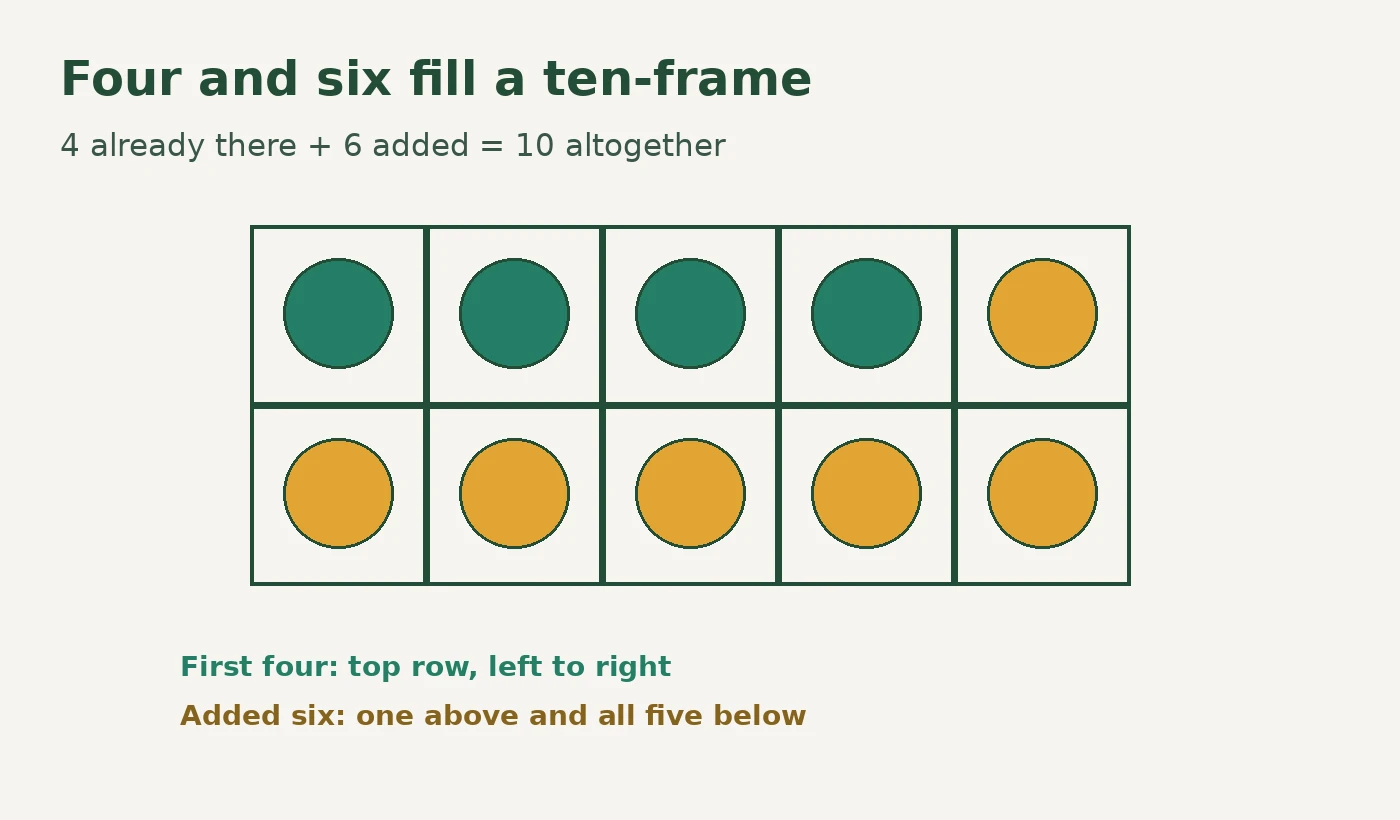
A two-part workspace makes the groups visible, but it does not by itself specify the total. A ten-frame adds a fixed structure: two rows of five spaces. Place four counters into the frame, one counter per space, and say explicitly that the target is a full frame of ten. The unfilled spaces now represent the missing part.
Ask the child to fill those spaces with counters of another color or shape. Color can help, but position and separate outlines should also communicate the groups. Count the added counters together. Then look at the completed frame and describe both parts: four already there, six added, ten altogether. Keep the original four in place so the learner can compare before and after.
An original three-round activity
Round 1: build the whole you name
Use six counters and two bowls or marked spaces. Invite the child to choose one split, such as one and five. Rearrange the same counters to make another split, such as three and three. Ask whether either arrangement changed the whole. Record or draw both. This round focuses on decomposition; it is not yet specifically a make-ten task.
Round 2: complete a whole of ten
Show a ten-frame with seven spaces occupied and ask the child to build the missing part. Let the learner count empty spaces, use the row of five as a reference, or place counters directly. Discuss three as the missing part. Next try eight and then five, leaving time to explain rather than rewarding the first shouted answer.
Round 3: compare the same starting part
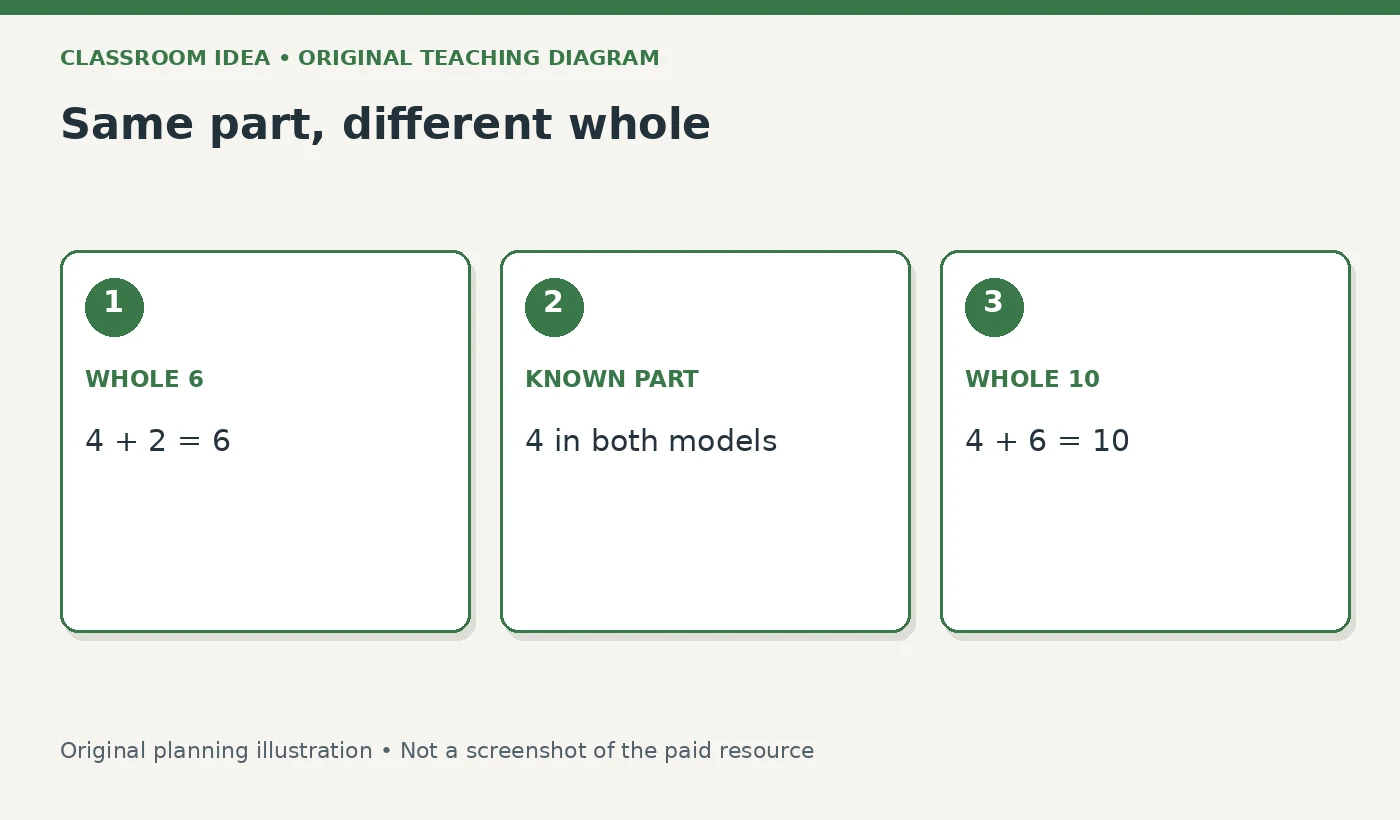
Place four counters in each of two workspaces. Label one whole six and the other whole ten, using a spoken explanation and objects as needed. Ask children to complete each whole. Keep both finished models visible. The important comparison is not simply that two and six are different answers: the target totals are different, so the same known part has a different missing partner.
Use zero without making it mysterious
A split can leave one part empty. Put all six counters in one part of the workspace and none in the other. Ask what is in each part and what remains true about the whole. An empty group is still meaningful in the model. Likewise, a full ten-frame needs zero additional counters to reach ten.
Do not introduce zero only as a trick question. Include it alongside other arrangements and use the same language: parts and whole. If a learner adds counters to an already full frame, return to the target and count the actual spaces. Avoid saying that the child “does not understand zero” after a single response; the difficulty may lie in interpreting the instruction or noticing that the frame is complete.
Read mistakes as information
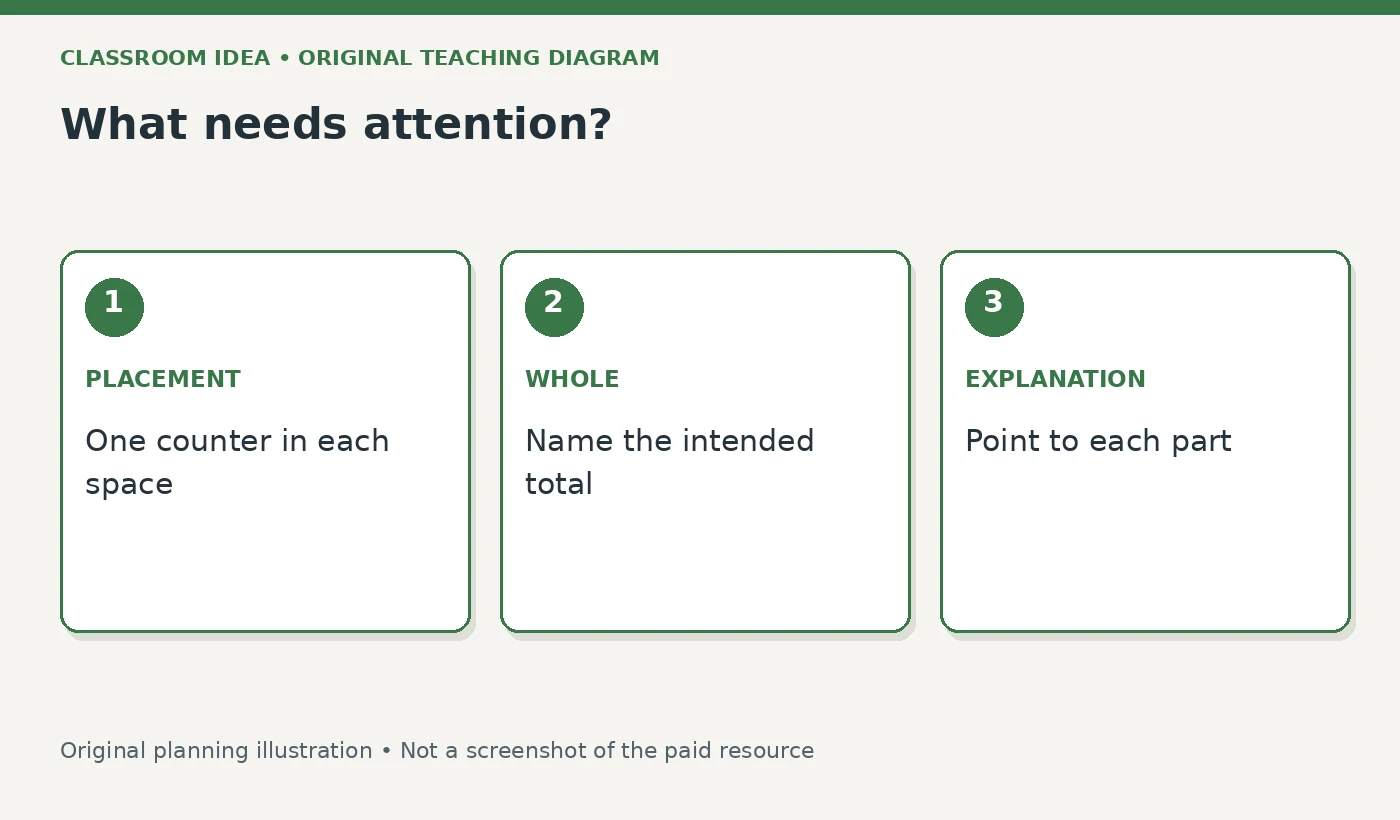
If a child places two counters in a space, revisit one-to-one placement before using empty spaces to represent a missing part. If the learner says seven plus four makes ten, ask them to build the complete model and inspect the extra counter. If the learner gives six as the missing partner whenever four appears, compare the six-whole and ten-whole workspaces again.
If a child produces the correct equation but cannot connect its numbers with the model, ask the child to point to the known part, the added part, and the entire collection. Conversely, a child who builds and explains correctly but reverses a written numeral needs a different response from a child who changes the whole while partitioning. Keep those observations separate.
A short check with explanations and answers
- The whole is ten. Six counters are already in the frame. Build the missing part.
- The whole is six. Four counters are in one part. Show the other part.
- The whole is ten. Four counters are in one part. Show the other part.
- A ten-frame is full. How many more are needed to make ten?
Open the answers and what to listen for
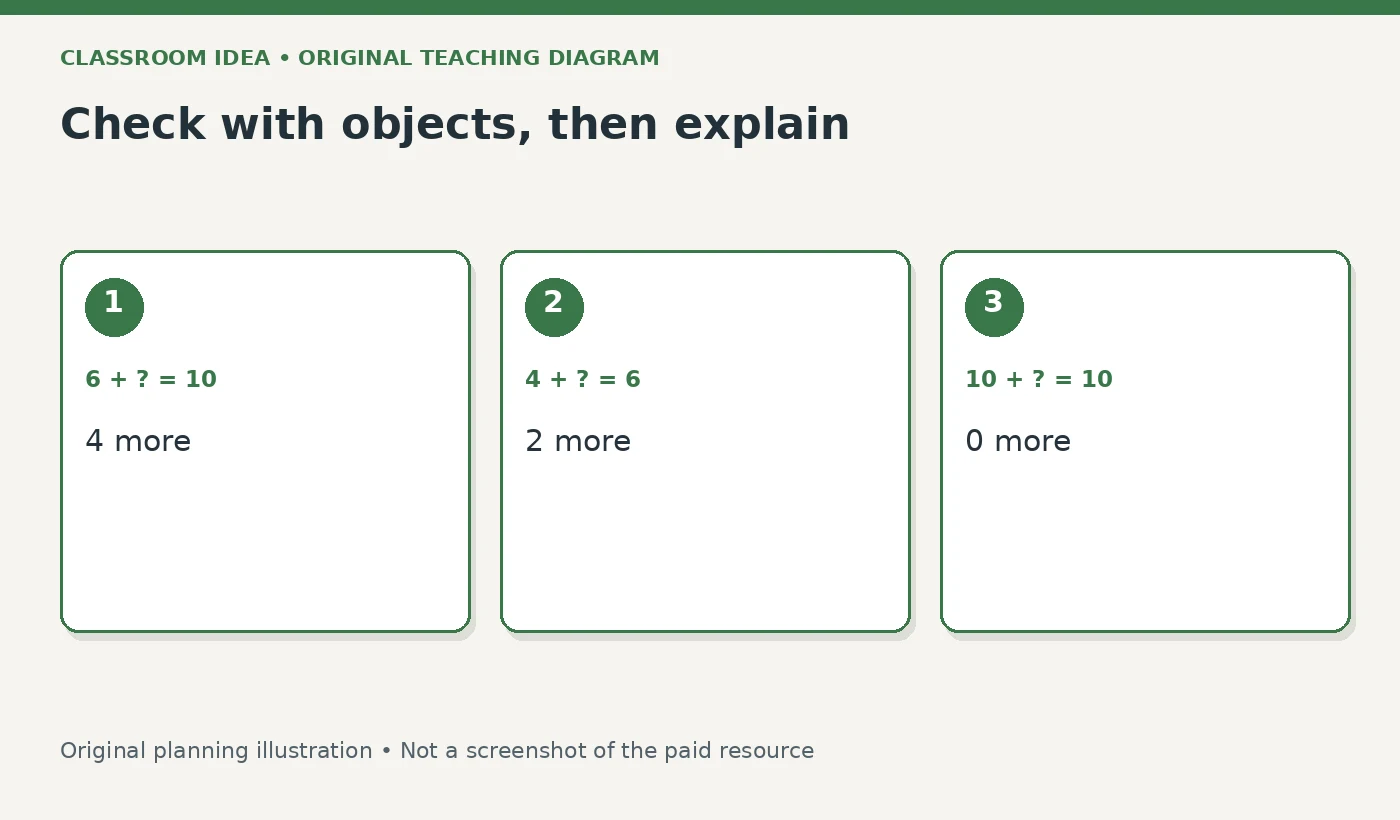
1: Four more. 2: Two. 3: Six. 4: Zero. For questions 2 and 3, listen for an explanation that the whole changed. A correct answer alone does not reveal the strategy used. Ask learners to demonstrate with objects or point to the relevant spaces. Accept an accurate counting strategy; a quick recall response is not the only useful response.
Common Core K.OA.A.4 addresses finding the number that makes ten with a given number from one through nine and recording the answer with a drawing or equation. The comparison with a whole of six is a supporting instructional contrast, while the zero example extends the discussion beyond that standard’s stated given-number range. Check your own curriculum; this connection is not a claim that all jurisdictions use the same standards.
Choosing a prepared pack
The Make 10 and Decomposing Numbers mini-pack includes 25 slides with native notes, 12 printable cards, four student worksheets, a Teacher Guide, answer key, and observation form. Its final worksheet compares wholes of six and ten. Supply safe real counters and a suitable workspace; student artwork is fixed, and native notes and Word guide text are editable. The scope stays within ten.
For planning the teaching sequence, use informal observations to decide whether to return to counting collections, comparing two parts, or completing the ten-frame. Keep the whole visible in your question as well as in the materials.
