
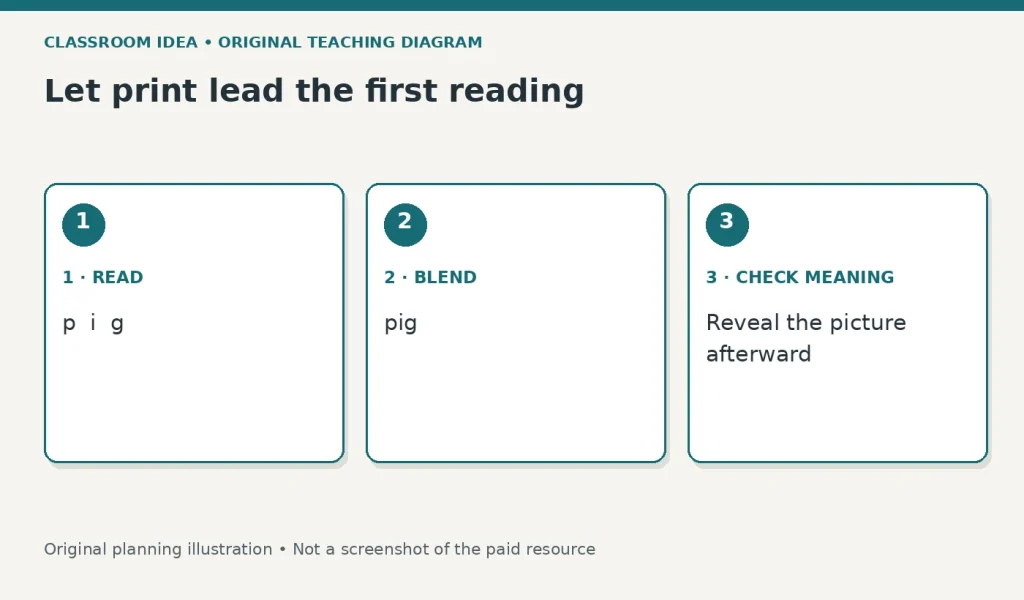
A child sees a picture of a pig beside the letters pig and says the word immediately. That response may show good vocabulary. It does not, by itself, tell us whether the child read the letters. To find out, change the order of the task: let print do the work first, then use the picture to discuss meaning.
This short routine is designed for children who have already been taught the letter–sound correspondences in the selected words. It is a practice sequence, not a way to introduce every correspondence at once or a complete phonics curriculum. The useful question is specific: can the child connect these letters to sounds, blend the sounds, and recognize the resulting spoken word without a picture supplying the answer?
Separate three jobs that can look like one
Keep decoding, oral vocabulary, and picture matching visible as different jobs. Decoding connects the printed sequence with a spoken word. Vocabulary concerns the meaning of that spoken word. Picture matching asks whether the learner can identify an appropriate illustration. A child can succeed at one and need support with another.
The IES foundational-reading practice guide recommends explicit work connecting speech sounds with letters and teaching children to decode words. The routine below is an original classroom application of those broad recommendations; it is not a separately tested intervention or a promise of a particular outcome.
Prepare a small, teachable word set
For short i, a useful bounded set is pin, pig, wig, fin, sit, lip. Check the correspondences before selecting the whole set. If a child is still learning w, for example, do not interpret difficulty with wig as evidence that the child cannot blend. Teach or revisit the unfamiliar correspondence, or temporarily use a smaller set containing known letters.
Have word-only cards, separate pictures, paper or a whiteboard, and three safe counters available. Keep the pictures out of view for the first reading. Explain the routine simply: “We will read the letters. Then we will look at the picture and talk about the word.” Avoid a timer. A correct response reached through careful sounding out is useful evidence, not a failure to read quickly enough.
Model one word, then let the learner do the work
- Show the print. Display pin without an illustration. Point beneath the letters in order.
- Connect letters and sounds. Model each taught sound accurately. Keep the stop consonant brief; avoid adding an extra “uh” that would make blending harder.
- Blend and reread. Move through the sequence, then say the whole word naturally. Ask the child to read the same printed word.
- Check meaning afterward. Reveal the picture. Explain that a pin is a small object used for fastening, using a safe illustration rather than handing out a sharp object.
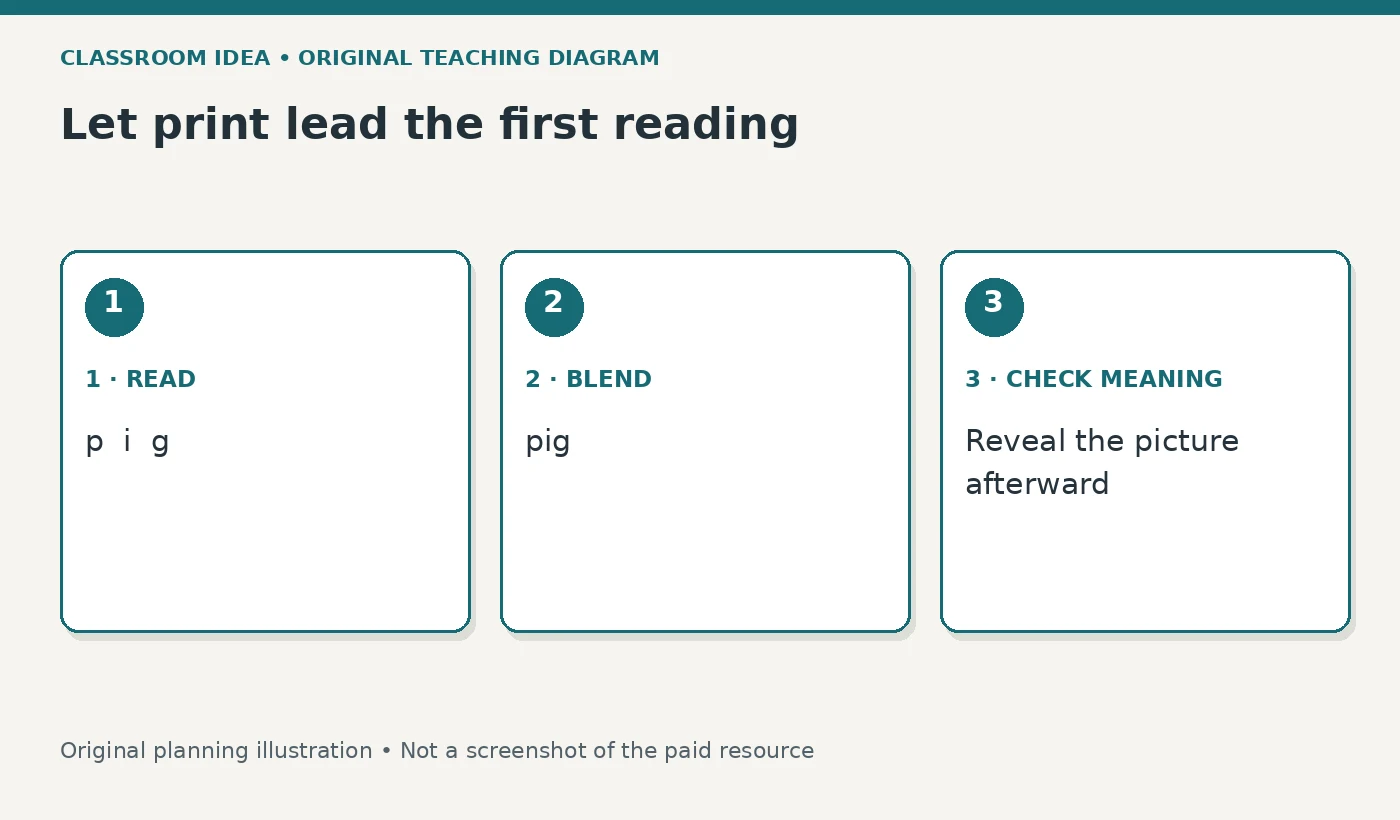
Next show pig. Let the child attempt it before you model. If the learner reads pin again, point back to the final letter and ask which sound it represents. The correction should return attention to the changed print, not suggest looking at the hidden picture or guessing an animal.
Use sound mapping for a different purpose
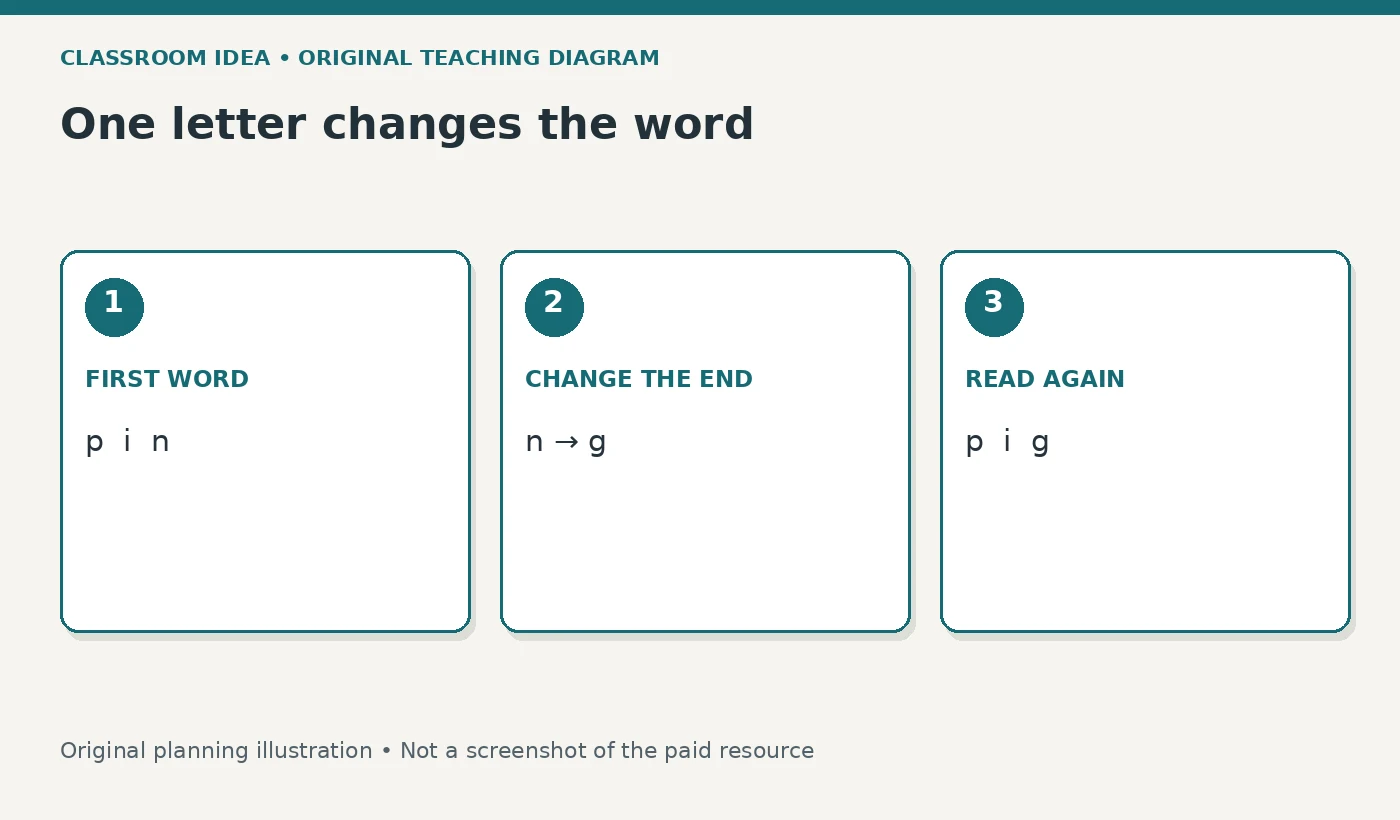
For a spelling turn, say fin, use it in a short spoken sentence, and have the child repeat it. Place one counter for each of its three speech sounds. Then replace or pair those counters with the appropriate taught letters. The child can move tiles, point, write, or ask an adult to record the letters selected.
Keep the completed answer out of view while the child responds. Showing a model and asking a child to copy it can be useful handwriting practice, but it answers a different question from spelling a spoken word. When the answer is revealed, compare the sequence together rather than simply marking the response wrong.
A ten-minute small-group sequence
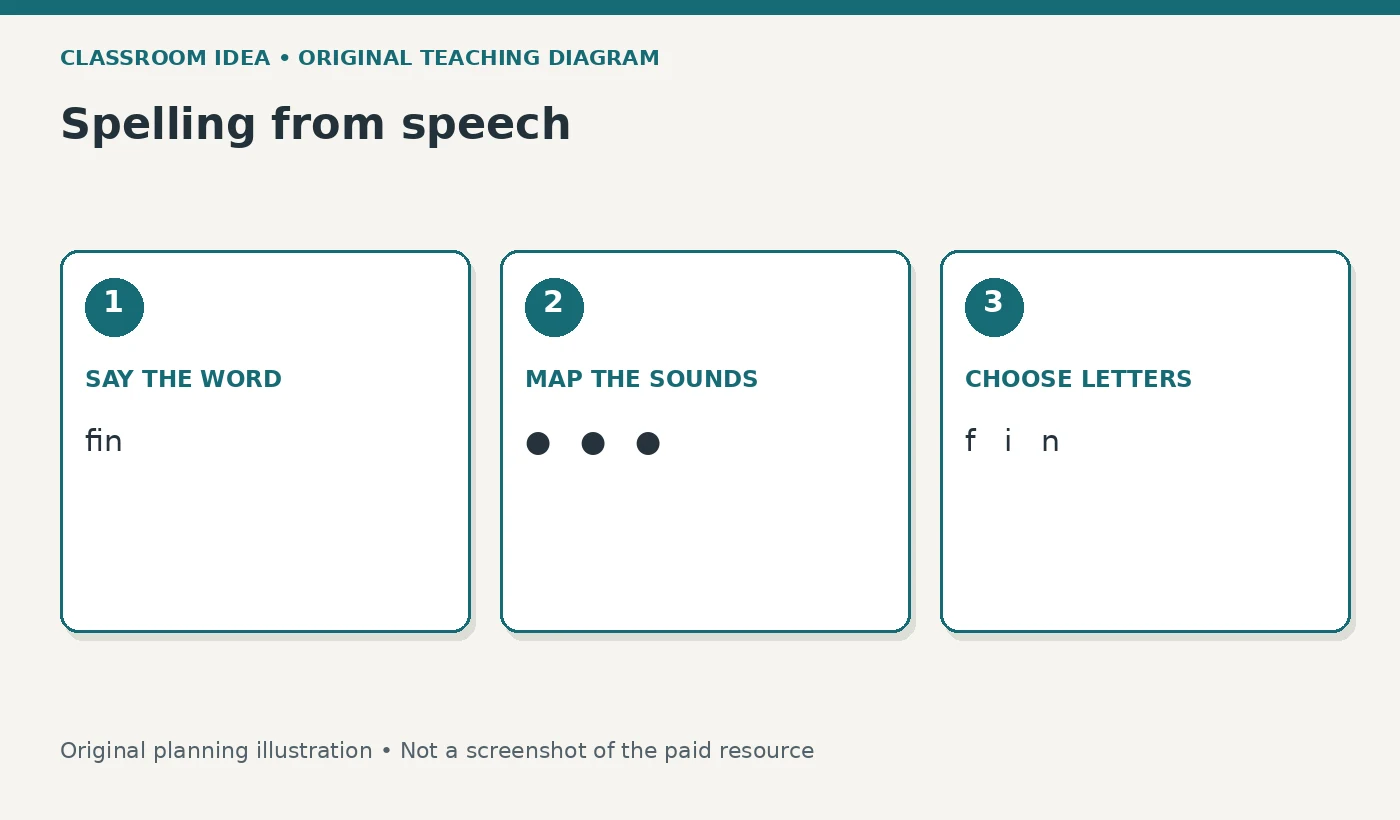
Begin with a quick check of the correspondences needed today. Model one word for the group, then give each learner a separate reading turn with two or three word-only cards. Other children can follow silently or read their own card; do not let a confident chorus hide individual responses. Reveal the pictures only after those first readings.
Follow with one spoken-word mapping turn and one change-a-sound task. For example, change pin to pig: what changed in the spoken word, and what must change in the print? Keep the other letters visible so that the comparison remains concrete. Finish by returning to an earlier word in a different position in the sequence. Adjust the duration and amount of practice to the group rather than treating ten minutes as a performance target.
Respond to the error you actually observe
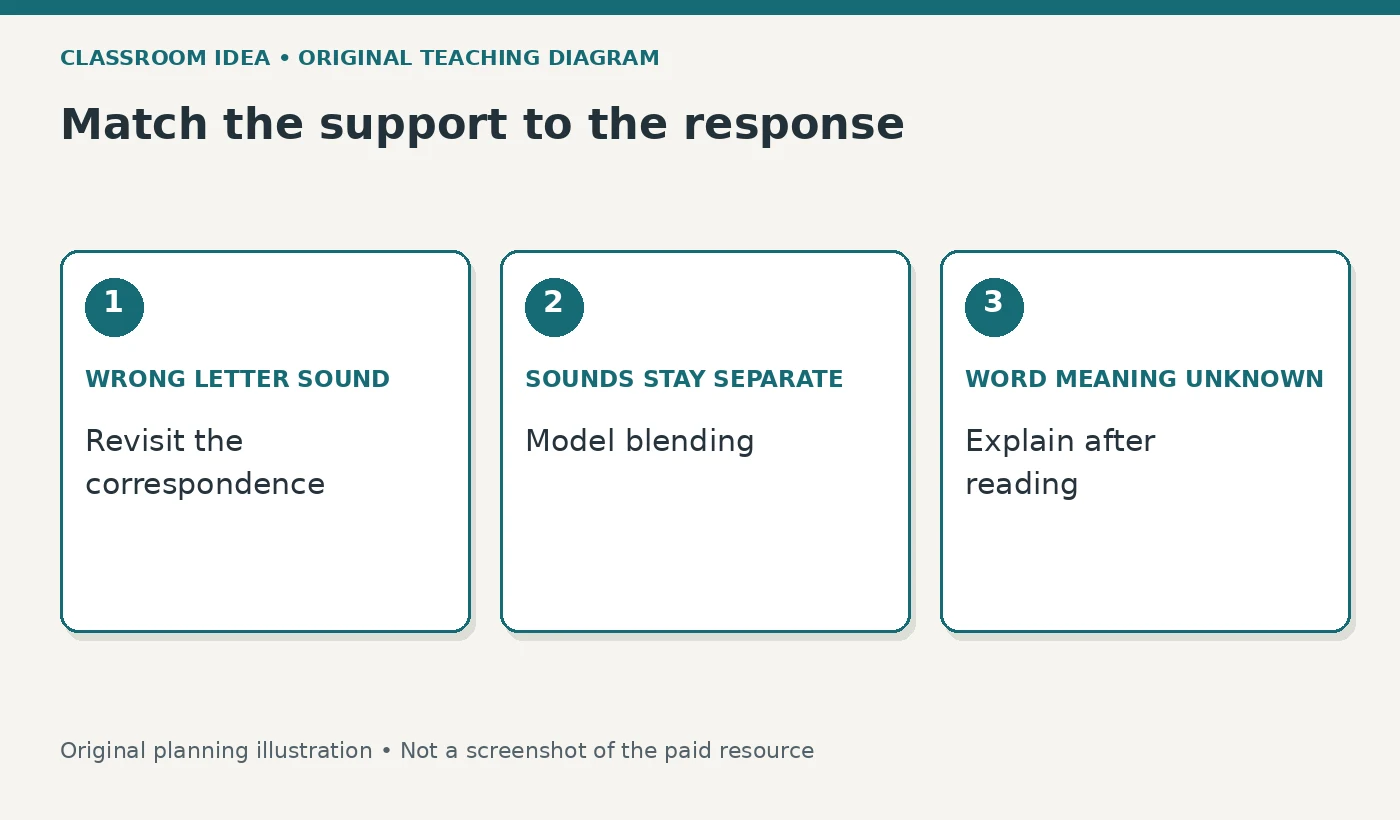
If the child gives the wrong sound for a letter, briefly reteach that correspondence and reread. If the sounds are accurate but remain separate, model blending and try together. If the child blends correctly but does not know the word, explain its meaning; do not erase the successful decoding result. If a child names the picture accurately after an unsuccessful first reading, record those as two different observations.
For multilingual learners, establish the meaning of unfamiliar spoken words without making a picture available during the decoding check. Use familiar language or a short oral explanation when appropriate. Established communication supports should remain available. A pointing or tile-selection response may help you inspect sound–letter knowledge, while also recognizing that it is not identical to an independent spoken reading.
Check understanding without turning six words into a mastery claim
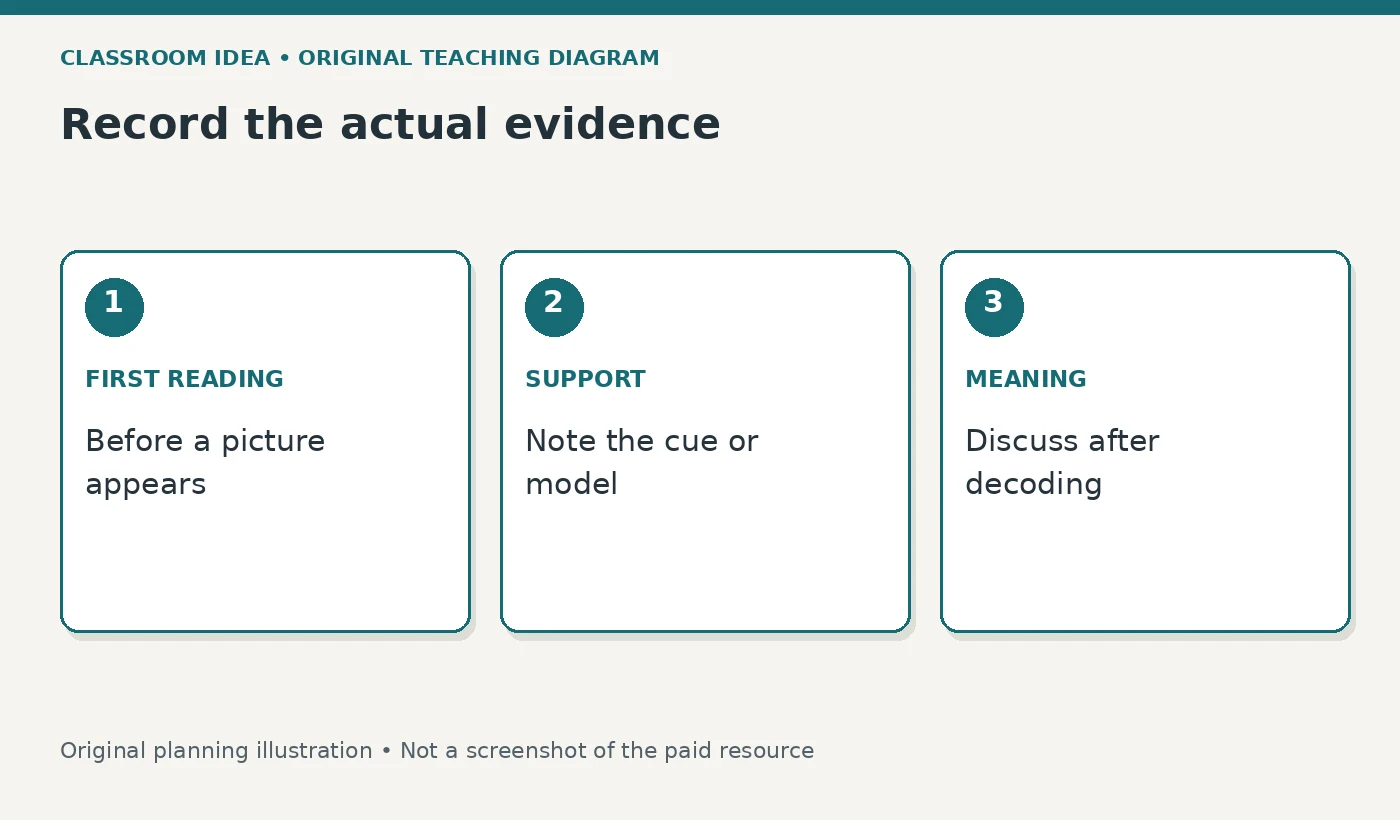
Use a small record with three columns: first reading, support provided, and meaning after reading. Note an actual response such as “blended after teacher model,” rather than a broad label such as “weak reader.” Familiar-word success cannot establish transfer to all CVC words. If you later introduce an unpracticed word, verify that its correspondences and spoken meaning fit the learner’s instruction first.
Teacher check: what would each response tell you?
A child reads pig correctly before the picture: evidence of successful reading of that displayed word under these conditions. A child says pig only after the picture: evidence of picture naming, with decoding still unresolved. A child blends fin correctly but asks what it means: successful decoding with a vocabulary question. A child copies fin from a model: copying, not independent spelling from speech.
Where a prepared resource can help
The CVC Short I mini-pack follows this word-first sequence for six target words. Its public listing includes 20 teaching slides with native notes, separate word and picture cards, four worksheet pages, a Teacher Guide, an answer key, and a quick-check page. Student-facing artwork is fixed; native notes and Word guide text are editable. Review the public preview and prerequisites before choosing it.
For an earlier step that uses spoken language without printed words, see oral blending versus segmenting. Keep the instructional question clear: are you listening to speech, reading print, spelling from speech, or discussing meaning?
