
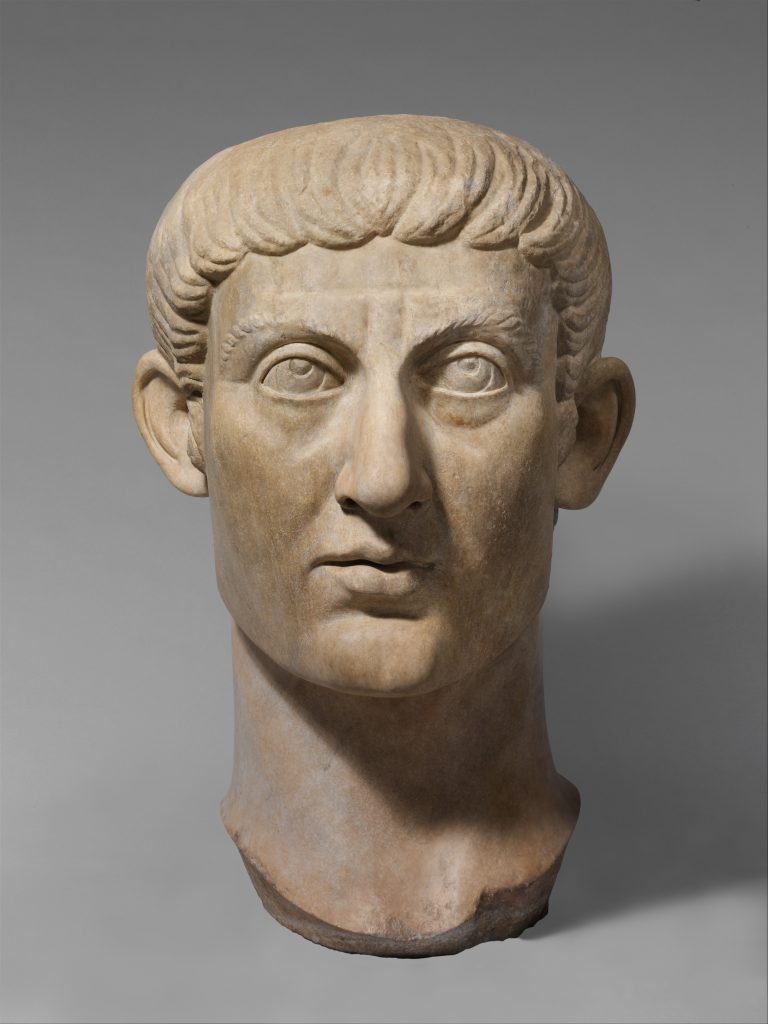
Featured image: Marble portrait head of Constantine I, approximately 325–370 CE. An ancient object, not a modern reconstruction. The Metropolitan Museum of Art, Bequest of Mary Clark Thompson, 1923; collection record. Public domain, available through The Met’s Open Access program.
History Gate · Ancient Rome & Late Antiquity
In 330 CE, Constantine dedicated a new imperial capital at Byzantium, an existing city beside the Bosporus. Renamed Constantinople, it would become one of the most enduring centers of Roman power. Its success depended on more than a striking position on a map: emperors had to turn a coastal city into a working capital.
The familiar statement that Constantine “moved Rome” eastward can hide as much as it explains. Rome did not disappear, and the Roman Empire did not suddenly become a different civilization. A new imperial center was being built within an old political world. Constantinople’s story is therefore about continuity as well as change: how geography, government, wealth, and religious patronage combined to give Roman rule a powerful eastern home. The Metropolitan Museum of Art’s overview places this foundation at the beginning of the long history conventionally called Byzantine.
A new capital on an old site
Constantine did not begin with empty ground. Byzantium already had a history, inhabitants, and a position on a heavily traveled waterway. After defeating his rival Licinius in 324, Constantine ruled the empire without an imperial colleague. The enlargement and embellishment of Byzantium followed this consolidation of power. The dedication in 330 marked an important public beginning, rather than the completion of everything the capital would eventually become.
The name Constantinople attached the emperor’s identity to the city. The designation New Rome made another claim: this place belonged to the Roman imperial tradition. Writing in the fifth century, the church historian Socrates described Constantine expanding Byzantium, surrounding it with walls, and giving it public buildings. His account looks back from a later, more developed capital, so it should not be read as a photograph of one finished city in 330. Even so, it preserves the central ambition: to create a city whose status matched imperial rule. Socrates, Church History I.16.
Where waterways met imperial roads
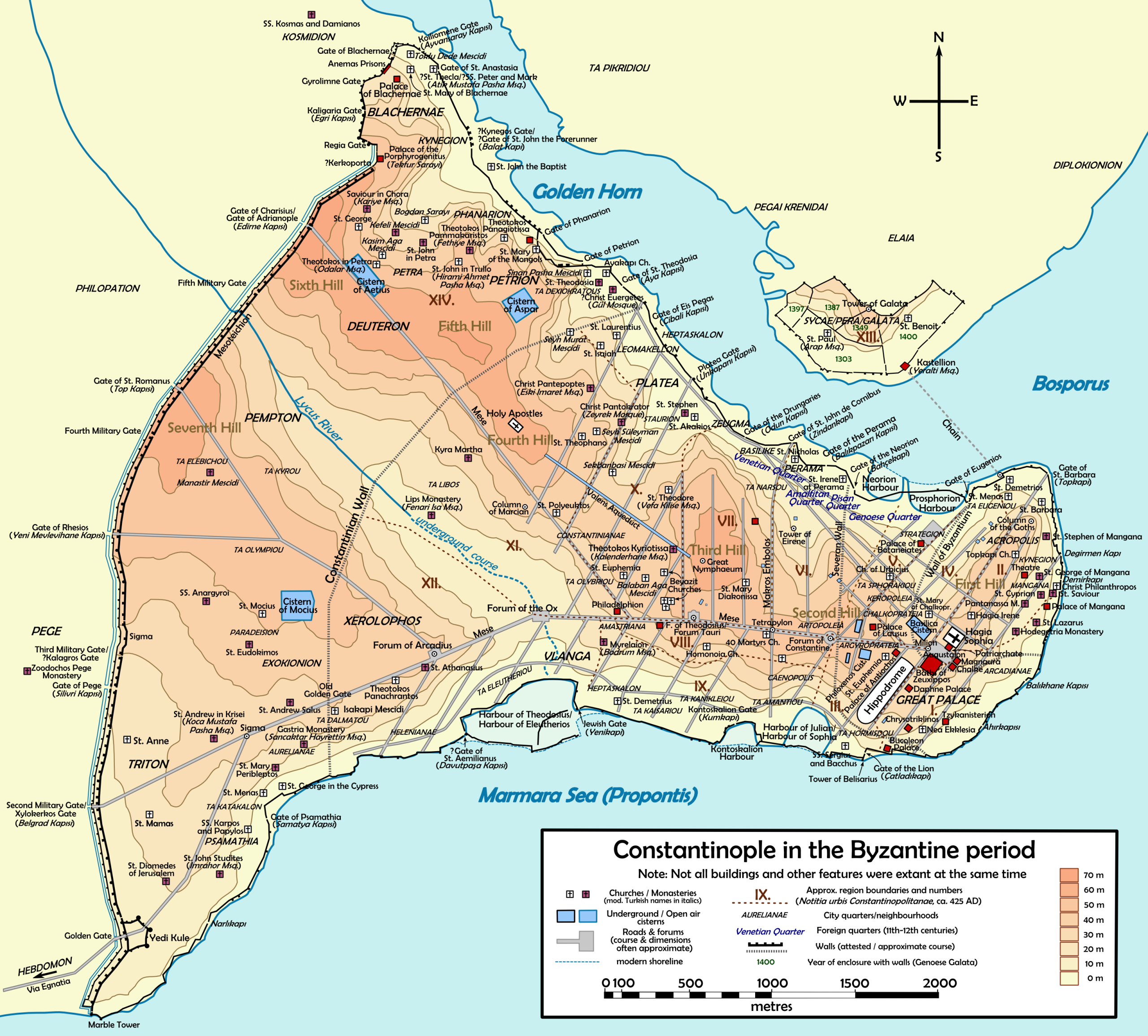
The geography explains much of the opportunity. The old city occupied a peninsula on the European side of the Bosporus. The Golden Horn, an inlet, lay to its north; the Sea of Marmara lay to the south. Beyond the Bosporus was the Black Sea. Ships moving between the Black Sea and the Mediterranean world had to navigate this linked system of straits and seas.
This was also a meeting place between European and Asian routes. People, goods, orders, and military resources could pass through the region in different directions. An imperial residence here could connect with the Balkans and with Asia Minor, rather than sit at the western edge of the empire’s eastern affairs. That did not mean every journey was easy or every route belonged to the city. It meant that Constantinople occupied a useful junction from which rulers could organize movement.
Reading the map this way avoids a common trap. A narrow strait was an advantage, not an automatic source of unlimited wealth. Harbors needed workers, ships needed protection, and traffic needed customers. Location offered possibilities; the presence of a court and its administration helped turn those possibilities into sustained demand.
A capital needed people, food, and institutions
Palaces and monuments could announce ambition, but they could not make a capital function by themselves. A court required officials and servants. Its population needed housing and provisions. Builders needed supplies and labor. Bringing government to a city therefore meant creating practical connections between the emperor, wealthy households, administrators, and the wider provincial economy.
Sozomen, another fifth-century church historian, describes Constantine attracting prominent people and their households, financing construction, and making provision for food. He also mentions a senate house, a hippodrome, fountains, and porticoes. These details show how many different activities supported the project. The new capital was simultaneously a place to live, a center of administration, and a public stage on which imperial generosity could be displayed. Sozomen praised its Christian founder, and his admiration needs to be kept in view when assessing his account. Sozomen, Ecclesiastical History II.3.
The senate illustrates the gradual character of this transformation. It is misleading to imagine that a fully developed copy of Rome’s institutions appeared overnight. Historian Alexander Skinner has argued that decisive changes in the Constantinopolitan senate came early in the reign of Constantine’s son Constantius II, building on developments already under way. Institutions, like streets and houses, took time to acquire their later form. Skinner’s study of the early senate.
Christian patronage in a Roman landscape
Constantine’s support for Christianity gave the capital a further dimension. Eusebius, the emperor’s Christian biographer, celebrated churches and Christian imagery in the new city. Yet his own description also records ancient bronze statues brought from elsewhere and displayed in public spaces. Constantinople’s monumental landscape drew on the accumulated objects and traditions of the Mediterranean world.
That combination matters. Christian patronage did not erase the Roman past or produce an instantly uniform religious society. Eusebius wanted his readers to see a ruler favored by God; his language is evidence of that interpretation as well as a source about buildings and objects. Reading him critically allows us to recognize the importance of Christianity without mistaking an admiring account for a neutral inventory. Eusebius, Life of Constantine III.48–54.
The walls came in generations
Water helped protect the peninsula, but its western approach still required defenses. Constantine’s enlarged city had its own fortifications. The imposing land walls associated with Constantinople’s later survival, however, belong to a different generation. The Theodosian walls were built in the early fifth century under Theodosius II, with a major phase completed in 413, well after Constantine’s death.
Those later defenses enclosed a larger urban area. Their combination of walls, towers, and a moat transformed the landward approach, and repeated repairs kept them useful over centuries. They were not simply a natural benefit bestowed by geography. Their construction and maintenance depended on organization, resources, and labor. Columbia University’s Istanbul Documentation Project traces this extended history. The distinction is essential: Constantine began the capital’s transformation; later generations built much of the city that survives in monuments and historical maps.
A Roman future that outlasted its founder
Constantinople’s foundation did not announce the end of Rome. Rather, it helped create another durable center through which Roman government could continue. The later eastern empire changed enormously in language, territory, religion, and institutions, but its inhabitants continued to identify themselves as Romans. “Byzantine” is a modern historical label, not the name of a new nation Constantine established in 330.
The city’s endurance is best understood as a relationship between place and human choices. Seas and straits gave it opportunities. Investment, provisioning, institutions, and successive building campaigns made those opportunities useful. Constantinople reminds us that a capital is never only a dot on a map. It is a network of decisions, resources, and people, continually remade after its founder is gone.

