
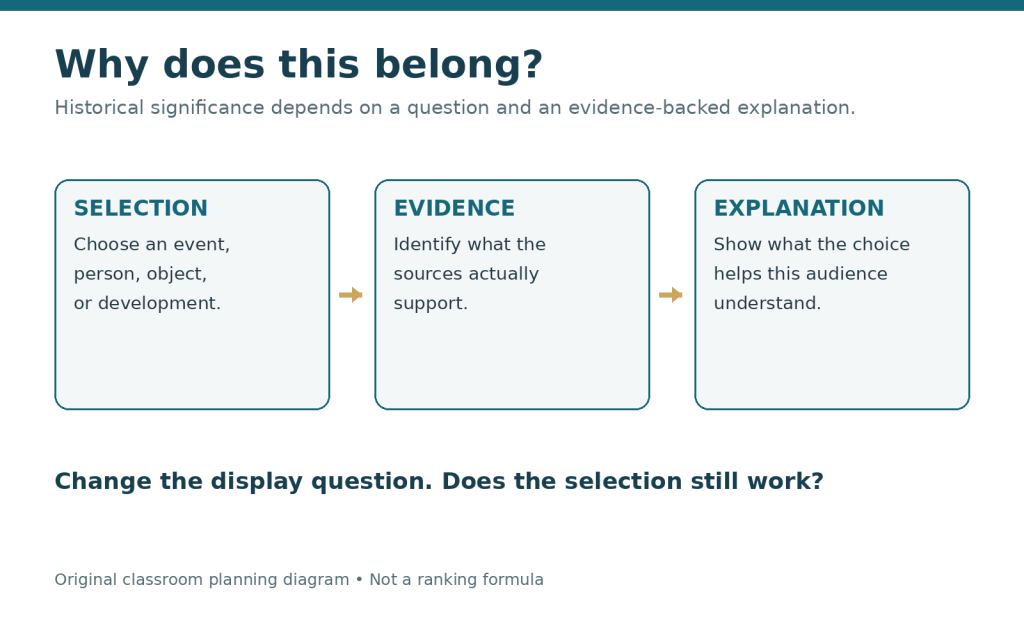
A student chooses a king for the class display because “he was important.” Another chooses a cooking pot because “ordinary people matter too.” Both may have a case. Neither has yet explained it. Historical significance becomes teachable when students must show what their choice helps someone understand.
Give the selection a purpose
Instead of asking for the three most important things in a unit, set a bounded editorial task: choose three items for a display answering “How did people organize life in this society?” An item might be an event, a person, an object, or a development. The display has an audience and a question, so selections must do more than reproduce the textbook’s largest headings.
The Historical Thinking Project distinguishes consequences affecting many people over time from the significance of something that illuminates a wider historical story. That second route matters: a modest object or an unfamiliar person’s experience can reveal something that a famous ruler does not.
Build a small evidence menu
Choose six items already encountered in the lesson and attach a short, sourced explanation to each. Do not make students search the entire internet while they are still learning the reasoning. Include enough variety that no single criterion automatically wins: a political decision, a working person’s account, a tool, a public building, a rule, and a change in everyday practice might work.
Prepare a three-column planning sheet: selection; evidence; reason it belongs. Ask pairs to complete the evidence column before writing the reason. A picture’s size, a person’s fame, or a student’s enjoyment is not sufficient evidence of significance.
For a 35-minute lesson, allow five minutes to revisit the question, ten to inspect the menu, ten to choose and justify, and ten to compare choices. Adjust the reading load rather than removing the demand for a reason.
Use criteria without turning them into a score
The Victorian Curriculum and Assessment Authority’s history guidance suggests questions about the number affected, depth and duration of change, importance to people at the time, and what something reveals about a period. These are prompts for judgment, not a formula that produces one indisputable ranking.
- What changed, and for whom?
- What larger pattern does this item reveal?
- How does that evidence answer our display question?
Model a weak sentence first: “We chose this tool because people used it.” Improve it by naming the practice it helps explain and the evidence supporting that connection. If the source only documents one household, students should not silently expand the claim to everyone in the society.
Change the question, then revisit the choice
Now give the same pairs a second display brief: “How was power maintained?” Ask them to retain, replace, or reorder their selections. They must explain one revision. Changing a choice is not a failure; changing it without a reason is the problem.
Support developing readers with short source extracts and a sentence frame: “For this question, ___ is significant because ___. The evidence is ___.” For confident readers, require a justified exclusion: which plausible item did they leave out, and what would its inclusion add?
End with an individual response naming one selection, one piece of evidence, and one limitation. Assess the connection between evidence and explanation, not agreement with your preferred list. This makes the students’ thinking visible without pretending that all selections are equally well supported.
Image: original explanatory diagram created for LightwayEdu, not an authentic historical object or reconstruction.
