
A fragment of imported pottery is easy to turn into a headline. A grinding stone is less glamorous. At Great Zimbabwe, however, concentrating on the first and overlooking the second changes the story of how an African city worked.
A city, not an unexplained monument
Great Zimbabwe’s stone walls were made by African builders, not a vanished foreign civilization. The site belongs to the history of communities ancestral to Shona peoples. Its principal areas include the Hill Complex, Great Enclosure, and Valley Enclosures. These are parts of a settlement, not a single isolated building. UNESCO’s account of the monument identifies its local origins and the archaeological evidence for farming, herding, and exchange.
The dry-stone construction itself depended on knowledge of available materials. As archaeologist Tawanda Mukwende explains in The Metropolitan Museum of Art’s account, granite from the surrounding landscape could split into slabs suitable for building. Walls stood alongside structures made with earth. Surviving stone is visually dominant today; it should not be mistaken for the whole lived environment.
What an imported object can tell us
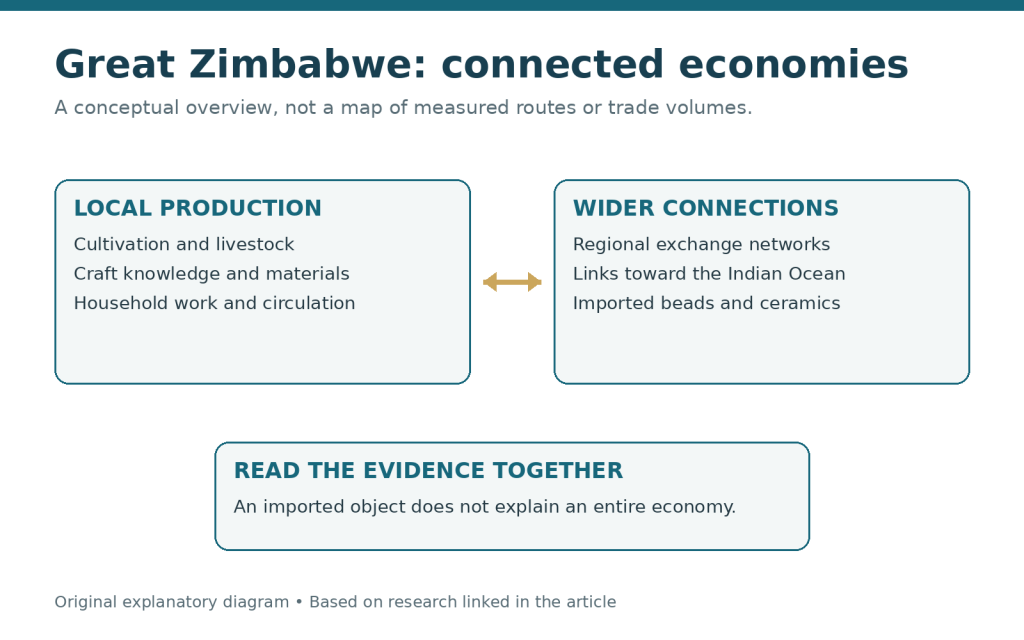
Glass beads and imported ceramics connect Great Zimbabwe with wider exchange networks reaching the Indian Ocean. Such finds establish contact through circulation. They do not, by themselves, identify every intermediary, prove that a particular merchant travelled the entire route, or explain the full economic basis of the settlement.
This distinction is more than a technical caution. If every striking imported object becomes proof that outside trade created the city, local people appear mainly as recipients. Their work becomes background to someone else’s journey. Evidence of connection deserves attention without being asked to carry that much explanation.
The productive world closer to home
Mukwende’s synthesis describes crop cultivation, livestock keeping, weaving, metalworking, and soapstone carving. Animal bones, locally made pottery, charred plant remains, and production debris help reconstruct these activities. Gold and ivory moved outward through exchange, while imported goods entered an economy that already required food, materials, skill, and labor.
In his open-access study of Great Zimbabwe’s political economy, archaeologist Shadreck Chirikure argues that household production and local circulation deserve more weight than models dominated by imported prestige goods. His interpretation does not deny external trade. It asks how foreign commodities fitted into relationships and priorities that existed locally.
That changes the useful question from “What arrived from far away?” to “How did people combine local production and wider connections?” The second question can accommodate a bead and a grinding stone without assuming that their historical roles were identical.
Power and decline are not single moments
A city can lose political prominence without every resident departing on one date. Chirikure’s review discusses evidence of occupation after the often-repeated cutoff around 1450, including later material from parts of the settlement. Mukwende likewise distinguishes the decline of Great Zimbabwe’s influence from its longer occupation history. A neat rise-and-fall timeline can conceal this uneven process.
The same caution applies to explanations of power. Chirikure presents an interpretation in which rulers, households, and communities participated in overlapping economic relationships, rather than a ruler necessarily controlling every transaction. That is a research argument to examine, not permission to replace one simple picture with another.
Great Zimbabwe becomes more intelligible when its walls, households, crafts, and connections are studied together. Imported objects matter, but they need not be the stars of every account. The daily work that sustained the city is history too.
Image: original explanatory diagram created for LightwayEdu, not an authentic historical object or reconstruction.
