
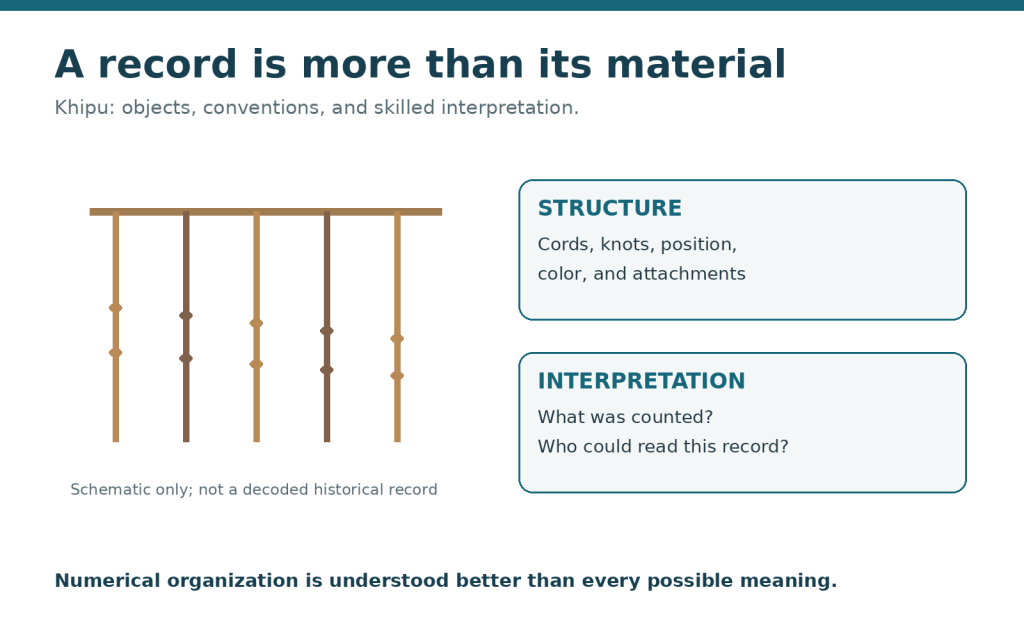
A bundle of cords can look like an object waiting to be untangled. To an Inka record keeper, its arrangement was the point. Knots, positions, and relationships between strings could preserve information that an empire needed to organize people and resources.
Information did not have to look like a page
A khipu, also spelled quipu, commonly has a main cord with pendant cords attached. Cotton and camelid fibers were among the materials used. Additional subsidiary cords could extend the structure. The National Institute of Standards and Technology’s museum account explains how the placement of knots on numerical khipu follows a base-ten system.
That does not make the object an alphabet in string. Nor does it make it a decorative substitute for a “real” record. A recording system should first be examined through what it did and how it was used, rather than through its resemblance to the notebooks familiar to us.
Counting in an imperial system
The Smithsonian National Museum of the American Indian’s teacher guide gives concrete examples of information recorded: households, stored maize, and llamas travelling along the road system. These were not abstract mathematical puzzles. They concerned supplies, obligations, and the movement of resources.
The same guide places record keeping within the Inka road network. Roads helped move people, armies, goods, and information; relay messengers carried communications between places. A portable record could therefore belong to a much larger administrative process. The cord bundle was one component, alongside people trained to make and interpret it.
NIST identifies these specialists as khipukamayuqs and describes uses including census information, tribute accounts, and inventories. Features beyond the number of knots also mattered: cord color, twist, attachment, and patterning are among the characteristics scholars study. Counting visible knots alone is not a complete reading.
What researchers can and cannot read
The scholarly Open Khipu Repository preserves data about surviving examples and identifies accounting, administration, and historical narratives among their reported uses. Its project description also states a crucial limitation: the recording system has not been fully deciphered.
Two claims therefore need to remain separate. Numerical organization is understood well enough to establish sophisticated accounting. The meaning of every cord combination, and the means by which some objects may have conveyed names, events, or narratives, are not equally secure. Saying that nothing is understood erases demonstrated knowledge; saying that the system has been completely deciphered overstates it.
Even a numerical value leaves further questions. What was counted? Which people, places, or goods did a cord represent? Who was expected to interpret the record? Without that context, knowing a number does not automatically recover the transaction or decision behind it.
Keep the maker and reader in the story
It is tempting to compare a khipu with a spreadsheet. The analogy can open a discussion about structured information, but it can also hide the historical differences. A modern spreadsheet brings conventions, software, and labels that cannot simply be projected onto an Andean object.
A better starting point is to examine three things together: the physical record, the conventions for using it, and the trained people involved. This makes room for technical skill without turning the Inka past into a prediction of modern technology. It also leaves the unanswered questions visible.
Image: original explanatory diagram created for LightwayEdu, not an authentic historical object or reconstruction.
