
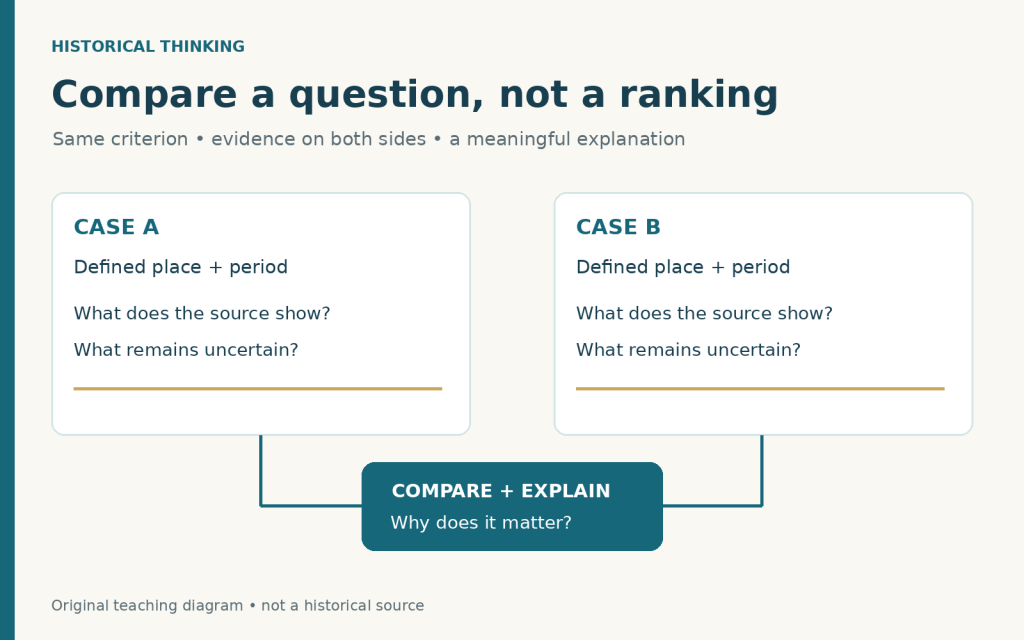
Consider an answer that says two ancient societies were alike because both had rulers, then declares one “more advanced” because its buildings were larger. The comparison has produced a ranking, but not an explanation. A better lesson begins before the Venn diagram: what, exactly, are we comparing, and what evidence would make the comparison fair?
Featured illustration: original explanatory diagram created for LightwayEdu, not a historical source or reconstruction.
Historical comparison is useful when it turns two familiar cases into a new question. It can reveal different responses to a shared problem, or show that apparently similar institutions worked differently. It becomes much less useful when “civilization” means an entire population across several centuries and “better” remains undefined. The routine below is designed for a middle-school class that already knows something about both cases. It is an original teaching sequence, not a claim that one organizer can replace subject knowledge.
Replace the contest with a question
Begin by displaying two prompts: “Which society was more advanced?” and “How did each community organize the movement of food?” Ask students which prompt tells them what evidence to look for. The second does not guarantee a good answer, but it names a function that can be investigated. Students might need information about transport, storage, labor, authority, and the people receiving food. A large monument, by itself, does not answer that question.
Explain that comparison is more than collecting similarities. OER Project’s historical-thinking guidance moves from describing similarities and differences toward explaining their significance, while attending to scale across time and space. For this lesson, translate that ambition into a manageable goal: make one precise comparison, support both sides, and explain why the difference matters.
Prepare a small, balanced evidence set
Choose two cases already taught, and write their dates and locations at the top of the task. Avoid matching a whole empire against a single village without explaining the difference in scale. If the cases are centuries apart, make that visible too. Students can compare across time; they should not accidentally treat distant events as simultaneous.
Provide two or three short, properly attributed sources for each case. “Balanced” does not mean equal word counts or identical source types. It means both sides offer relevant evidence for the question. A royal claim and an excavation report do not speak in the same voice. Label what each source is, when it was made, and what the class is receiving: an original image, a translated extract, or a modern account. Do not silently rewrite a source into simpler language and present the result as its original wording.
Include at least one genuine limitation. Perhaps the evidence describes an official rule but says little about compliance. Perhaps one case has rich written records and the other survives chiefly through material remains. The aim is not to manufacture perfect symmetry. It is to teach students to recognize an uneven record rather than turn it into a judgment about the people being studied.
A forty-minute sequence
Minutes 0–7: set the comparison’s boundaries
After the opening prompt, ask pairs to complete this sentence: “We are comparing ___ in ___ and ___, during ___, in order to understand ___.” Listen for an answer that names a practice or problem, not just two enormous labels. If students write “Egypt and Rome,” ask them to narrow the task to the communities, institutions, and periods actually represented in the evidence packet.
Minutes 7–17: collect evidence before adjectives
Students divide a page into three columns: the comparison question, evidence for case A, and evidence for case B. Use two or three rows rather than a long checklist. For a food-distribution inquiry, possible rows are “Who organized it?”, “What moved, and how?”, and “Who depended on the arrangement?” These are prompts to investigate, not answers supplied in advance.
Every entry needs a source label. Permit “not established by this packet” as a valid entry. Do not allow an empty cell to become “they had none.” A student who distinguishes missing information from evidence of absence has made an important historical move, even if the organizer looks less complete.
Minutes 17–27: write a matched claim
Give students a sentence frame only after they have gathered evidence: “Both cases show ___, but they differ in ___; source A supports ___, while source B supports ___.” Ask them to underline the exact feature being compared. If the first half concerns transport and the second concerns religious belief, they have shifted criteria mid-sentence. They need to revise the claim or explain the connection, not simply add “however.”
Next add a significance sentence: “This difference matters for our question because ___.” A useful answer explains a consequence or relationship. “They were different” merely repeats the observation. If the evidence cannot establish why the difference existed, students can say so and propose what they would need to investigate next.
Minutes 27–35: challenge the comparison, not the partner
Partners exchange paragraphs and ask three questions: Are the units of comparison clear? Is there evidence on both sides? Does the explanation go beyond what those sources can support? The reviewer marks one strength and one revision request. This keeps peer feedback focused on reasoning instead of spelling alone or an unhelpful verdict that the answer is “good.”
For an additional challenge, give pairs a third, contrasting source from one case. Ask whether it changes the entire comparison or only one part. More evidence need not destroy an argument; it may make the argument narrower and more defensible.
Minutes 35–40: check the reasoning independently
Use an exit ticket with three short tasks: write one supported comparison; identify one limitation; explain why “more advanced” is not an adequate conclusion here. Assess the response against those tasks, not the number of similarities listed. A student who names a difference without explaining its relevance needs a different next step from one who understands the question but misreads a source.
Support without removing the historical problem
For students who need language support, preteach the few terms essential to the inquiry and offer a vocabulary bank of relationships: depends on, distributes, records, restricts, and connects. Read one source aloud while keeping its attribution visible. Let students rehearse a comparison orally before writing it. Do not prefill the conclusion; the thinking belongs to them.
For confident students, remove the sentence frame and ask them to defend the choice of criteria. Would the comparison change if the question concerned access rather than efficiency, or households rather than rulers? This makes the method itself visible. Different questions can produce different, equally defensible comparisons without making historical evidence optional.
