
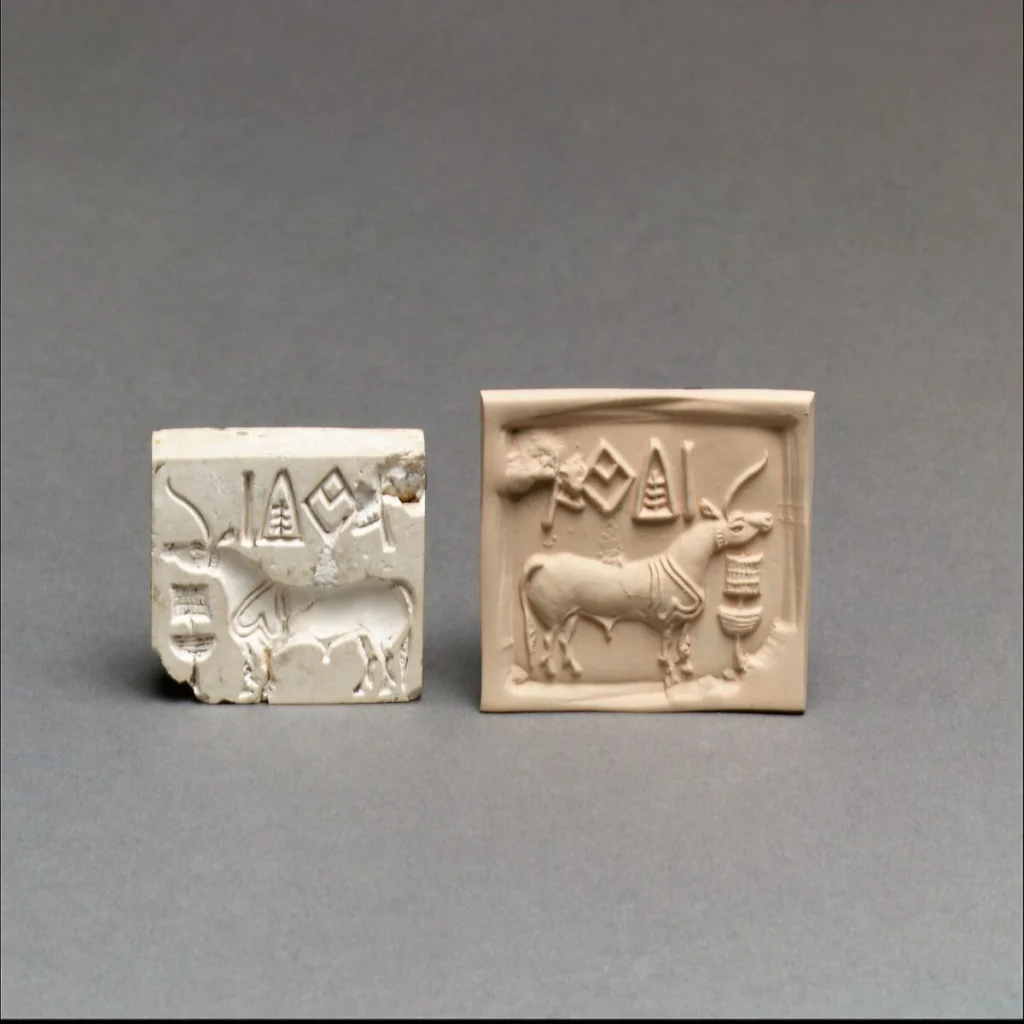
A seal can show an animal, a row of signs, and careful carving. It cannot automatically tell a student the owner’s name, occupation, or beliefs. That gap is the teaching opportunity in an Indus civilization lesson: students can learn a great deal from material evidence while being precise about what remains unknown.
Rather than opening with a list of mysteries, give students a bounded question: what can one object support, and what additional evidence would a stronger claim require? The activity below combines a museum object record with a three-column evidence organizer. It works as a short source-reading lesson or as preparation for comparing several objects in a larger unit.
Establish place, time, and the kind of source
Introduce the Indus civilization as an ancient South Asian society whose archaeological sites extend across areas of present-day Pakistan and India. Harappa and Mohenjo-daro are both in present-day Pakistan. Modern borders are location aids, not the boundaries of an ancient nation-state. Use a reliable map in your existing curriculum rather than asking students to draw political borders from memory.
The Harappa excavation overview describes how archaeology investigates cities, technology, trade, food production, and symbolic objects even though the script is undeciphered. Keep that relationship clear: uncertainty about reading the signs does not mean that every aspect of the civilization is unknowable.
Begin with one carefully identified seal
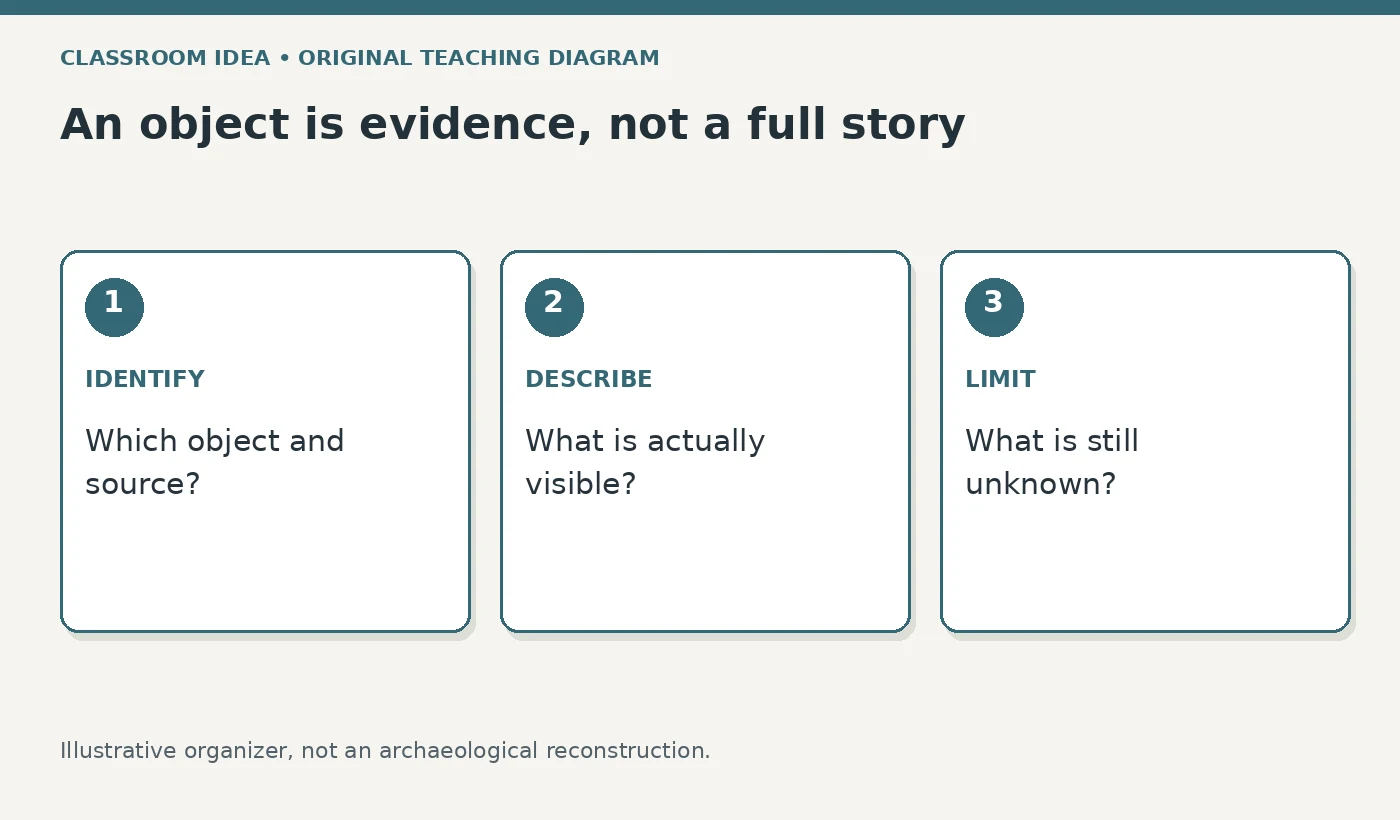
Use the Metropolitan Museum of Art’s stamp seal and modern impression, object 49.40.1. The museum dates it approximately 2600–1900 BCE and identifies its material as burnt steatite. Its title includes a question mark after “incense burner.” That small mark is worth noticing: a museum label can communicate uncertainty rather than remove it.
Project the museum’s image from its object page or use an authorized reproduction with its credit. Tell students that the impression is modern. Otherwise they may mistake two views or a later impression for two separate ancient objects. Do not ask children to “translate” the signs with a made-up alphabet chart. There is no generally accepted decipherment that would justify such an exercise.
Use three columns with different jobs
Label the columns I can observe, The source record tells me, and I can argue cautiously. These are not three levels of certainty in a simple ladder. They are different types of information that need to be connected. An observation can be mistaken if an image is unclear; a catalog entry can change with research; an inference can be stronger or weaker depending on its support.
In the first column, students describe visible features: a roughly square object, an animal in profile, and signs arranged above it. In the second, they record the museum’s date range, material, object number, and identification of the modern impression. In the third, they write a limited claim and explain which observation and source detail support it.
Museum source and Open Access rights
Model a strong claim and an overreach
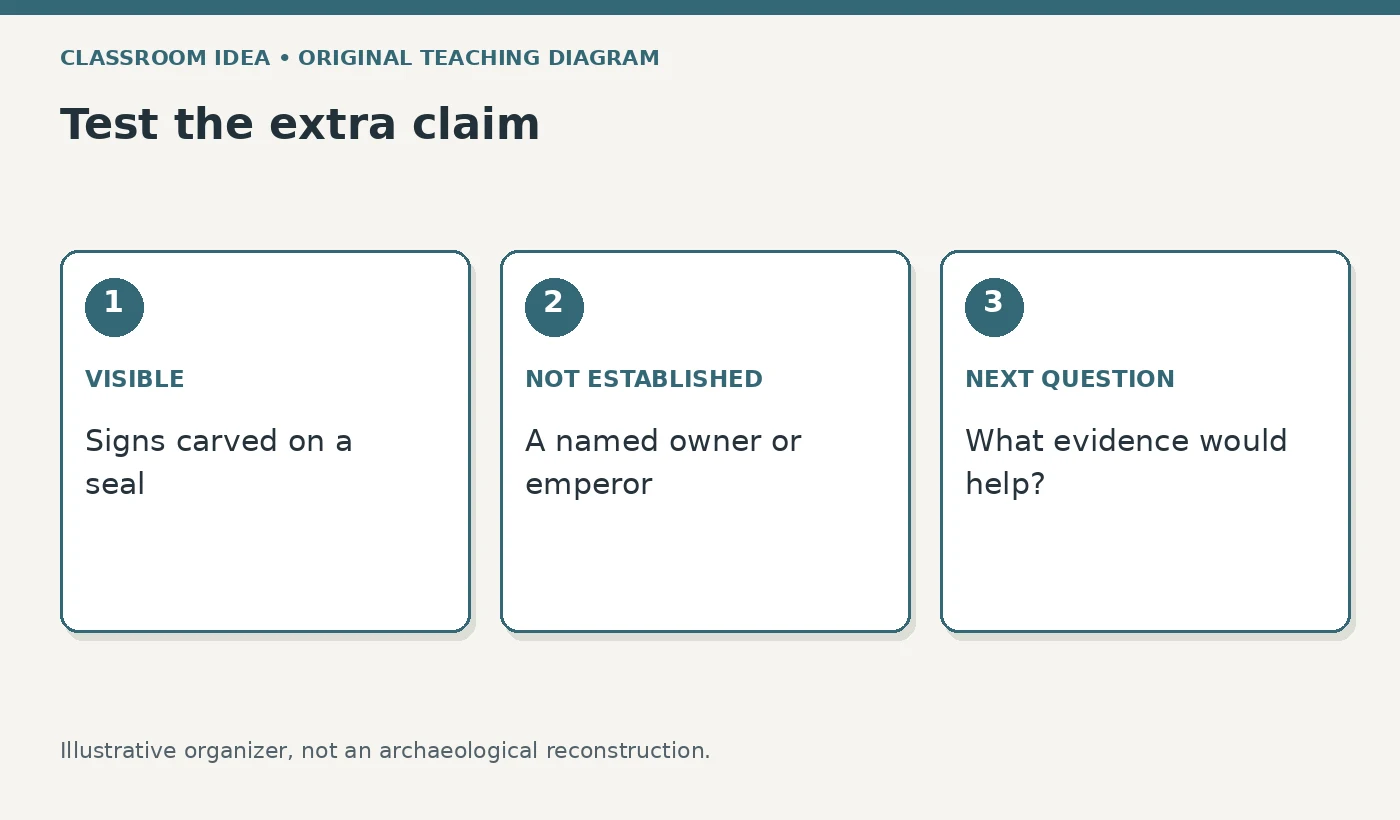
A supportable statement might be: “The seal combines a carved image and signs, showing that its maker used both visual forms on one small object.” It stays close to what is visible. A more interpretive statement might connect the object with marking or identifying, while explicitly attributing that interpretation to the museum’s explanation of stamp seals.
“This belonged to the emperor who ruled every Indus city” goes much further. Ask students to identify the missing steps. Where is the evidence for ownership? What establishes the title emperor? What connects this single object with authority over all cities? The purpose is not to ridicule an imaginative answer. It is to show how a sentence can acquire claims faster than the evidence can support them.
Run a thirty-minute evidence workshop
- First look: Give students a quiet minute with the image and ask for two observations, without a historical explanation yet.
- Read the record: Supply the museum’s short identification details. Students mark which earlier statements came from seeing and which now depend on the record.
- Build one claim: Pairs write a sentence with a reason. They must identify the specific detail doing the evidential work.
- Exchange and question: Another pair asks what the claim leaves uncertain and what would strengthen it.
- Revise: Students change one phrase to make the claim more accurate, then explain why the revision matters.
Adjust the time and reading load. Read the short source record aloud when needed. Allow oral explanation, a labeled organizer, or a scribed response. The historical reasoning target should remain visible even when writing support changes.
Compare kinds of evidence without pretending they answer the same question
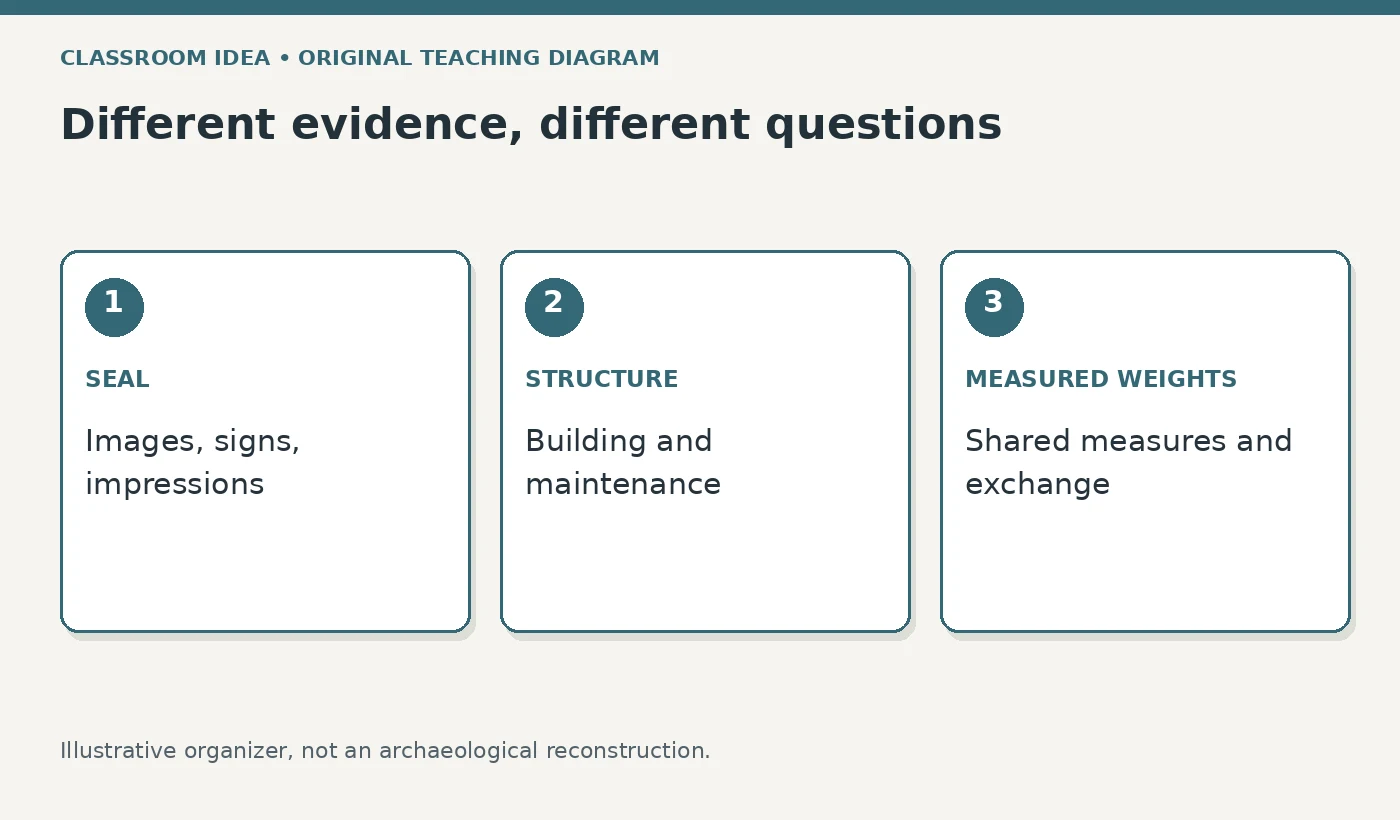
After the seal, introduce a well-documented site photograph or plan from a reliable archaeological source. Ask what new questions a building or drainage feature makes possible. Construction can support discussion of materials, labor, and maintenance. It does not, by itself, name the person who ordered the work or prove that every resident had the same experience.
For another comparison, a group of measured weights can lead to questions about shared measures and exchange. Students need the measurements and archaeological context, not just a photograph of several stones. Describe this as a next inquiry requiring its own evidence rather than adding unsupported conclusions to the original seal record.
Distinguish “unknown” from “anything goes”
Students sometimes respond to uncertainty by treating every explanation as equally likely. Return to the evidence requirement. If two explanations both fit one visible feature, ask what different traces each might predict and whether those traces are available. A claim can remain unresolved without becoming an invitation to invent names, speeches, or motives.
Use cautious language purposefully. “Possibly” cannot repair an otherwise unsupported story. A useful qualified claim says what its support is and where it stops. “This arrangement suggests planning, but does not identify the planners” is more informative than “Maybe they had a king,” because it separates the inference from the unanswered question.
Exit-ticket model: repair an overconfident claim
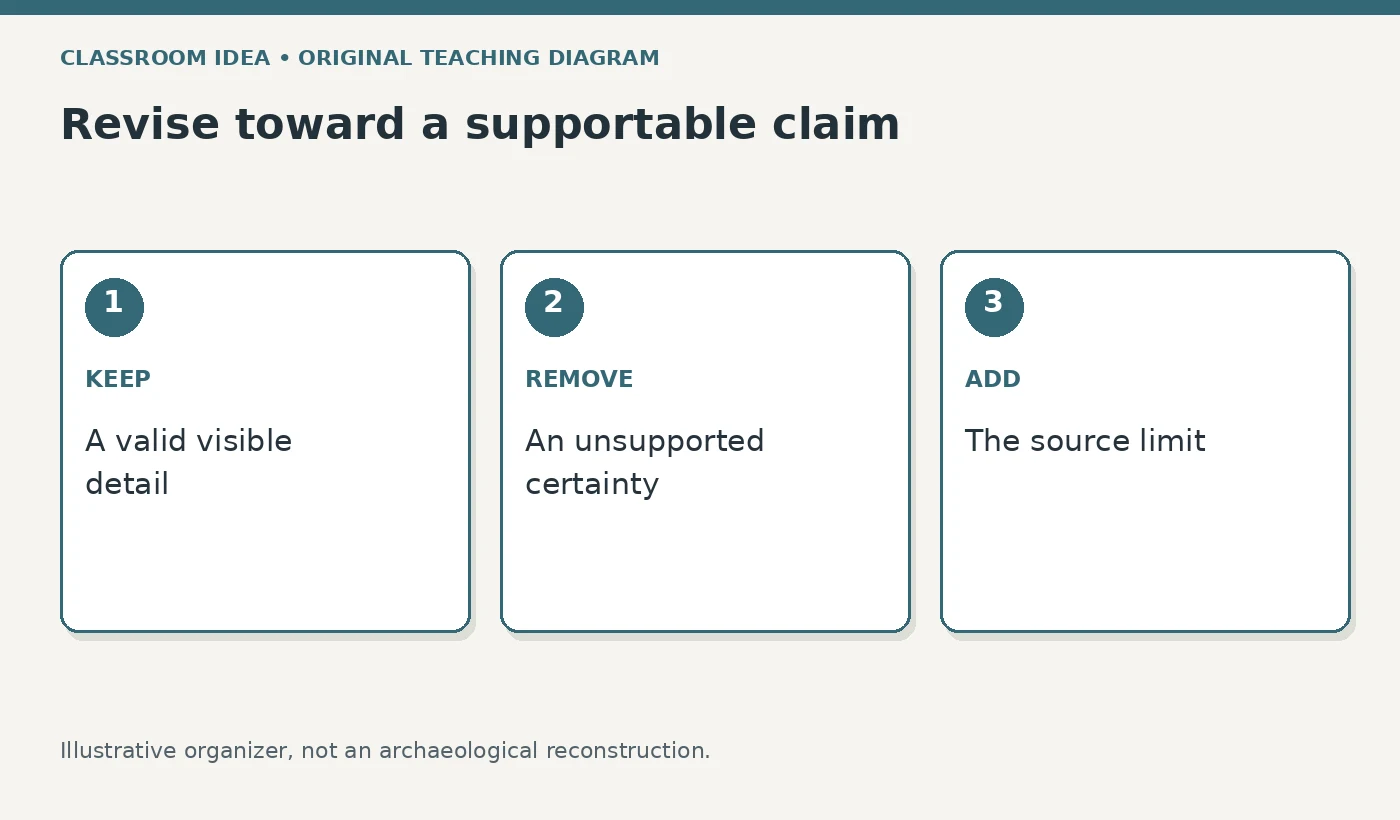
Claim to revise: “We can read the seal and know its owner was a priest.” Possible revision: “The object has signs and an animal image. Its signs cannot be reliably translated using a generally accepted decipherment, so this image alone does not establish the owner’s identity or religious role.” A strong response identifies the unsupported assertion, retains a valid observation, and states the limit.
Connect the activity with a broader lesson
The public Indus Valley Civilization lesson pack brings together teaching slides, worksheets, notebook activities, task cards, assessment, a historical-image gallery, teacher support, and five material-evidence cases. Its focus on observation and interpretation fits this workshop. Review the actual preview and reading demands before choosing which components to use.
For a separate exercise in comparing multiple accounts, see the historical corroboration inquiry. Here, the immediate achievement is smaller and important: a student can say where a claim came from, what supports it, and what the source does not establish.
