
Practical teaching ideas
A middle-school source-comparison lesson with four clearly fictional cards, a worked answer, and an exit ticket that teaches students to weigh independent evidence.
When students compare historical sources, a familiar shortcut appears: two accounts agree, so the claim must be true. Another shortcut is to call every account “biased” and stop there. A useful corroboration lesson helps students move beyond both habits.
Corroboration means comparing evidence across sources to test a particular claim. Agreement matters, but students also need to ask what each source could know, why it was created, and whether apparently separate accounts actually repeat the same information.
The Library of Congress discusses corroboration as a dialogue among sources, including agreements, disagreements, and questions requiring further investigation. The following original middle-school activity turns that idea into a manageable first lesson.
Start with a narrow question
Write: “Was Millhaven’s new footbridge open to the public before noon on Saturday?”
Tell students that Millhaven, the bridge, the people, and every source card below are fictional. These are teacher-created practice materials, not historical documents, quotations from real people, or evidence about an actual event. Keep that label on every copy.
A fictional practice case reduces background-reading demands. It should be followed by work with genuine, accurately attributed historical sources so students can transfer the reasoning.
You need four cards per pair, paper, and approximately thirty minutes. Draw four response columns: “Claim,” “Relevant detail,” “Reason to use cautiously,” and “What it helps us answer.”
Give pairs these four fictional cards
Card A Town notice
Fictional practice material. A notice issued by the bridge committee on Thursday announces that the footbridge will open to the public at 9 a.m. Saturday. Its purpose is to encourage residents to attend. It contains no later update.
Card B Weekly newspaper
Fictional practice material. A Friday newspaper item announces a Saturday 9 a.m. opening. A line at the end says the information was supplied by the bridge committee. The reporter did not attend the opening because it had not happened yet.
Card C Work supervisor’s log
Fictional practice material. A Saturday entry, recorded at 12:15 p.m., says that a loose railing delayed public admission until 11:30 a.m. It records workers checking the railing between 9 and 11 a.m. The supervisor keeps the log to document work and delays.
Card D Shopkeeper’s notebook
Fictional practice material. A shopkeeper writes on Saturday evening that, while looking toward the bridge at about 10 a.m., she saw barriers across its entrance. She writes that she used the old road to reach the market. The note does not describe what happened after she left.
Minutes 0–5 Read the labels before the claims
Model Card A. Ask, “When was it made compared with the event? What was its creator trying to do? What could this person know at that point?”
Think aloud: “This tells us what the committee planned. Because it was issued on Thursday, it cannot by itself confirm what happened on Saturday.”
The National Archives document-analysis guidance recommends modeling analysis and then having students use sources as historical evidence. Preserve that distinction: identifying a date or purpose is useful when students explain how it changes their answer.
Minutes 5–12 Compare the evidence
Give pairs Cards B, C, and D. Ask them to annotate three things:
- What does the source actually say about the opening?
- Which part directly helps answer “before noon”?
- Which claim is planned, observed, or reported after the event?
Prompt students to use exact times. “Saturday morning” can conceal an important difference between 9 a.m. and 11:30 a.m.
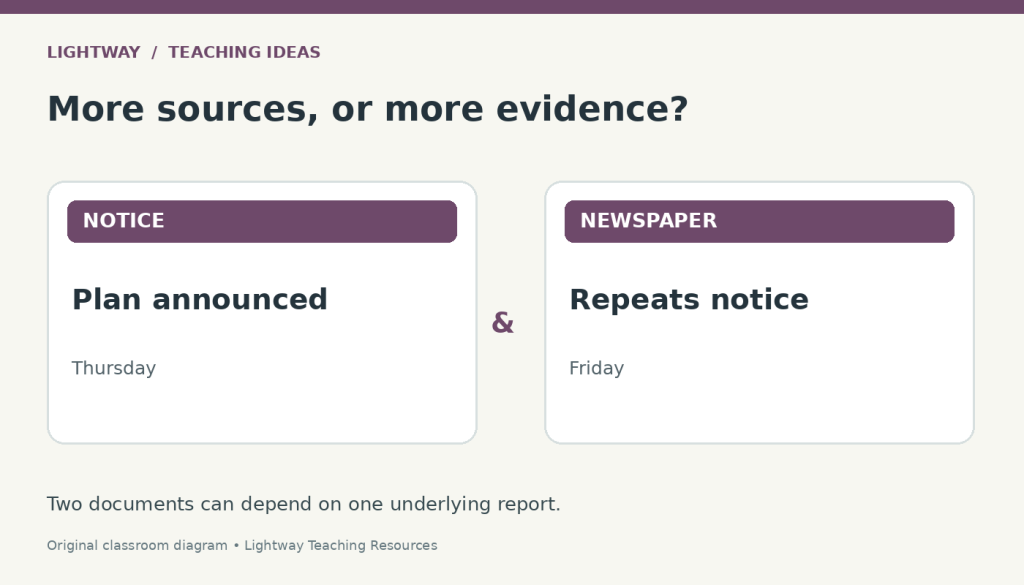
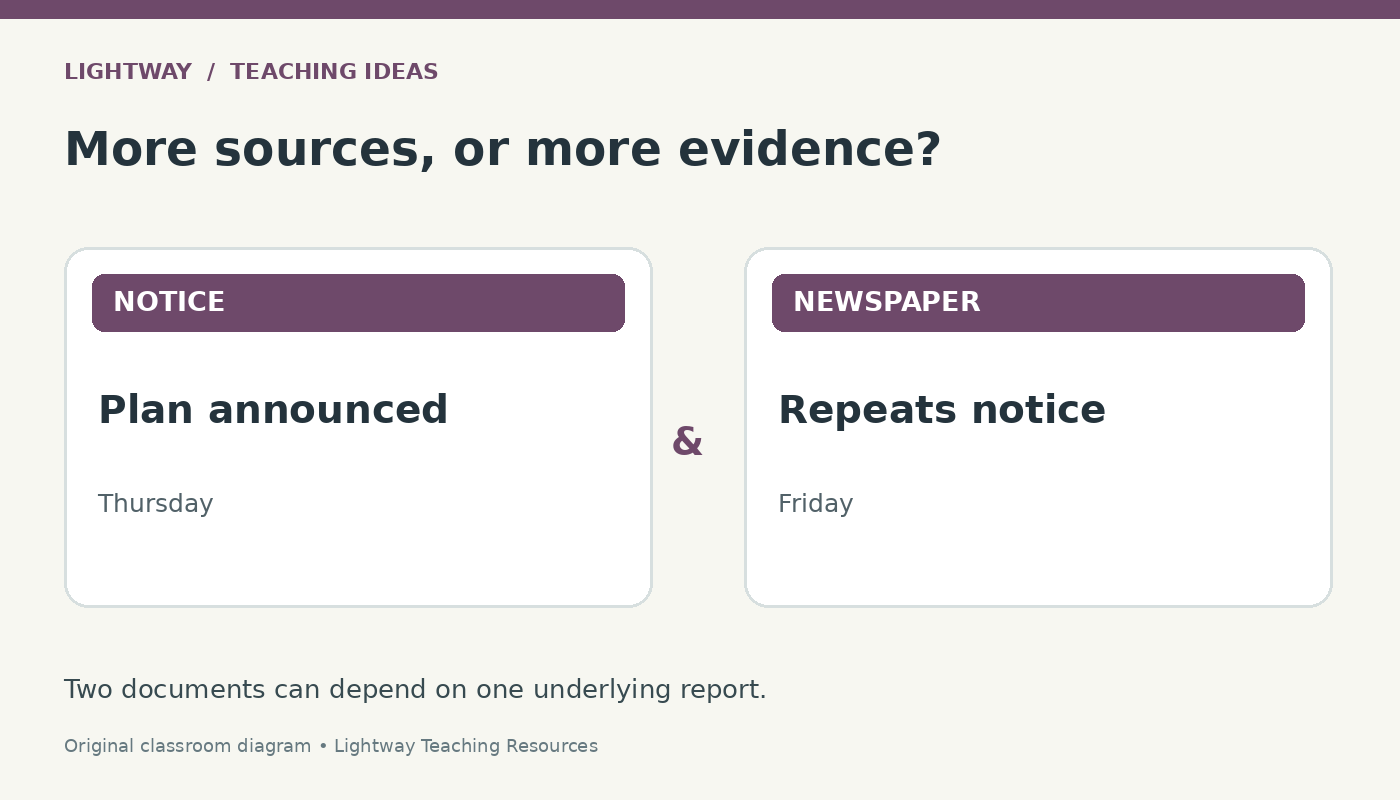
Then ask, “Are A and B two independent confirmations?” A strong answer is: “No. B repeats information from the committee, so both depend on the same announcement.” Two documents can preserve one underlying report.
Minutes 12–18 Weigh sources for this question
Avoid assigning permanent scores such as “diaries are reliable” or “official records are best.” Instead ask, “Which detail deserves more weight for this claim, and why?”
Card C is the strongest available support for an opening before noon because it gives a specific opening time in a same-day operational record. Its limitations still matter: it is one person’s record, and the supervisor may have reasons to explain or minimize a delay.
Card D independently supports closure around 10 a.m. It does not establish that the bridge remained closed all morning. Ask, “Can C and D both be accurate?” Yes: barriers at 10 a.m. are consistent with an 11:30 a.m. opening.
The National Archives explains that perspective and limitations affect how evidence is interpreted. A perspective is a reason to investigate how a source can be used. It is not an automatic reason to discard everything in it.
Minutes 18–24 Write a qualified answer
Ask pairs for four sentences: their conclusion, their strongest evidence, a comparison, and a remaining uncertainty.
A model response:
“Probably yes: the available evidence suggests the bridge opened before noon, at 11:30 a.m. Card C directly records that time after the event. Card D supports an earlier delay and does not contradict the later opening, while A and B describe the same advance plan. We would want an independent account of the actual opening to increase our confidence.”
Discuss why “probably” is appropriate here. It reflects the limits of this packet, not a rule that every historical claim must remain equally uncertain. Better evidence can justify greater confidence.
Minutes 24–30 Change the question and check transfer
Now ask, “What time did the committee advertise?” Cards A and B become highly relevant. This shows why evidence must be evaluated in relation to a question.
For an exit ticket, give students this new fictional detail: a Monday newsletter says “the bridge opened at 9” and explicitly cites Friday’s newspaper. Ask:
- Does this add independent confirmation? Why?
- Which missing source would help answer the original question?
Expected answers: it adds another repetition of the announcement, not an independent observation; a dated account from someone who crossed at the opening could help, provided its origin and context are checked.
Adjust support while keeping the reasoning
Read the cards aloud, preteach “announcement,” “barrier,” and “independent,” and provide a time line from Thursday to Saturday evening. Let students explain orally before writing. Keep the creator, date, and purpose labels even when shortening the language.
For extension, ask students what evidence could overturn their conclusion. Then replace the fictional packet with a small, genuine source set from your current unit. Keep the question narrow, preserve provenance, label any adaptations, and ask students to justify each comparison. The goal is a defensible explanation of what the evidence supports and what still needs checking.
For another classroom application, try Lightway’s cuneiform tablet inquiry. For a broader follow-on lesson, explore the How Does a Historian Work lesson bundle.
Quick check: Do the fictional notice and newspaper independently confirm the opening time?
No. The newspaper repeats the committee’s announcement. They document the same plan, rather than two independent observations of the opening.
Sources for teachers
- Library of Congress discusses corroboration as a dialogue among sources
- National Archives document-analysis guidance
- National Archives explains that perspective and limitations affect how evidence is interpreted
The classroom sequence and diagrams are original teaching suggestions, not a tested intervention or a guarantee of learning outcomes.
