
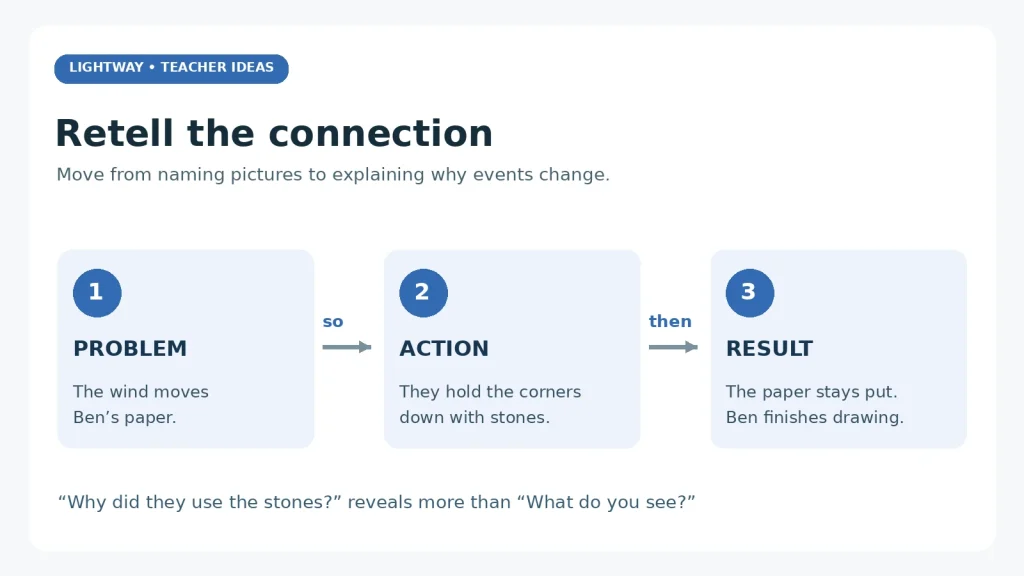
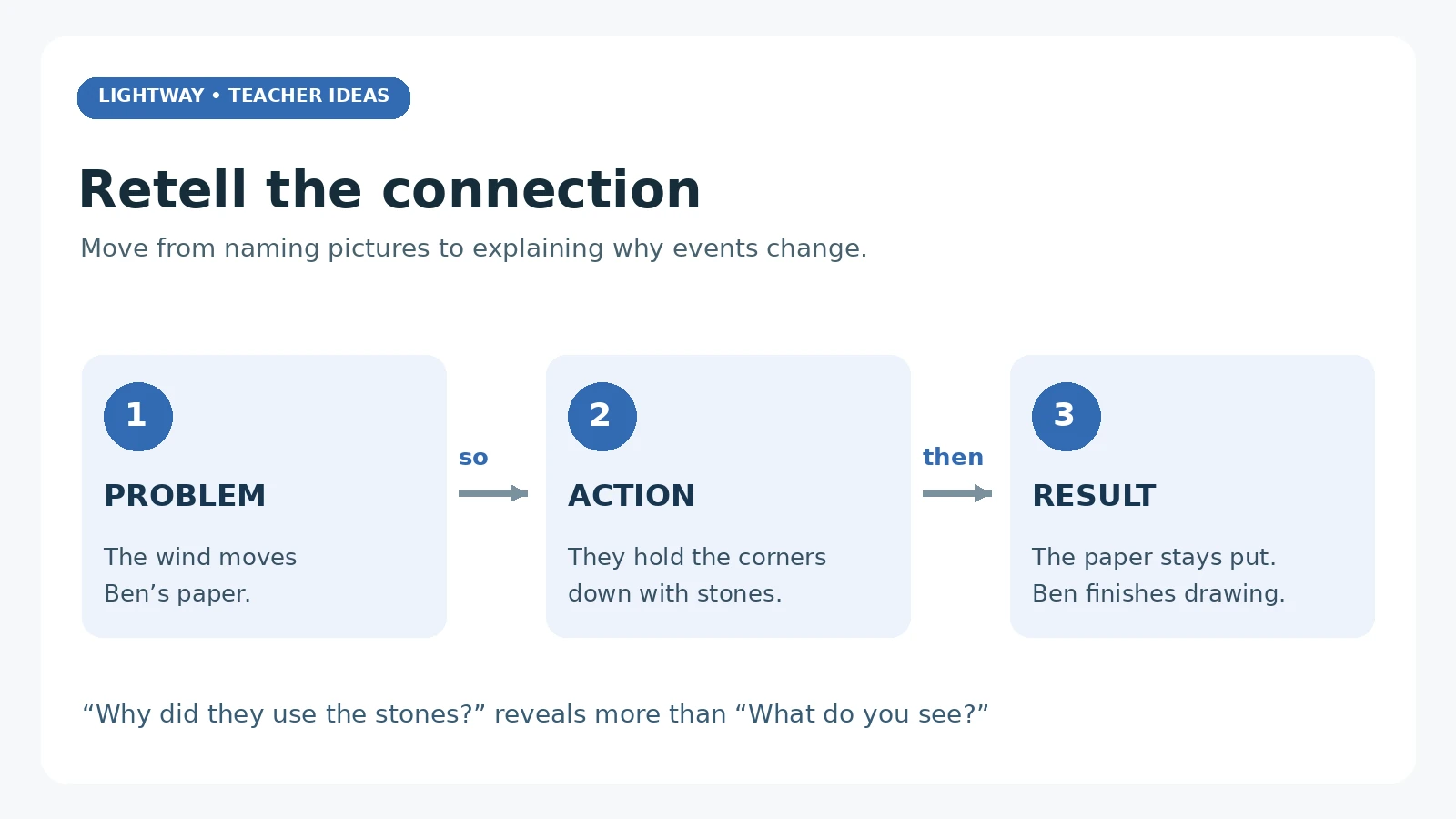
A child can name every object in a story picture and still miss why the story changes. “A basket, a door, a dog” is a description. A retelling connects the character’s problem with an action and a result. That connection is a useful next step when kindergarten retellings sound like lists.
How can we help children explain what happened and why, without turning a read-aloud into a long worksheet?
Give the story a first reading before dissecting it
Let children hear a short story as a whole. Pause only where a word or confusing event would block understanding. Then return to a few important moments on a second reading. The IES interactive read-aloud planning guide describes repeated readings that move from surface understanding toward deeper discussion. Repetition can serve a new purpose each time; it need not mean repeating every question.
For this routine, use three child-friendly prompts: What was the problem? What did the character do? What changed? They are a temporary scaffold, not a rule that every story has exactly three events or one problem.
Try this original mini-story
The Windy Drawing Table
Leah and Ben took paper outside to draw the school garden. Leah drew a tall sunflower. Ben began a beetle. Then a gust of wind lifted Ben’s paper off the table. It slid under a nearby bench.
Ben reached the paper, but he did not start drawing again. “The wind will take it,” he said.
Leah looked at the basket beside the door. It held smooth stones for a counting game. She asked the teacher if they could borrow four. The teacher agreed. Leah and Ben put a stone on each corner of the paper. This time, when the leaves rustled, the paper stayed on the table. Ben finished his beetle.
This fictional story was written for the activity. It is not an extract from the linked commercial resource. Use pictures, gestures, or three quick board sketches to support it. No outdoor activity or collecting stones is required.
Build the connections in a 15-minute revisit
- Recall the goal. Ask, “What were Leah and Ben trying to do?” A response such as “They were outside” is true but does not identify the goal. Follow with “What did they want to make?”
- Locate the interruption. Ask, “What stopped Ben from finishing?” Point to the windy moment. Distinguish the wind moving the paper from Ben simply being tired of drawing.
- Connect an action to the problem. Ask, “Why did they put stones on the paper?” Children may say “So it won’t blow away,” use a gesture, or point to the relevant pictures.
- Retell with a partner. Give one child the problem picture and another the action/result pictures. Have them make one connected explanation, then switch roles.
- Remove one support. Hide the middle picture and ask which action belongs between the problem and the ending. Listen for a reason rather than a guess about picture order.
Model a short response: “The wind moved Ben’s paper, so they held the corners down with stones. Then he could finish.” Do not insist on this exact wording. “He needed the stones because it was windy” also shows a causal link.
Model answers and useful follow-up questions
Goal: draw the garden. Problem: the wind moved the paper and Ben expected it to happen again. Action: they asked to borrow stones and weighted the corners. Result: the paper stayed put and Ben finished. If a child says “The problem was the beetle,” ask what happened to the paper. If a child says “Leah gave Ben a new sheet,” reread the relevant lines and invite a revision. Revising after listening is evidence of learning, not failure.
Ask a question that a picture list cannot answer
Try, “If the wind had not moved the paper, would they have needed the stones?” The likely answer is no, with the explanation that the stones solved the wind problem. This asks children to consider the relationship between events. It is more informative than asking whether they remember the color of an object that the story never names.
Keep counterfactual questions close to the text. “What if the school were on the moon?” may invite a wonderful new story, but it assesses imagination rather than understanding of this one. Both have a place; use the question that matches your goal.
Separate listening comprehension from English sentence production
A child may understand the solution but not yet have the English words to explain it. Offer a choice between two pictures, invite a demonstration, or let the child tell a partner in a familiar language before trying English. You can supply a connector: “The paper moved, so…” Another child may speak fluently but add unsupported details. Ask that child to show where the idea came from.
The IES K–3 comprehension toolkit recommends teaching how narrative parts connect and adjusting the number of elements to learners’ needs. Begin with one clear problem-action connection. Add setting, multiple attempts, or character motives when children are ready, rather than presenting a crowded organizer from the start.
Use a quick observation record
On a class list, note three things: identifies the main problem; links an action to that problem; describes the result. Add the support used, such as picture choices or a teacher prompt. These are observations from one task, not fixed ability labels. A child who recalls only the ending may need the story reread, vocabulary clarified, or fewer pictures to manage.
For a transfer check the following day, use a different short story with a clear problem and response. Keep the prompts but change the content. If the child can explain the new connection, you have more useful evidence than a perfect recitation of yesterday’s model.
Choose visual resources that serve the retelling
Project only the moments you want children to connect, and give them time to look before you ask. A busy picture can produce rich vocabulary but distract from the central action. If using The Rainy Day Surprise storytime slides, preview the actual story and choose its own problem-action-result sequence. Do not assume it follows the mini-story above.
For older readers, see our turning-point lesson, which extends the same attention to choices and consequences into literary analysis.
