
A broken statue is a strong way to begin a history lesson. It is also an easy way to teach a story that the evidence cannot support. Students see damage, hear that a later ruler altered a predecessor’s monuments, and quickly conclude that they know exactly what someone felt. A more useful lesson asks: What can this object help us establish, and what would require more evidence?
This 45–55 minute sequence is designed for middle school ancient history. Students compare representations of Hatshepsut, place them within an overlapping reign, and revise a claim about damaged sculpture. The aim is not to make every conclusion uncertain. It is to distinguish well-supported facts, reasonable interpretations, and invented motives.
Start with the overlap, not a ruler-versus-ruler contest
Hatshepsut acted as regent for the young Thutmose III before becoming his senior co-ruler. The Metropolitan Museum dates her reign as king to approximately 1473–1458 BCE. Thutmose III continued to rule after her death. Put those relationships on two parallel timeline bars before showing the statues. Otherwise, students may imagine one reign simply replacing the other or treat the two people as permanent opponents. See The Met’s exhibition overview for the basic sequence.
Keep the timeline modest: regency, co-rule, and later sole rule. Label ancient dates as approximate. Ask students to explain the overlap in one sentence without using the word “enemy.” This is a chronology check, not an invitation to infer friendship. A useful response is that the two held royal positions during the same period, while their roles changed over time.
Prepare two objects and a three-column record
Use The Met’s Hatshepsut Wearing the khat Headdress and The Female Pharaoh Hatshepsut. Open the object records before class. Preserve each title, date, object number, and museum attribution; do not detach an image from the information that identifies it.
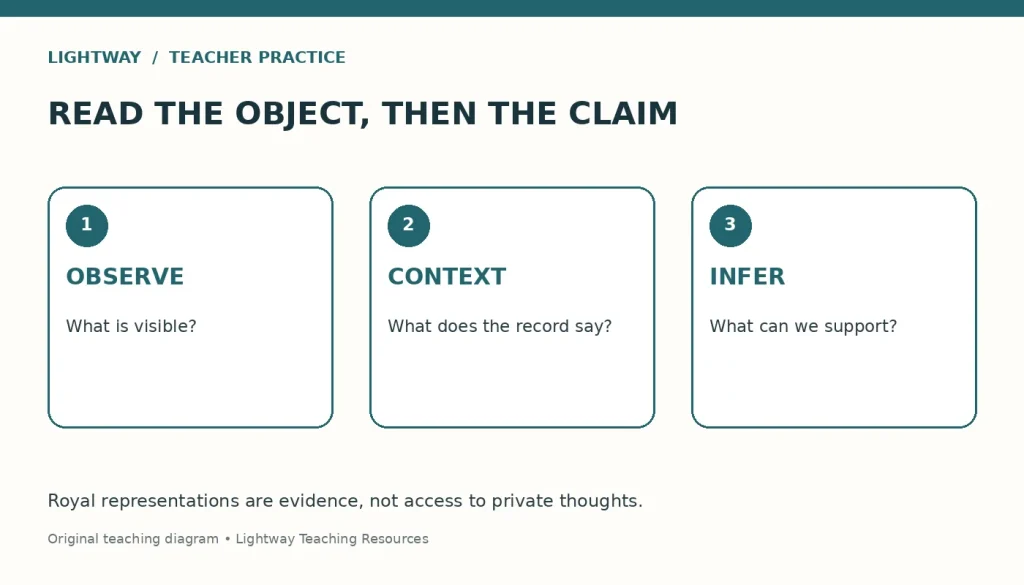
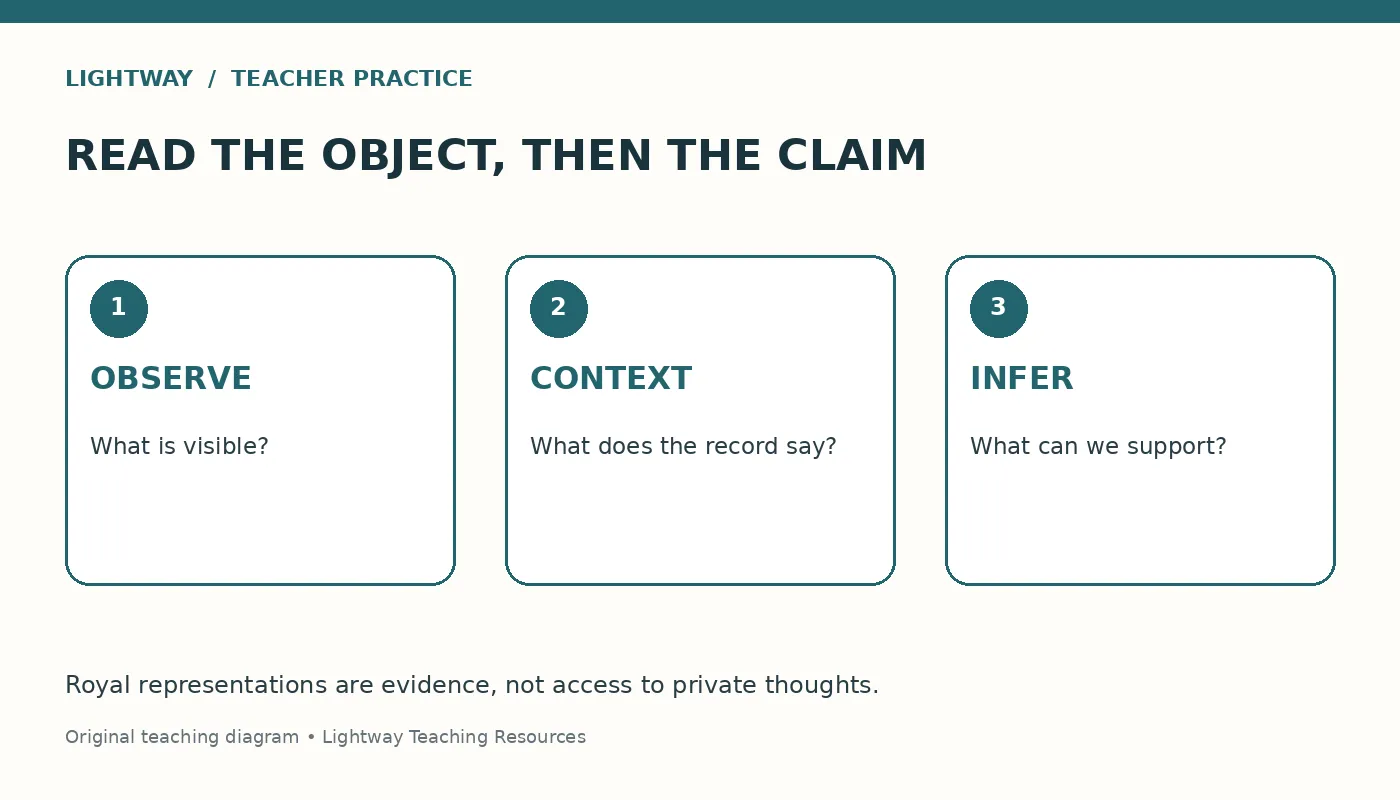
Students divide a page into “I can observe,” “The museum record tells me,” and “I infer.” This simple distinction prevents a translated title, archaeological findspot, or restoration history from being treated as something visible in the photograph. It also gives students permission to use expert information honestly.
For the first object, the museum describes a dress, a headcloth, royal titles, and symbolic bows beneath the feet. Students may see some details clearly but need the record for others. A photograph does not automatically reveal the meaning of an inscription. Read a short paraphrase of the museum explanation alongside the image instead of asking beginners to decode Egyptian writing.
Round 1: describe before interpreting
Give partners two minutes to record three observable details. Require ordinary descriptions before specialist vocabulary. “A seated figure with hands resting on the legs” is a more useful start than an unsupported sentence about personality. Invite students to point to the detail they mean.
Then reveal the object information and have students add two contextual facts in a different color. Ask: Which fact changed your interpretation? Which fact could you not have obtained from the photograph alone? Students should notice that looking and reading the record are complementary kinds of work.
Teacher check: observation or inference?
“The figure is seated” is an observation. “The seated position relates to receiving offerings” depends on the museum’s interpretation. “The ruler was always calm” is not established by the pose. A composed royal representation is not a record of someone’s everyday emotional state.
Round 2: compare the same question across both objects
Use the question “How is royal authority represented?” rather than “Which statue looks more powerful?” The first can be supported with named features and object context; the second easily becomes a preference poll.
Ask each pair to write a comparison with four components: one similarity, one difference, a specific detail, and a limitation. For example, both objects represent the same ruler, yet they do not use identical visual choices. The variation is a reason to investigate royal representation, not proof that the ruler disguised herself in ordinary life. Keep claims about clothing and imagery attached to the particular object being discussed.
Give students a sentence frame only after they have talked: “In object A, ___ helps represent authority; object B uses ___. This suggests ___, but it does not show ___.” The final clause must name a real limitation, such as the inability to reconstruct a private conversation or every viewer’s response.
Round 3: make the damaged statue a question
Introduce the second object’s reconstruction history using its museum record. Then offer a deliberately overconfident classroom claim: “Every break proves that Thutmose III personally hated Hatshepsut.” Tell students this is a claim written for the exercise, not a quotation from an ancient source.
Recent scholarship gives teachers a particularly useful caution. In a 2025 study of Hatshepsut’s statuary, Jun Yi Wong examined excavation archives and argued that the varied damage cannot be explained simply as indiscriminate hostile destruction. Deactivation and reuse of stone may account for much of it. This does not erase evidence of alterations to Hatshepsut’s monuments; it changes how confidently a particular kind of damage can be linked to one motive.
Students underline the parts of the exercise claim that go beyond the evidence: “every,” “proves,” and the asserted feeling. Ask them to revise it while retaining what the sources do support. Do not reward a replacement such as “nothing can be known.” Historical caution should improve an explanation rather than eliminate it.
A defensible revision
Some of Hatshepsut’s monuments were deliberately altered after her reign. Damage to surviving statues has a complicated history, so a broken part alone cannot establish a specific person’s private motive. The explanation needs archaeological context, comparison with other objects, and the history of the fragments.
Finish with a museum label, not a biography dump
Have students write a 70–100 word label for one object. It must identify the ruler, place the object in the co-rule sequence, explain one visible feature using the record, and state one carefully limited inference. They should name the museum source. A concise label makes students choose evidence instead of filling a page with loosely connected facts.
Check four things: accurate chronology, separation of observation and context, a supported explanation, and a meaningful limit. If a student has an accurate fact but no visible evidence, ask for a detail. If the label is full of uncertainty words, ask which fact is actually secure. If it asserts a motive, ask what source would be needed to support that claim.
Support without lowering the historical question
Offer enlarged images and read the object descriptions aloud. Let students dictate a label or record their comparison orally. For learners who need vocabulary support, provide “regent,” “co-ruler,” “representation,” and “restoration” with brief definitions. Avoid turning the activity into a test of handwriting speed or prior knowledge of Egyptian art.
For extension, ask students to compare an older museum narrative with the 2025 research. They should identify the evidence each author uses and the precise claim being reconsidered. A changed interpretation does not automatically mean that all earlier scholarship was worthless; it shows why archaeological records, preservation, and new questions matter.
For an introductory practice case before working with royal objects, use our fictional bridge inquiry on historical corroboration. It separates agreement between accounts from independent support.
