
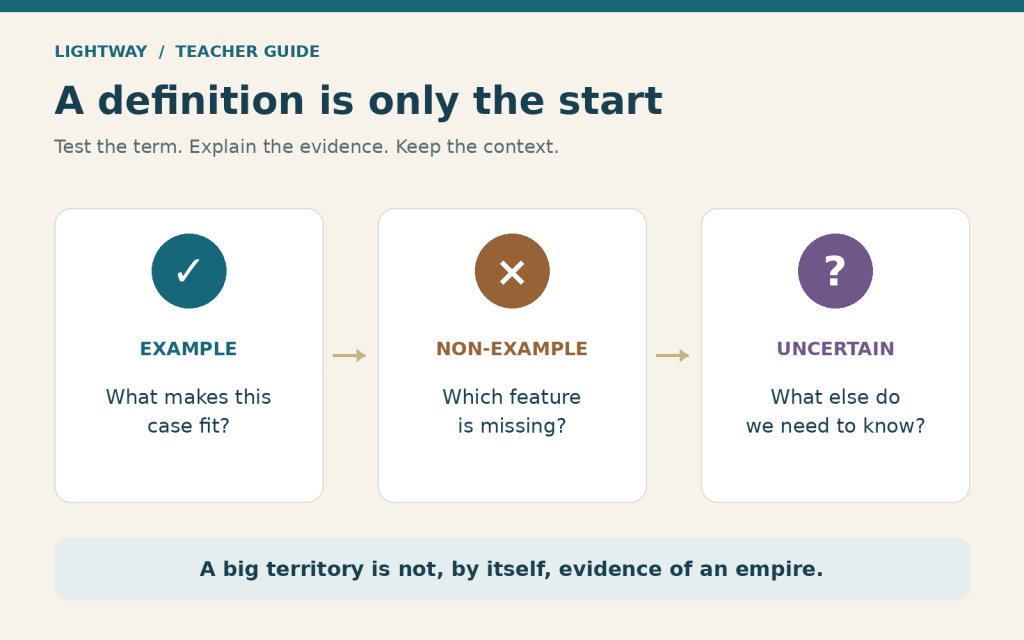
A student can spell empire, copy a definition, and still use it to mean any large place on a map. The useful check is not “Do you remember the word?” but “What would make you use it here—and what would make you hold back?” A short lesson built around examples, non-examples, and missing information can turn a vocabulary entry into a tool for historical explanation.
Teach a relationship, not just a replacement word
Historical vocabulary often compresses a complicated relationship. Tribute connects a payment with an obligation and a political relationship. Colony asks who settled, who already lived there, and who claimed authority. Citizen identifies a legal or political status whose rights and exclusions differ across places and periods. Replacing each term with a simpler phrase helps at first, but it does not remove the need for context.
The Education Endowment Foundation’s secondary literacy guidance treats language as part of learning each discipline, not an extra job belonging only to English lessons. The What Works Clearinghouse guide to adolescent literacy also recommends explicit vocabulary instruction. These are grounds for planning vocabulary deliberately; they are not evidence that any particular worksheet or thirty-minute routine guarantees improvement.
The routine below is an original classroom adaptation for a middle-school lesson in which students already know something about Mesopotamian city-states. It uses empire as the focus term. The same structure can work with other concepts, but the examples and definition must be rebuilt for the actual historical topic.
Before class: choose one word that carries the explanation
Start with the question students will eventually answer. For example: What changed when an expanding royal power brought several previously separate city-states under its control? If students cannot explain political control, adding ten more vocabulary words will not solve the problem.
Prepare a small map for orientation, a short factual paragraph from the class’s approved materials, and three invented cases for sorting. Label the invented cases clearly. They are thinking exercises, not primary sources. Students should never leave believing that an imaginary kingdom appeared in a real ancient document.
Write a provisional definition: For this lesson, an empire is a political system in which a ruling power exercises authority over other territories and peoples. Tell the class that this is a working definition, not a test that settles every case in world history. How far authority reaches, how it is exercised, and how securely it is maintained all need evidence.
Do not use the size or color of a territory on a modern textbook map as the definition. A map can help locate a claim; it cannot, by itself, explain the relationship between the ruler and the ruled.
A thirty-minute sequence
1. Surface the shortcut — four minutes
Display two statements: “This state covers a large area” and “This ruler requires several other communities to obey his officials.” Ask which statement gives more useful evidence for the word empire, and why. Take a few answers without turning the activity into a guessing game about your preferred wording.
The second statement addresses authority. The first addresses size. Neither sentence supplies a complete historical account, but the contrast reveals whether students are treating a political concept as a measurement. Record that distinction in two columns: information about size and information about rule.
2. Model the reasoning — six minutes
Read the short factual paragraph together. A suitable anchor is the Akkadian dynasty’s conquest of rival Mesopotamian city-states in the third millennium BCE. The Metropolitan Museum’s account of the Akkadian period explains this shift from competing cities to rule under the kings of Akkad. Use only the details your class has actually read; there is no need to compress the entire dynasty into the vocabulary lesson.
Model two sentences: “The word empire fits because the kings extended authority over previously separate cities. A large colored area on the map is not my reason; the relationship of political control is.” Then identify the detail in the paragraph that supports the explanation.
Keep conquest and control distinct. An army can travel somewhere without establishing lasting rule there. A campaign route, a royal boast, and an administrative record do not answer exactly the same question. If the source does not establish durable authority, say so rather than forcing it into the definition.
3. Sort three cases — eight minutes
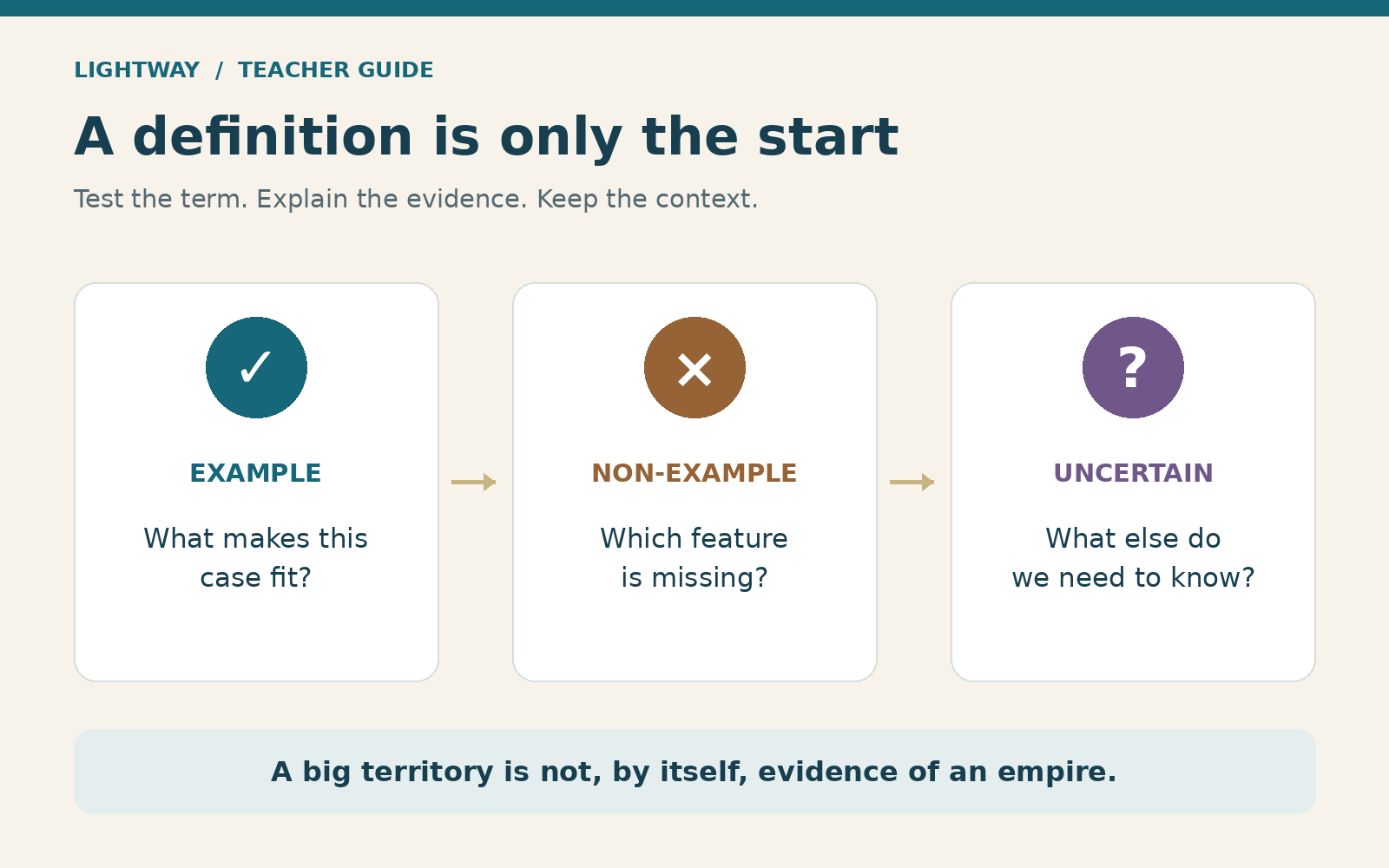
Give pairs these fictional practice cases. Ask them to choose supports the term, does not establish the term, or need more information. Every choice needs a reason.
- Case A: A ruler conquers neighboring towns, appoints officials there, and requires regular payments. This supports using the term under our working definition: the case describes authority over other communities. It still leaves questions about how long and how effectively the system operated.
- Case B: Merchants from one city trade at twenty independent ports. This does not establish an empire. Commercial connections alone do not demonstrate that the merchants’ city rules the ports. Trade and imperial power can coexist, but one does not automatically prove the other.
- Case C: A king’s inscription says he defeated a distant people. We need more information. Victory may matter, but this statement does not show whether the king subsequently governed that population, imposed obligations, or retained control.
Listen for a useful distinction: not enough evidence is not the same answer as definitely not an empire. Case C is especially valuable because it prevents the activity from becoming a mechanical match between a keyword and a box.
4. Return the word to a historical sentence — eight minutes
Ask students to revise this deliberately weak explanation: “Sargon had an empire because his country was big.” A stronger response should name the relationship, identify a detail from the class reading, and avoid adding facts not provided by that reading.
Offer a scaffold when useful: “The term ___ fits this example because ___. The detail ___ supports this, although it does not tell us ___.” Students need not fill every blank in every task. The point is to make their reasoning visible, not to require a long formula for a short answer.
Have partners underline the evidence and circle the explanation connecting that evidence to the term. If both students underline the definition itself, pause: they have identified the rule, not the evidence for applying it.
5. Check transfer — four minutes
Present one fresh fictional case: “A ruler claims a grand title and sends gifts to several independent kings. No other information is available.” Ask: “Can we establish an empire from this evidence? What would you want to know next?” A useful answer recognizes that titles and diplomatic contact do not by themselves establish rule over other territories.
Collect this answer independently. Pair discussion can reveal good questions, but it can also hide which student still equates fame, wealth, or size with political authority.
Use the answers to choose the next lesson move
If students recall the definition but sort by size, return to two carefully contrasted cases. If they identify authority but cannot cite the reading, model how to select a relevant detail. If they treat uncertainty as failure, demonstrate how “This evidence does not establish that claim” can be a precise historical conclusion.
For students who need language support, allow a brief oral explanation before writing and supply a small word bank: rule, officials, obligation, independent, evidence. Keep the historical demand intact. For a challenge, ask students whether the same working definition explains indirect rule through local leaders, and what further evidence they would need.
The Victorian education resource on history terms and concepts discusses definitions, characteristics, examples, and non-examples through the Frayer model. An organizer can make those distinctions visible, but filling four boxes is not the endpoint. Students should use the term accurately in a new explanation, revisit it in later contexts, and notice where its meaning or application changes.
