
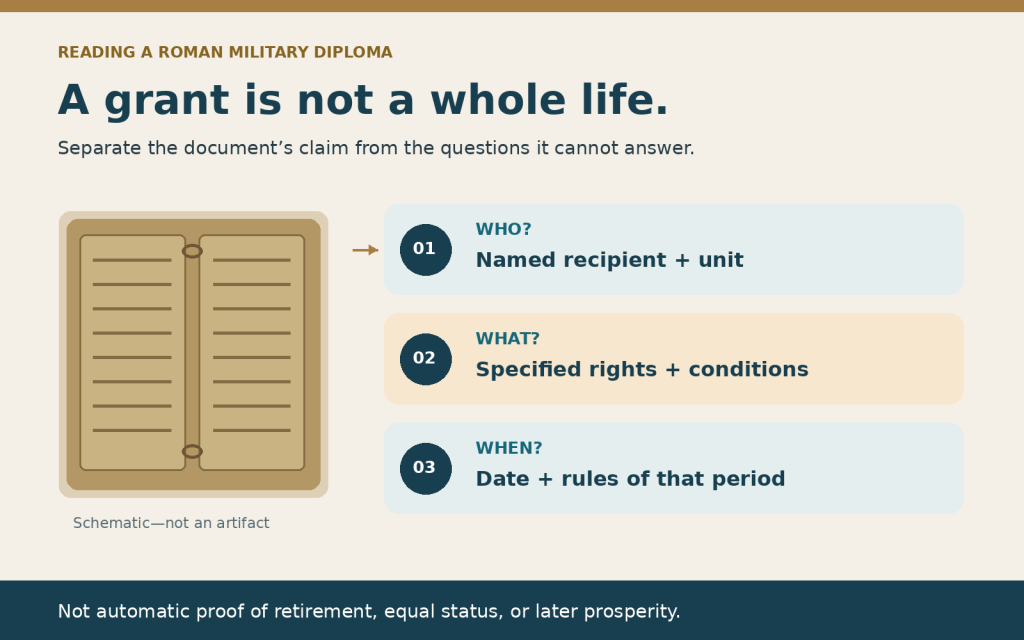
On 19 January 103 CE, an imperial grant included a cavalry officer named Reburrus, son of Severus, from Spain. His surviving bronze document connects a named man serving in Britain to a decision issued in Rome. It is often described as a military discharge diploma. Yet Reburrus was still serving. That small correction opens a larger question: what, exactly, did these remarkably durable documents certify?
A change of status, not a school qualification
The British Museum’s record of Reburrus’s diploma identifies him as a decurion, a junior cavalry officer, in the First Pannonian regiment. The grant concerned Roman citizenship and the right to a legally recognized marriage with a present or future wife. The bronze plates were therefore more than a souvenir of service. They recorded rights that could affect a person’s standing outside the army.
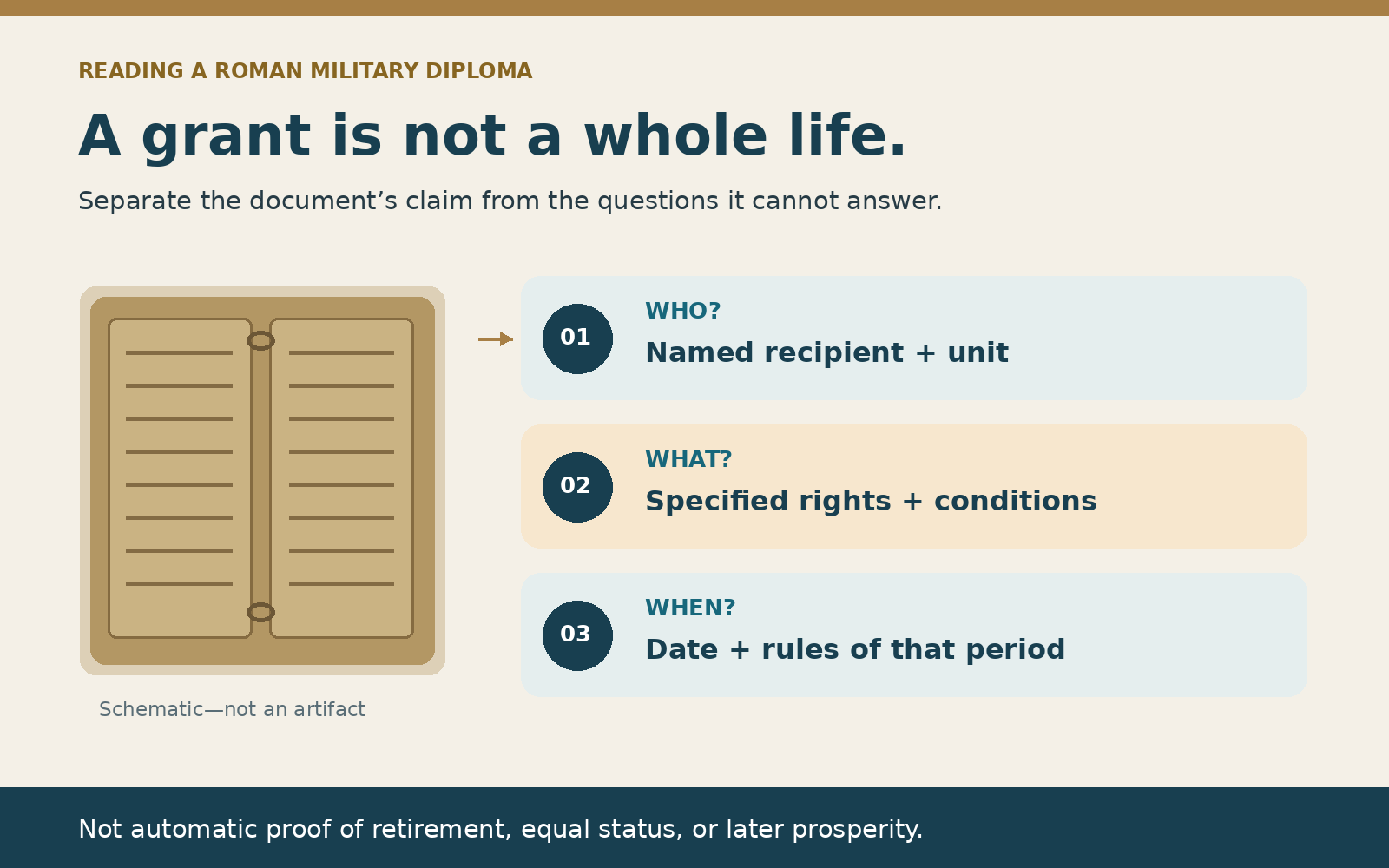
A modern diploma usually tells us that someone completed a course. Applying that meaning here is misleading. The Roman object did not assess Reburrus’s knowledge, and it was not a universal identity card issued to everyone living under Roman rule. It documented a particular grant. To understand it, we need to identify the recipient, the authority making the grant, the benefits specified, and the conditions attached.
The date matters as much as the name. The edition in Roman Inscriptions of Britain explicitly identifies Reburrus as a serving soldier. Its text names units stationed in Britain and men who had completed twenty-five or more years. It does not allow us to turn 19 January into the first day of his retirement.
How an imperial decision became portable evidence
According to the RIB introduction to military diplomas, these documents certified copies of a bronze text displayed publicly in Rome. A typical diploma comprised two small tablets: an internal text, a counterpart on the outside, and the names of seven witnesses. Wires fastened the tablets together; the arrangement protected an authenticated version while leaving another version available to read.
This was a solution to a practical problem of scale. An emperor’s decision might apply to people stationed far from the capital. A recipient needed something more usable than the instruction to consult a monument in Rome. The diploma linked an individual to a public act through a material object and a procedure for authenticating its text. Its authority came not simply from being bronze, but from that documented relationship.
The inscription should consequently be read as a chain rather than a list: emperor, province, eligible units, qualifying service, privileges, recipient. Each part narrows the claim. A long sequence of official names may feel like an obstacle to a modern reader, but it helps establish which decision the copy represents.
Service and citizenship were connected—but not identical
The army contained people with different starting positions. The Kelsey Museum’s account of Roman military experience distinguishes legionaries from non-citizens who could enter auxiliary units. Citizenship was relevant to recruitment, not merely a reward waiting at the end of every military career. A sentence such as “Roman soldiers became citizens after twenty-five years” therefore erases distinctions before it explains anything.
Nor should twenty-five be read as a promise of an exact finishing date. Historian Myles Lavan’s study of the army and the spread of citizenship emphasizes that it was a minimum in the grant formula, with some men serving longer. The relationship between grant and discharge changed over time; grants to veterans became normal in the early second century, after a period in which serving soldiers also received them.
For a later comparison, the Metropolitan Museum’s diploma dated about 149 CE records a grant under Antoninus Pius to discharged auxiliary veterans. The two examples are not contradictory. They warn us against using one object as a timeless instruction sheet for the whole empire.
The family clauses require especially careful reading
Citizenship and marriage rights were related benefits, but they were not the same benefit. The marriage privilege, often called conubium, permitted a legally recognized Roman marriage across a status boundary. Under the standard auxiliary arrangements discussed by RIB, granting that privilege to a soldier did not automatically make his non-citizen wife a citizen. The document’s references to wives must not be flattened into “the whole family received citizenship.”
The position of children also changed. Around 140 CE, the auxiliary grant formula stopped including existing children in the same way. Brian Campbell’s entry on diplomas in the Oxford Classical Dictionary distinguishes these existing children from later descendants whose status would follow the relevant rules. Different military branches and exceptional grants further complicate the picture.
For a reader, the safest method is simple: ask separately what the text grants to the serviceman, what it says about a spouse, and what provision it makes for children. Do not supply an answer in one column from evidence in another. An administrative formula can recognize a household while still assigning different legal positions to its members.
Citizenship did not mean equality
The University of Giessen’s exhibition on Roman citizenship describes a society differentiated by freedom, birth, citizenship, and other forms of status. Roman citizenship could be inherited or granted through routes other than military service. A diploma is evidence of one route, not a complete account of how the citizen population grew.
That distinction prevents two opposite mistakes. The grant should not be dismissed as an empty label: legal status mattered. But it should not be translated into a modern promise of equal opportunity either. Becoming a citizen did not by itself make a former auxiliary officer wealthy, eliminate social rank, or reveal how other people treated him. A legal document tells us what a particular act recognized; it does not contain the whole subsequent life.
Caracalla’s broad extension of citizenship to the empire’s free inhabitants in 212 CE changed this landscape. It did not abolish slavery or every hierarchy. Nor does it justify assuming that every kind of military diploma immediately vanished. Campbell’s survey records later examples, reminding us that the documents concerned privileges beyond a simple citizen/non-citizen distinction.
Whose experience survives in bronze?
A diploma gives unusually precise information, but precision is not representativeness. The British Museum’s Legion exhibition placed military rewards alongside danger, occupation, and the lives of women, children, and enslaved people around the forces. The army offered opportunities to some while enforcing Roman power over others. A successful grant should not become a story in which everyone benefited from the same institution.
Surviving diplomas also cannot simply be counted as a census of new citizens. Lavan’s demographic study models military enfranchisement between 14 and 212 CE using such variables as force size, survival, service length, and family formation. His estimated range of roughly 0.9–1.6 million beneficiaries is a scholarly model, not a total written in an ancient register. It illustrates why a large historical conclusion needs more than an impressive collection of individual finds.
The same caution applies at the scale of one person. A findspot does not automatically establish where its owner was born, where he spent his entire career, or why the object entered the ground. Missing information is not an invitation to invent a homecoming.
Read the claim before filling in the life
Returning to Reburrus, we can distinguish three levels of knowledge. His inscription supplies a date, identity, unit, and grant. Comparison with other diplomas helps explain the administrative system. Questions about his private response, later prosperity, or daily use of the tablets remain unanswered by this object alone.
The surviving evidence shows how Rome could connect a man from Spain serving in Britain to citizenship recognized through an act in the capital. But the bronze certificate did so in carefully delimited terms. Reading those terms closely reveals both the reach of imperial government and the boundaries of what an individual document can prove.
