
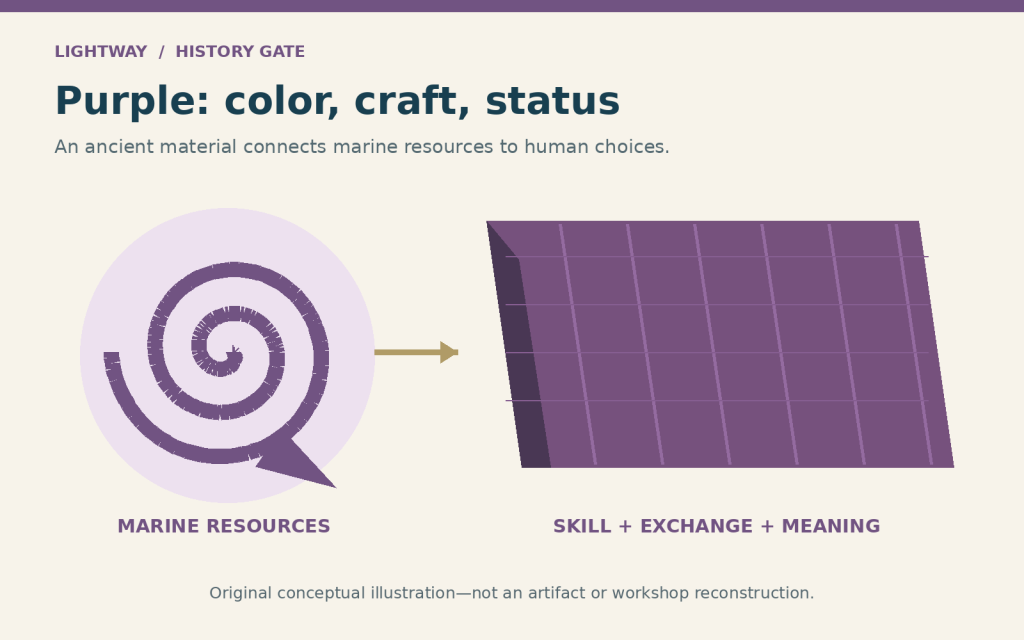
Three small textile finds from an ancient copper-smelting site in the Timna Valley carry a surprising connection to the Mediterranean. Chemical analysis identified a dye made from marine snails. The fibers came from an inland desert landscape, not a coastal workshop. Their journey is one way into the history of purple: a history of skilled production, exchange, and the people who made a difficult color socially valuable.
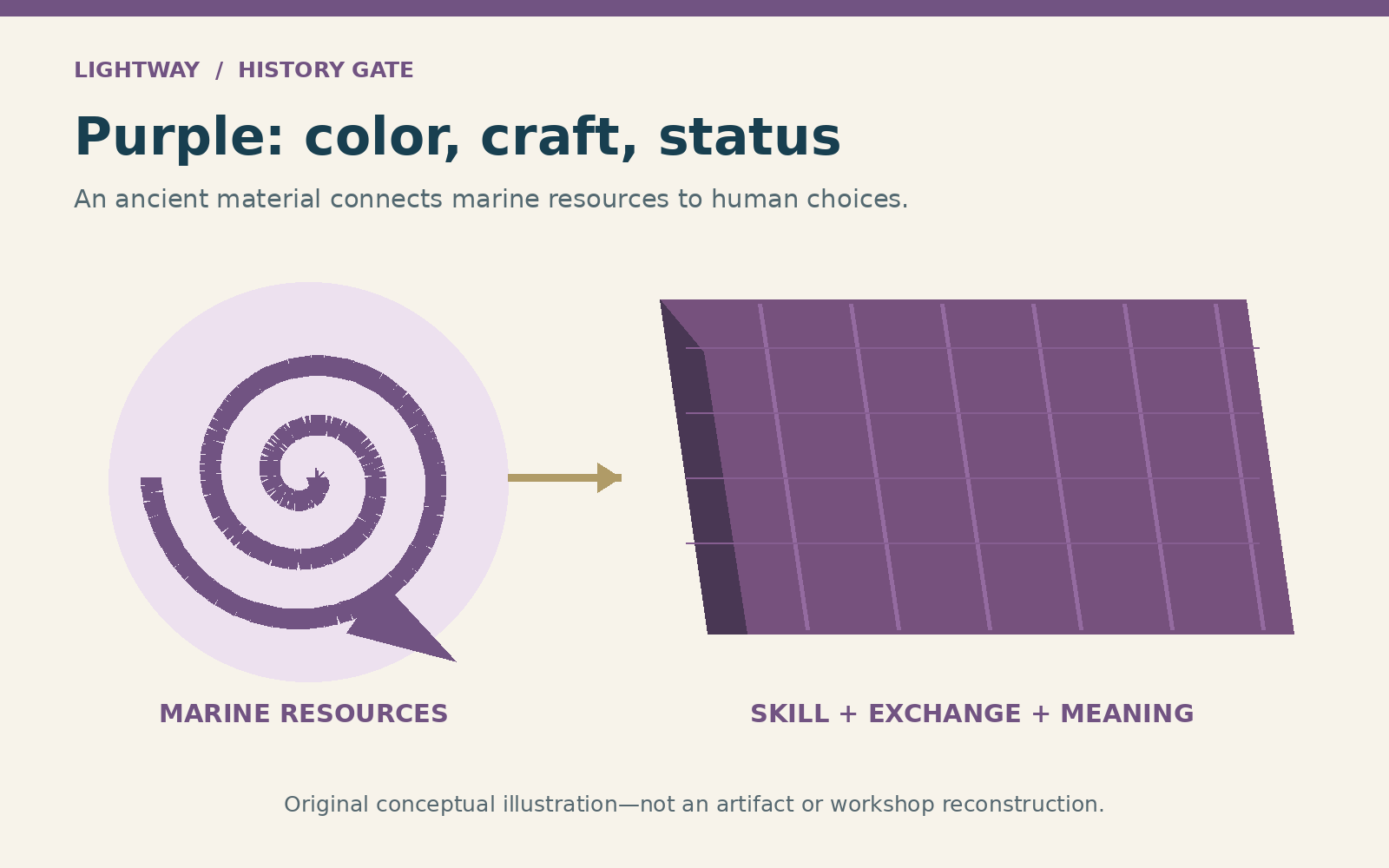
A desert find with a coastal beginning
The study published by Naama Sukenik and colleagues in 2021 identified shellfish-derived purple in three textile samples from “Slaves’ Hill,” the modern name of a Timna smelting site. Its archaeological context dates to the late eleventh and early tenth centuries BCE. The team used chemical analysis to distinguish the colorant from other substances that could produce a purple-looking textile. Their research article places these rare finds within wider questions about the organization and connections of the communities working the copper landscape.
The finding does not supply the name of a wearer, a complete trade itinerary, or a photograph of social life. It shows that a material associated with coastal resources reached people far inland. That distinction matters. An object can establish a connection without telling us every step by which it arrived.
A scrap of thread also survives under very different conditions from a stone wall. The scarcity of ancient dyed cloth partly reflects the difficulty of preserving textiles. Absence from an excavation is not a straightforward measure of absence from ancient wardrobes.
Why the name Tyre became attached to a color
Tyre and Sidon, on the coast of what is now Lebanon, became especially associated with purple textiles. Yet the people grouped under the name “Phoenicians” did not form one simple territorial country with a single ruler and a uniform economy. The Metropolitan Museum’s overview describes independent, competing coastal cities and a wider world of maritime exchange. Their workshops produced more than dyed cloth: metalwork, carved ivory, woodwork, and other textiles also connected them with customers and patrons.
The Greek name connected with Phoenicians may itself refer to purple-red, but that etymology should not be treated as certain proof of an entire people’s identity or occupation. Nor does the label “Tyrian purple” mean that every surviving example was manufactured in Tyre. A prestigious place-name can become attached to a valued material without identifying the workshop responsible for each specimen.
It is therefore more useful to follow skills, raw materials, and evidence than to imagine a single “purple empire.” Coastal cities were important participants in an industry whose history extended across different societies and political systems.
The shell did not contain a ready-made purple paint
The celebrated color began with substances obtained from certain sea snails. Producing a stable dye required more than gathering attractive shells. Workers had to obtain the relevant material and manage a chemical process before a textile acquired its final color. Species, processing, and conditions could affect the resulting shade.
The National Maritime Museum in Haifa emphasizes three connected sources of value: durability, specialized knowledge, and the large quantities of shellfish needed for production. Its account also describes purple in a range of tones rather than as the single standardized swatch a modern screen suggests. Color names cover material variation.
The work of dyeing sat inside a longer chain. Someone had to obtain suitable fibers, prepare and spin them, weave or otherwise organize the textile, transport materials, and find buyers or patrons. Purple was not merely a substance at the end of this chain. It was labor made visible in a finished surface.
A workshop older than a simple Phoenician origin story
Archaeology complicates the familiar claim that one people invented purple dye on a particular day. A 2024 study of Aegina Kolonna, in the Greek Saronic Gulf, examined evidence from a sixteenth-century BCE production setting. The interpretation combines pigment-bearing pottery, abundant mollusk shells, tools, and installations. Chemical analysis strengthens the connection between the material remains and purple production.
This is not just another place-name to add to a list. It changes the historical question. Instead of asking which later community “owned” the discovery, we can ask how expertise circulated, how production was organized, and how investigators identify a workshop. The Aegina evidence belongs to a Bronze Age setting; it should not be folded casually into the much later political history of Greek city-states.
The study also illustrates why several kinds of evidence are valuable together. A heap of shells can raise a hypothesis. Residues, species identification, the arrangement of a building, and associated equipment can make the argument more precise.
Shell heaps are evidence, but not a complete factory report
A coastal shell deposit does not automatically establish the scale, purpose, or ownership of a dye industry. Archaeologists must consider how the shells were broken, which species are present, what residues survive, and whether the surrounding structures support a production interpretation. Food, craft, and disposal practices can leave overlapping traces.
In a study published in September 2026, Golan Shalvi proposes more differentiated criteria for assessing production sites and uses Tel Shiqmona as a key comparison. The argument distinguishes direct evidence from weaker indications and interprets a gap in the wider record as potentially related to consolidation of production. That is a research interpretation, not a final map of every ancient workshop.
For readers, the methodological lesson is important: “purple was found here,” “purple was made here,” and “a ruler controlled purple production here” are three different claims. Each needs its own evidence. Moving from one to the next without explaining the link makes the ancient economy appear simpler than the remains allow.
Prestige was made by people as well as chemistry
A costly process can help explain a high price, but price alone does not explain a color’s social meaning. People also had to recognize the textile as desirable, associate it with distinction, and decide when its display was appropriate. Purple’s attraction connected the material properties of cloth with institutions, ceremonies, and conventions of dress.
The University of Michigan’s Kelsey Museum exhibition on ancient color describes the laborious, odorous production process and recounts a discovery legend recorded by Julius Pollux in the second century CE: a dog’s stained mouth reveals the color during a seaside encounter involving Melqart. This is a story about discovery, not a contemporary record of its actual invention. Its memorable characters help explain how later people imagined an extraordinary material.
We should also resist turning every purple thread into proof that its wearer was a king. A prestigious material can appear in different quantities, forms, and contexts. The meaning of a decorative band is not necessarily identical to that of an entire garment, and neither should be interpreted without information about its date and setting.
Following a color without flattening its history
The strongest account keeps several scales in view. At the smallest scale are fibers and chemical compounds. At another are workshops, skilled decisions, and discarded shells. Beyond them are buyers, political authorities, maritime routes, and inland connections. None of these scales makes the others unnecessary.
The Timna fibers are especially valuable because they bring those scales together without completing the story for us. They connect an inland industrial landscape with a marine-derived luxury, but leave open questions about individual possession and the precise route of exchange. The missing answers are not invitations to invent a merchant’s journey. They identify what future evidence would need to explain.
Purple’s history is richer when it is not reduced to “a color only kings could wear.” It reveals how technical skill and social recognition could reinforce one another—and how a small material trace can connect places that look distant on a map.
