
The people who made Egypt’s royal tombs left more than decorated burial chambers. They also left records of work, supplies, and disagreements. These less spectacular traces shift the historical question: not simply how a king wished to be remembered, but how the people responsible for that remembrance organized their lives.
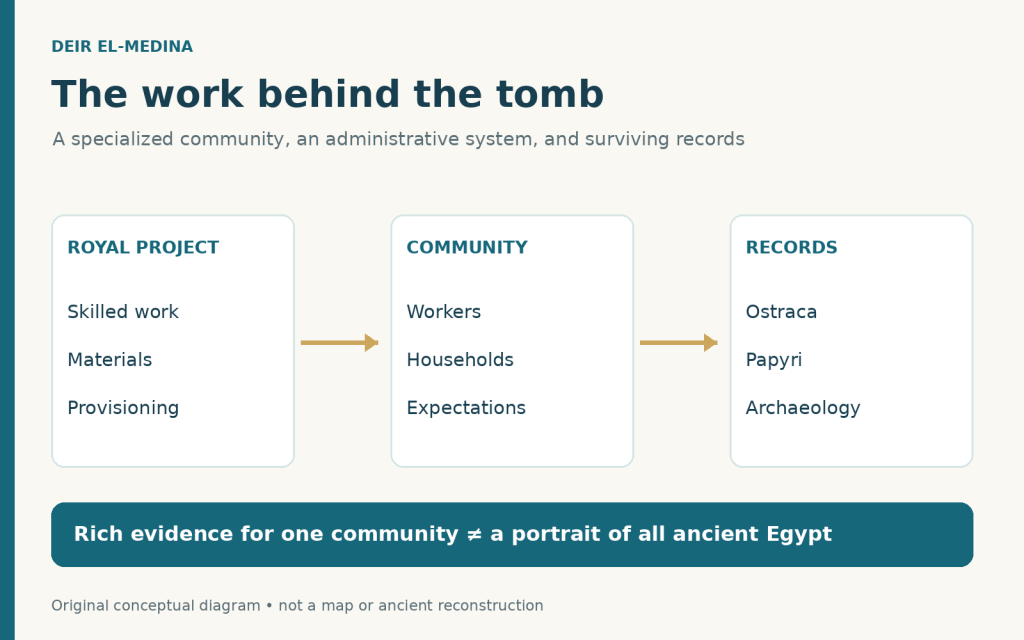
Featured illustration: original explanatory diagram created for LightwayEdu, not a historical source or reconstruction.
Deir el-Medina, on the west bank at Thebes, is unusually revealing because written records and the remains of a settlement can be studied together. Its evidence brings named workers and administrative routines into view. Yet it presents a trap as well as an opportunity. A richly documented community can seem like a miniature version of an entire society. This one was not. Its inhabitants served a highly specialized royal enterprise, and that position shaped both their work and the records that survive.
A village attached to a royal project
During Egypt’s New Kingdom, royal burial projects in the Theban region required skilled labor. UCL’s introduction to the Deir el-Medina ostraca describes a full-time team that included draughtsmen, carpenters, and suppliers. The workers’ settlement lay in a desert valley west of the cultivated fields. The royal tomb was therefore not just an architectural object. It was a continuing project connecting specialist knowledge, materials, provisioning, and administration.
The location matters to the interpretation. A settlement closely associated with royal tomb-making does not offer a random sample of Egyptian livelihoods. Its documents are especially valuable for understanding this particular community and its relationships with the state. They cannot automatically tell us how every farmer, craft worker, or household elsewhere in Egypt lived. The exceptional archive should sharpen a question, not erase differences between communities.
When a piece of limestone became a writing surface
Many surviving records are written on ostraca: pieces of pottery or, in Egyptian usage, flakes of limestone used for writing and drawing. These modest objects are important partly because they disrupt a familiar image of Egyptian writing as something confined to grand inscriptions. UCL notes that the limestone available around the tomb-working environment offered a convenient surface. Alongside papyri, the ostraca preserve an unusually extensive body of everyday documentation.
The Metropolitan Museum’s account of ostraca emphasizes their range: administrative and literary writing could share the same general class of inexpensive surface with drawings. Its object 09.184.700 carries marks associated with royal necropolis workers. A material that appears humble in a display case could perform a serious organizational task. The object’s physical size is not a measure of its historical importance.
There is also a useful distinction between recognizing writing and understanding it. Many records were produced in hieratic, a cursive script, rather than the monumental hieroglyphs familiar from popular illustrations. Reading them requires specialized knowledge of language, handwriting, and context. A modern translation is an interpretation of that evidence, not a transparent window through which the ancient scene becomes fully visible.
A record of work is also a record of priorities
An attendance list, an allocation of supplies, and a personal exchange answer different questions. A register can show that an administration monitored labor. It does not necessarily explain every reason behind a recorded absence or reveal everything the worker thought about it. A distribution record may establish that something was entered into an account; other evidence is needed to understand how an allocation was experienced by a household.
This distinction is not a reason to distrust every document. It is how documents become usable evidence. Start with what an item was made to do. Who needed the information? What counted as worth recording? What could be left unstated because the original readers already knew it? The more ordinary a note was to its writer, the more background a modern reader may need to recover.
The community’s records also resist a simple division between “great history” and “daily life.” A royal burial project depended on repeated, practical arrangements. When those arrangements failed, the failure could become a matter for officials and a challenge to the operation of royal authority itself. Institutions did not exist separately from food, work, and the people who expected an obligation to be fulfilled.
The dispute preserved in the Strike Papyrus
The clearest example is the document conventionally called the Turin Strike Papyrus, now in the Museo Egizio. The museum identifies it as an administrative record written by the scribe Amunnakht during the reign of Ramesses III. It describes a conflict caused by interruptions to the workers’ grain rations. The workers stopped work and moved to locations in the Theban necropolis and temple area while pressing the authorities to provide what was due.
The account is not a simple story in which one payment resolves everything. The museum’s summary describes renewed action after grain was supplied, and workers who wished to take their complaint to the pharaoh. It also notes that the papyrus contains other kinds of material, including an attendance record and texts about grain distribution. The famous dispute survives within a broader administrative document, not as a modern newspaper report devoted exclusively to a strike.
Calling this a labor dispute is useful because it identifies the relationship at stake: work was connected to an expected provision, and workers challenged a failure in that relationship. But comparison with a modern strike should not silently import trade unions, wage contracts, or labor law that the document does not establish. The historical force of the episode lies in its own setting. People serving the royal necropolis could still make claims against the arrangements on which their work depended.
An archive assembled after the event
The evidence available today is not an untouched village filing cabinet. Objects have been excavated, moved, collected, published, and distributed across institutions. The Museo Egizio’s research volume, Deir el-Medina Through the Kaleidoscope, brings excavation history, written records, and material culture into conversation. Its range is a reminder that no single famous papyrus can stand for the whole site.
Even the ending of the settlement’s occupation requires caution. In a study of late Twentieth-Dynasty ostraca, Egyptologist Ben Haring reassesses evidence used to date the workers’ move away from the village. A reference to food distribution at another location does not by itself prove that everyone had permanently relocated there. The example shows historical reasoning at work: an attractive narrative must still fit what a document can actually demonstrate.
Deir el-Medina is compelling not because its inhabitants were simply “just like us,” but because an unusual combination of sources lets us ask closely defined questions about them. The royal tomb and the small written fragment belong in the same history. One shows the scale of a project; the other can reveal the arrangements, expectations, and tensions that helped make that project possible.
