
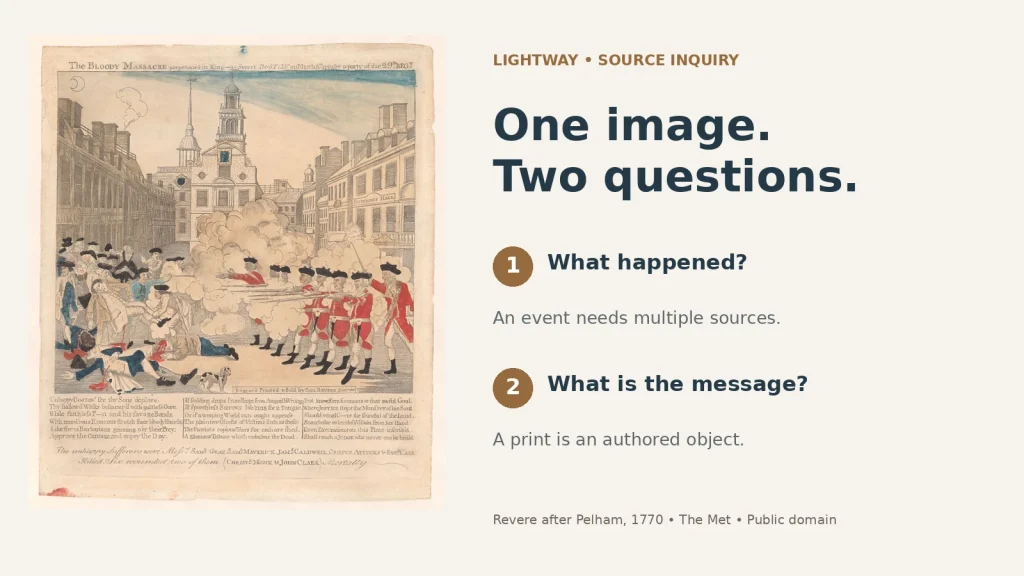
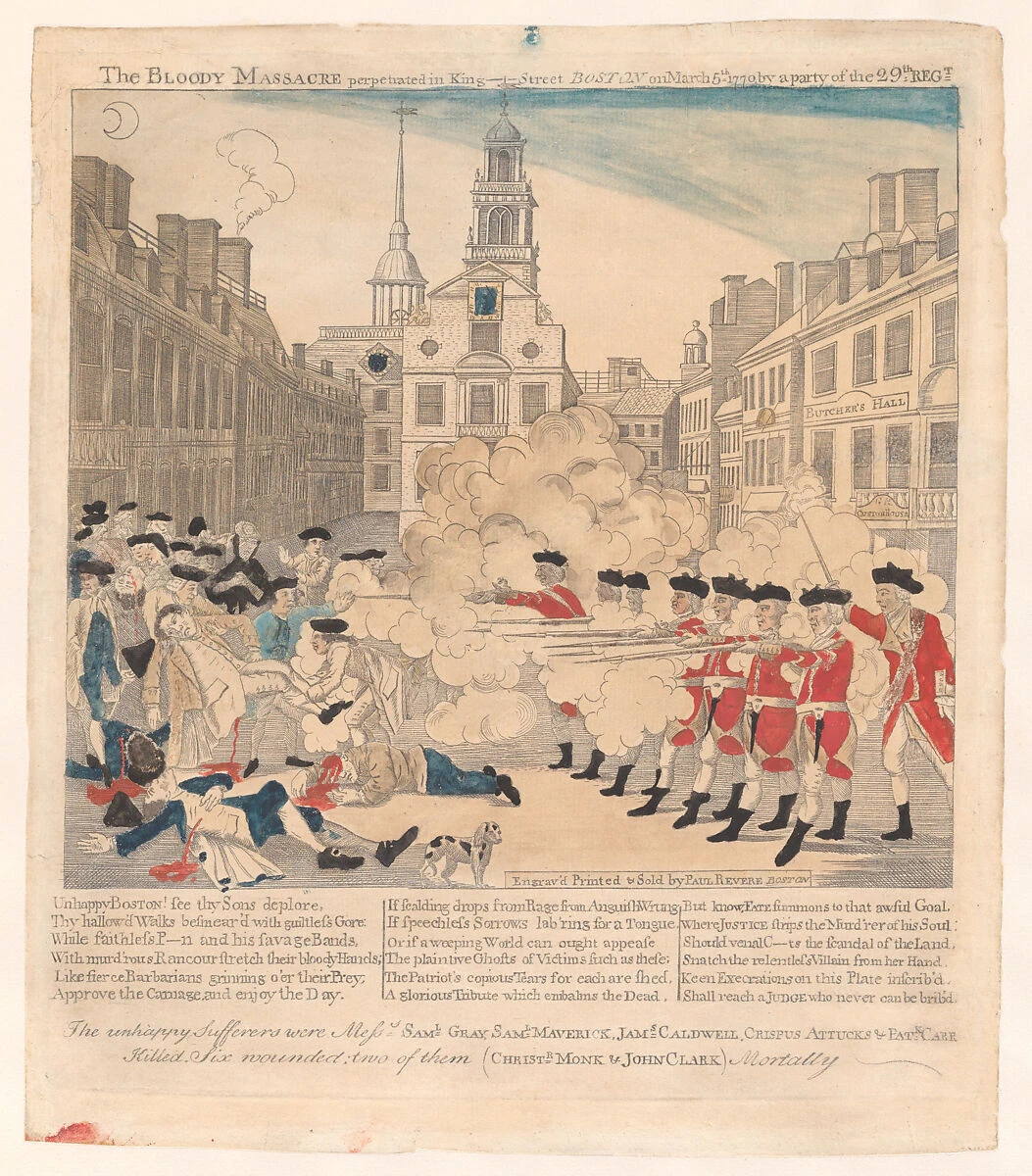
Show students Paul Revere’s Boston Massacre engraving and ask what happened. Many will describe a neat line of soldiers firing at a helpless crowd. Now change the question: what does this image want a viewer to believe? The shift opens a better lesson about historical evidence.
What can a persuasive image tell us about an event, and what can it tell us about the effort to shape public opinion?
Keep two historical questions on the board
Write What happened in Boston? beside How was the event represented? Students need both. An image can be valuable evidence for political persuasion even when it is insufficient to establish the precise sequence of an encounter.
On March 5, 1770, British soldiers fired on a crowd in Boston; five people died as a result. The encounter occurred amid tensions over the presence of British troops. Revere’s print appeared soon afterward. The Metropolitan Museum of Art notes that he advertised it on March 26 and used a design by Henry Pelham without crediting him. Those production details matter because a printed representation is an authored object, not a camera recording.
Use the Met’s collection record alongside the image reproduced here: a hand-colored engraving and etching, second state, dated 1770. Comparing catalog information is itself useful. A Library of Congress record for another impression identifies a later printing of the design. The date of an event, the creation of a design, and the printing of a particular sheet are not automatically the same thing.
A 35-minute image inquiry
Prepare the image, its catalog information, and a short teacher summary of the trial history. Students need paper divided into three spaces: visible detail, possible message, and a question requiring another source. The following sequence is original; it can be used without purchasing a resource.
1. Describe before interpreting, about six minutes
Invite students to list only things they can point to: the soldiers’ alignment, the direction of the weapons, the arrangement of the crowd, the wounded figures, and words printed on the image. Require phrases such as “the print shows” at this stage. “The soldiers planned a murder” is an interpretation, not an observable detail.
Make the full image available. Cropping away the title or verse can remove some of the clearest evidence of its intended message. Students with limited vision can work from an accurate verbal description and enlarged details.
2. Connect a design choice to a message, about eight minutes
Ask, “What impression does the orderly line create?” “How does the arrangement of the crowd influence sympathy?” “What work is the title doing before a reader examines the figures?” Avoid asking children simply to circle everything that is “biased.” A useful answer identifies a choice and explains its effect.
A model sentence is: “The regular line of armed soldiers may encourage viewers to interpret the shooting as organized force against the people shown opposite them.” The phrase “may encourage” identifies an inference about the image’s effect rather than claiming we know every viewer’s reaction.
3. Add context that complicates the first reading, about ten minutes
Provide a brief paraphrase of the National Park Service account of the trials: Captain Thomas Preston was acquitted in a separate trial; of the eight soldiers tried afterward, six were acquitted and two were convicted of manslaughter. Testimony and arguments addressed a confused confrontation, threats, and the justification for force.
These outcomes do not make the deaths unimportant, and they do not turn a court verdict into an all-seeing account. They do show why a print alone cannot settle questions about individual actions, orders, or legal responsibility. Ask students what additional evidence would be needed to investigate those questions.
4. Write a qualified conclusion, about eight minutes
Have students complete: “This print is useful evidence for ___ because ___. To decide ___, I would also need ___.” Require one specific visual detail and one limit. The last three minutes can be used to compare two conclusions and revise a claim that overreaches.
Model conclusion and feedback
“The print is useful evidence for an effort to portray British soldiers as aggressors because it arranges them in an orderly firing line opposite wounded civilians and uses a strongly accusatory title. To decide whether a particular soldier fired after an order, I would also need relevant testimony and other records.” This response explains usefulness and limitation. “It is biased, so it is useless” does neither. “It proves exactly what happened” ignores the source’s construction.
Three misconceptions worth addressing directly
- “A primary source must be accurate.” Being close to an event does not remove purpose, selective knowledge, artistic choice, or error. A source’s usefulness depends on the question.
- “Propaganda means every detail is false.” Persuasive material can combine recognizable events with selective framing. Students should identify what a particular detail supports rather than reject the whole source by label.
- “The verdict tells us nobody was harmed.” Legal judgments concern charges and evidence under a legal framework. Five deaths remain central to the event; acquittal is not an erasure of the violence.
The Library of Congress’s discussion of Revere’s engravings places the print within the circulation of anti-British persuasion. Use that institutional interpretation as another source to examine, not a substitute for looking carefully at the object.
Keep the discussion rigorous and age appropriate
The engraving depicts lethal violence. Preview it for your students and local context; give a brief content notice and an alternative text description where needed. Do not reenact the shooting or assign children the roles of victims and soldiers. The intellectual work is source analysis, not simulated trauma.
For language support, offer “I notice…,” “This may suggest…,” and “This does not establish….” For extension, ask students why two accounts that agree on a death toll might still disagree about responsibility. Require them to specify a piece of evidence that could help, rather than deciding that disagreement makes all knowledge impossible.
Place the inquiry within the road to revolution
Revisit the distinction between a historical event and its later political use as the class studies protest and imperial policy. The Taxes & Road to Revolution lesson on TPT is a related resource to inspect for a longer sequence. This article’s inquiry remains usable on its own.
For earlier context, our 1763 consequences inquiry separates the different groups affected by imperial change. For a gentler introduction to comparing accounts, try the fictional bridge corroboration activity.
