
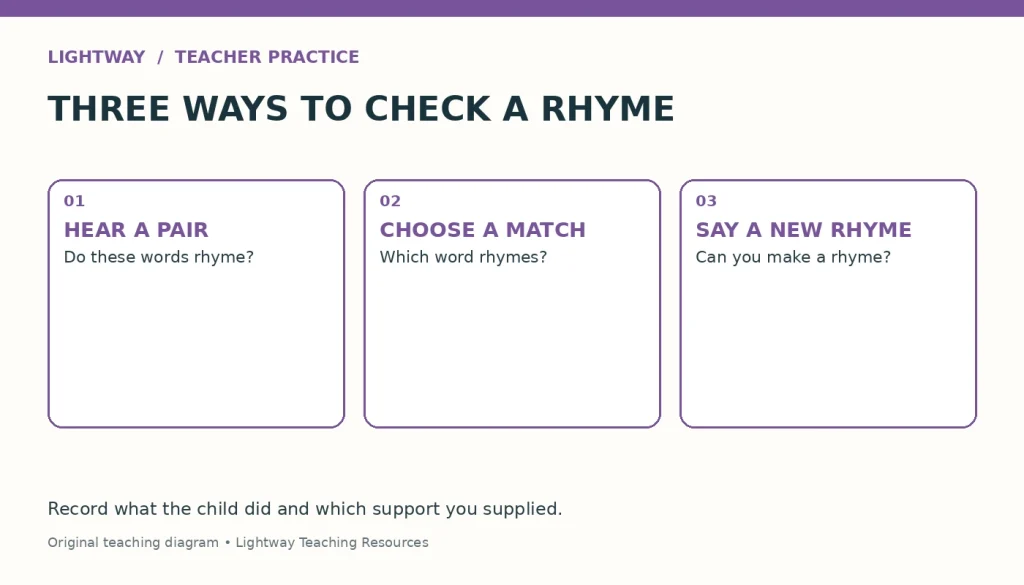
A child can choose hat when you ask for a word that rhymes with cat, yet pause when asked to invent another rhyme. Those responses tell you different things. Recognizing a relationship from supplied examples and producing a word independently place different demands on the learner.
This short kindergarten routine keeps those demands separate. You can teach it with your voice, a few familiar objects or teacher-made pictures, and a simple observation sheet. The examples and sequence below are original classroom suggestions. They are intended to inform your next teaching move, not to produce a standardized score.
Start with what rhyme means in speech
For the one-syllable examples in this lesson, rhyming words share the vowel sound and the sounds that follow it: cat and hat, or moon and spoon. Merely sharing the final consonant is not enough. Cat and boat both finish with /t/, but they do not rhyme.
Say the words aloud before showing any printed labels. The initial goal is to attend to spoken sounds. A child who cannot yet read the words can still participate in a rhyme task. Later, connect sound patterns with print through your planned phonics teaching, keeping the two purposes clear.
The Common Core kindergarten foundational-reading standards include both recognizing and producing rhyming words. That distinction provides a useful planning question: which response are you actually asking the child to make?
Check the picture names first
If you use pictures, name every item together before beginning. A drawing you intend as cap may be called hat; a picture intended as rabbit may be named bunny. Either label can be reasonable, but the resulting rhyme task changes.
Point to a picture and ask, “What shall we call this in our game?” Supply the intended word and use it in a brief sentence when necessary. If a child needs vocabulary support, teach the word before treating the response as evidence about rhyme. Choose examples that work in the pronunciation used by your class, and listen carefully when a student’s pronunciation differs from yours.
You do not need elaborate cards. For the examples below, simple drawings of a cat, a hat, a fish, a boat, a moon, and a spoon are sufficient. Keep the drawings clear and explain that the task concerns the words, rather than how similar the objects look.
Task 1: hear a pair and decide
Model one matching pair: “Cat, hat. I hear the same ending part in both words.” Then model a nonmatching pair: “Cat, fish. Those endings do not sound alike.” Keep the explanation brief, and pronounce each word naturally before repeating the relevant part.
Offer a small mixed set, such as moon/spoon, cat/fish, boat/goat, and hat/boat. Invite a spoken yes/no response or an agreed pointing signal. Do not put every rhyming example first. A predictable sequence can let a child guess the pattern instead of listen.
After a response, say the pair again and give specific feedback. “Moon and spoon rhyme. Listen to the part we hear in both.” Avoid asking a child to repeat an incorrect answer several times. When the child is uncertain, return to a modeled pair and try a different example.
Teacher check: why include hat and boat?
They end with the same consonant sound but have different vowel sounds. A child who calls them a rhyme may be attending only to the last sound. Use the response as a reason to model the larger ending part, rather than as a diagnosis.
Task 2: choose a rhyme from alternatives
Say, “Which word rhymes with cat: hat or fish?” Name both choices, then allow the child to point or speak. Change the positions of the matching pictures between trials. If the same side is always correct, the response becomes hard to interpret.
Use one target and two alternatives at first. Add another choice only when the child can manage the simpler task. A larger array brings extra vocabulary, attention, and memory demands; it is not automatically a better check of rhyme.
Ask occasionally, “Which two words go together in sound?” and repeat the pair the child chose. An explanation can be as simple as saying the words together. Do not require a technical definition before accepting an accurate sound match.
Task 3: produce a rhyme without choices
Now ask, “Can you say a word that rhymes with cat?” Give thinking time. If the child produces hat, acknowledge it and ask for another example only if that is useful. Repeating the target word itself does not demonstrate a new rhyme, so model a different word and explain the task again.
A made-up word such as zat can demonstrate that a child has preserved the sound pattern. Say that it is a pretend word, then decide whether your present goal is sound play or finding familiar real words. Record that distinction. Do not reject a sound-accurate response solely because the child has a smaller English vocabulary.
If production is difficult, offer two choices again or start a familiar oral phrase that invites a rhyme. Mark the response as supported. A successful answer after a model is useful information, but it should not be recorded as independent production.
Record the task and the support
Use three headings on your observation sheet: decides about a pair, chooses a matching word, and produces a rhyme. Beside each, note a specific example and whether you supplied a model, repeated the words, named pictures, or offered choices.
A useful note is “Matched moon/spoon after picture names were supplied; no independent rhyme for cat today.” It is more informative than “weak at rhyming.” Revisit the skill with different familiar examples on another day. A single brief activity can be affected by vocabulary, attention, comfort, and the response format.
When speaking is not an accessible response, use a familiar communication system for recognition and choice tasks. Work with the student’s established supports to plan an appropriate production task. Keep the sound-awareness goal separate from speech clarity or speed.
Keep rhyme within a wider reading plan
Rhyme is one part of phonological awareness. The IES emergent-literacy participant guide cautions that rhyming alone is insufficient phonological-awareness instruction. Continue appropriate work with syllables, blending, segmenting, and the connections between sounds and letters. Our oral blending and segmenting routine gives a separate teaching example.
For additional activity choices, the Florida Center for Reading Research kindergarten collection distinguishes rhyme activities from other sound and reading tasks. Select a task because it fits the response you want to observe, then use the result to choose the next small step.
